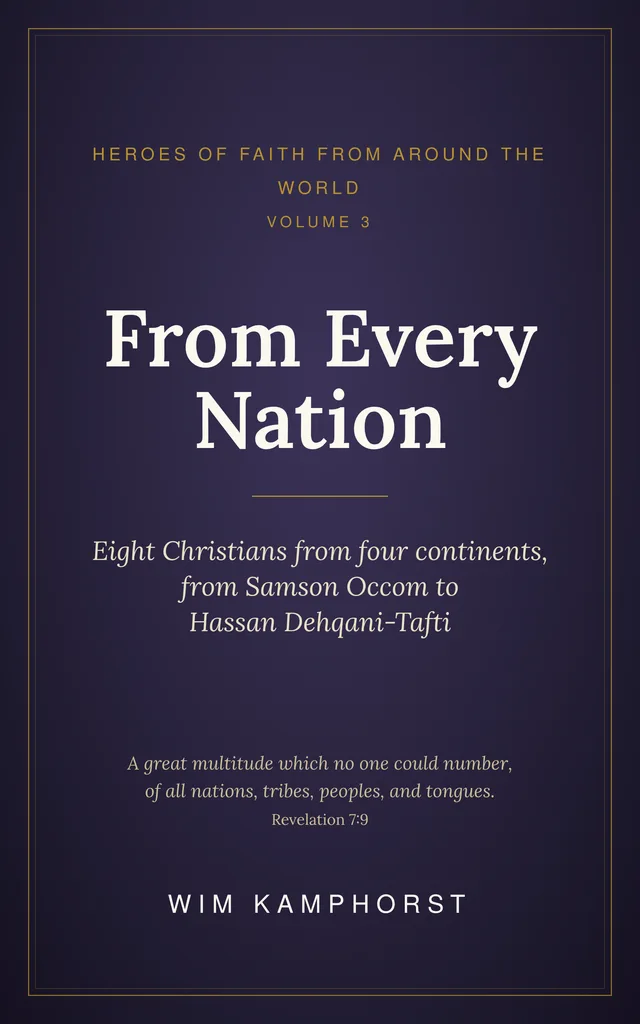
From Every Nation volume 3
Heroes of faith from around the world
Eight Christians from four continents, from Samson Occom to Hassan Dehqani-Tafti.
Introduction: to the edges
The first two volumes of this book were about Christians from Asia, Africa and Latin America. In this third volume the map grows larger. It includes people from North America, from the islands of the Pacific, from Australia and from the Middle East. Again they are not missionaries who came from far away, but people who carried the gospel in their own countries and among their own people.
A Mohegan in New England whose sermon, according to historians, was the first printed work published under the name of a Native American. A Tongan who sailed to Fiji to bring the gospel there. An Aboriginal inventor and preacher who appears on Australian money. A young Congolese man on a rubber plantation who wore a scapular around his neck. A Mexican evangelist who started his own church when he saw how little say Spanish speakers had in other churches. A Chinese pastor in Beijing who spent more than twenty years in prison. A Korean pastor who took in the young man who had killed his sons as a son of his own. And an Iranian bishop who wrote a prayer for the murderers of his son.
The same approach
In this volume too, the facts come first. After each chapter you will find what is certain, what is known only from a person’s own words or from later tradition, and what is uncertain or disputed. The sources are listed with it.
For a few people in this volume the sources are thin. Little has been written in Dutch or English about Francisco Olazábal and Son Yang-won. For Joeli Bulu much comes from his own life story, as a missionary wrote it down. Where I could not check more, I have kept the story shorter, and I say so when a story rests on a single source.
The eight people in this volume belonged to very different churches: Presbyterian, Methodist, Congregational, Roman Catholic, Pentecostal, Anglican, and congregations they started themselves. The order is again that of time, from the eighteenth century to the end of the twentieth.
From every nation
John saw a great multitude which no one could number, of all nations, tribes, peoples, and tongues (Revelation 7:9). Some of the people in this volume came from peoples who almost disappeared, or who were long left out of the count. They too stand in that multitude. Who knows whom else you will meet there.
Chapter 1 Samson Occom: the Mohegan who never stopped seeking his own people
On September 2, 1772, a man stood ready to be hanged in New Haven, Connecticut. His name was Moses Paul, and he was a Wampanoag, a Native American. In December of the year before, he had got into a fight in a tavern in Bethany. The innkeeper refused to serve him any more drink, a certain Moses Cook struck him, and Paul killed Cook. The court in New Haven sentenced him to the gallows.
In the summer, Paul wrote a letter from prison. He asked one particular minister to preach on the day of his death. His reason fit in half a line: “considering that we are of the same nation.” That minister was Samson Occom, a Mohegan from eastern Connecticut.
Occom came. He preached on a text from the letter to the Romans: For the wages of sin is death, but the gift of God is eternal life in Christ Jesus our Lord. (Romans 6:23). He spoke straight to the condemned man, as “my poor unhappy brother Moses.” He told Paul that he was bone of his bone and flesh of his flesh, and he held up the crucifixion of Christ as the last thing standing between Paul and heaven. The blood of Jesus, he said, was offered freely, even to the worst of sinners. Then he turned to the ministers who stood there, and finally to the Native people who had come. For them he had a hard message about drink.
That same year the sermon was printed in New Haven, and one reprint followed another. Historians usually call it the first writing by a Native American to be published under his own name. Occom was forty-nine at the time. He already had a whole life behind him as a teacher, preacher and spokesman for his people. In England he had raised money for a school that later became Dartmouth College, one of the oldest universities in America. And he had been forced to watch that school turn into something other than what he had been promised.
It began in Mohegan, in 1723.
A people losing their land
Mohegan lay close to the small town of New London. The area is now called Montville and lies within the Mohegan reservation. In 1723 Connecticut was a British colony. Colonists and Native peoples lived side by side, and between them it kept coming back to one thing: land.
For the Mohegan, one matter would color their entire century. In 1640 their leader Uncas had made an agreement with the colony about a large piece of land, under the supervision of Major John Mason. Who actually owned that land? The Mohegan said: it was entrusted to us, not given away. The colony saw it differently. That lawsuit, the Mason case, dragged on for decades, until 1773. It divided the tribe and would occupy Occom for half his life.
His father was called Joshua and was known as a hunter. His mother was called Sarah. The Brothertown Indian Nation, the people Occom would later help to found, tells that he was born in a wigwam.
He grew up in the religion of his people. That is how he later put it himself: he was born a heathen and brought up a heathen.
A primer and a New Testament
Around 1740 a wave of revival swept through the English colonies. Historians call it the Great Awakening. Traveling preachers called people to personal conversion, and this reached the Native villages too. Sarah, Occom’s mother, was one of the first Mohegan to become a Christian.
In 1768 Occom wrote a short account of his life, A Short Narrative of My Life. He was sixteen, he tells us there, when a rumor began among the English about extraordinary preachers who went from place to place. In the summer they came to his people too. It touched him. For half a year he was restless inside, until at seventeen he put his trust in Jesus Christ alone. After that, he writes, the distress lifted, and peace and joy stayed in his soul.
He had never seen a school. He bought a primer, a simple reading book, and asked English neighbors to teach him the letters. At seventeen he was reading in the New Testament. At nineteen he could read a little in the whole Bible. He wanted to learn to read well enough to teach poor children of his people, and he loved to talk with other Mohegan about what he believed.
What drives a Mohegan boy to knock on his white neighbors’ door with a spelling book? He wrote little about it. He mostly described what he did.
In 1742, not yet twenty, he was chosen by the Mohegan as counselor to their leader, Ben Uncas II. Even as a young man he was someone his people listened to.
A week or two in Lebanon
In 1743 his mother went to Eleazar Wheelock, a young minister in the village of Lebanon, Connecticut. She asked him to teach her son to read, for a week or two. Occom stayed four years.
Wheelock was a Congregationalist, part of a movement of English Protestants in which each local congregation governs itself. He taught Occom Latin, Greek and Hebrew. Friends gave the boy clothes, and the mission committee in Boston paid for his lessons. Afterward Occom continued his studies with another minister, Benjamin Pomeroy, to prepare for Yale. It never came to that. His eyes became so strained that he lost about a year, and in the summer of 1749 he had to stop for good.
In 1754 Wheelock opened a school for Native pupils in Lebanon, Moor’s Indian Charity School. That same school would later send Occom to the other side of the ocean.
The wigwam at Montauk
In 1749 Occom went along on a fishing trip to Montauk, at the eastern end of Long Island. The Montaukett were looking for a schoolmaster. He first agreed to half a year. He stayed about twelve years.
His own account reads like a working day. In winter he had almost thirty pupils, children and adults, and an evening school besides. He began every day with prayer. He had the children recite, often with the older pupils helping the younger, and nobody left the room without being able to spell a word. For children who struggled with the letters he made little cards, pasted on pieces of cedar wood, which they had to pick up from a bench and lay out in alphabetical order. Several times a week he taught them the catechism.
On Sundays he led the service three times, and again on Wednesday evenings. He read the Bible aloud and explained it in their own language. He visited the sick and stood at funerals. He settled quarrels, wrote documents for people and received guests from all kinds of peoples. He was paid in turns in food, not in money.
He was there for the Shinnecock too. The missionary there, the Reverend Horton, lived about thirty miles away and later left. Occom rode out to them on Saturday in the dark and back on Monday, to preach. Some Shinnecock children came to his school. After Horton was gone, a revival went through the congregation and many came to faith. Traveling preachers from New England tried to pull it all toward themselves with a great deal of shouting. Occom answered, as he tells it, by quietly reading to them from the Bible. He spoke with authority, and the people came back to listen.
He lived in a wigwam, a hut of thin poles covered with mats of rushes. Twice a year he moved about two miles, because wood was scarce in one area and corn grew in the other. For his grain he had to travel eighteen miles to the mill. He grew corn, potatoes and beans, kept five pigs, a cow and a horse, and had his land plowed every year, at about twelve shillings an acre. He caught fish with rod and line, shot birds, and sold the feathers to pay for powder and lead. He also bound old books, carved wooden spoons and scoops, and made gun stocks, buckets and churns out of cedar.
In 1751 he married Mary Fowler, a Montaukett and one of his former pupils. They had ten children. Researchers at Dartmouth describe Mary as a woman who stayed faithful to the Montauk way of life, and as a counterweight to Wheelock’s influence. I mention her here because she is missing from many books about Occom. His story cannot be told without her.
The household grew fast, and so did the number of guests. Then came the horses. A mare sank into quicksand and drowned. A second horse disappeared, probably stolen. A third died of a disease. A young mare broke her leg, and shortly afterward her foal died. Five animals in all, and Occom was in debt. Friends asked the committee in Boston for help, and the Reverend Buell wrote a letter for him. The committee approved fifteen pounds, but was displeased, and reproached him, as Occom tells it, for spending too much money.
On August 30, 1759, Occom was ordained by the Suffolk Presbytery on Long Island. In the Presbyterian church a presbytery is the gathering of ministers and elders from a region, which appoints ministers. He had never finished university. The Presbyterians ordained him all the same, as a missionary among his own peoples.
One hundred and eighty pounds
In his life story of 1768 Occom does something almost nobody dared to do at the time. He sets the figures side by side.
For his work at Montauk he received from the mission committee in Boston first sixty pounds in old currency, about six pounds sterling, for two to three years. After his marriage it became fifteen pounds sterling a year, and later another fifteen came to pay off debts. A young, unmarried white missionary received from the same committee one hundred pounds for a single year, plus fifty for an interpreter and thirty for someone to introduce him. One hundred and eighty pounds in all. Occom calculated that for twelve years of work he had received about as much as that man got in one year. And Occom was his own interpreter, his own schoolmaster and his own preacher.
When Jesus sent out His disciples, He said: for the laborer is worthy of his wages (Luke 10:7). In his account Occom asked for no more than that. He set the amounts side by side and let the figures speak for themselves.
Then he tells about a Native boy who was in service with an English family. The master’s son beat him almost every day. Someone asked the boy why. He thought it was because he was an Indian. Occom applied it to himself. “I believe it is because I am a poor Indian,” he wrote. And he closed with the thought that God had made him so.
I read that sentence as something other than self-pity. A man calls injustice by its name, and at the same time places his origins in the hand of God. This account, by the way, was not published until 1982. It lay in an archive for more than two hundred years.
A strange calling of providence
After his ordination Occom traveled in 1761 and 1762 to the Oneida, a people in the west of the colony of New York. His brother-in-law David Fowler went with him. A third journey in 1763 came to nothing, because war broke out around the Great Lakes between the British and Native peoples. In 1764 Occom moved with his family back to Mohegan. There he came into conflict with the local minister, David Jewett, who had his own interest in the Mason case. On March 12, 1765, the Connecticut mission board cleared Occom of all complaints except his role in that land dispute. Whoever stood up for the land of his people, then, got into trouble with the people who paid his salary.
In the fall of 1765 Wheelock asked him to go to Great Britain. The school needed money. The commissioners in Connecticut had decided to send someone across the ocean, the Reverend Nathaniel Whitaker, and proposed that Occom go along. On November 21, 1765, his travel journal begins. He calls it a strange calling of providence. He had no doubt that God was calling him and that it was his duty. Around eleven o’clock he said goodbye to his family and his friends and left for Boston, where the ship lay. He writes that he had committed himself, his family and his friends to the care of almighty God.
Together with Whitaker he crossed the ocean in December. The well-known evangelist George Whitefield introduced him to nobles and senior clergy. On March 11, 1766, Occom had himself inoculated against smallpox in London, a controversial treatment at the time.
What followed was a journey of almost two years through England and Scotland. Occom preached an estimated three hundred to four hundred sermons. King George III gave two hundred pounds. The Earl of Dartmouth, William Legge, subscribed fifty guineas and became one of the largest donors. Together Occom and Whitaker raised about twelve thousand pounds. That was an enormous sum. Researchers at Dartmouth estimate it at more than two million dollars in today’s money.
His sermons and his manner received much praise. Later he would write to Wheelock that in England he had sometimes felt like a curiosity on show, a spectacle for foreign countries. In May 1768 he arrived back in America.
A family that had been made to wait
At home a disappointment awaited him. Wheelock had not properly cared for his family while he was away. Occom no longer had a paid position. Wheelock offered him a post as missionary, far inland, but Occom was not well and did not want to leave his family alone for years again.
In those months something else happened that he put on paper himself. On January 4, 1769, he wrote a short letter in Mohegan to the Connecticut board of the Scottish missionary society that supported him. He began with the reason: because he was connected with them, he had to let them know his faults. He confessed that he had been “overtaken with strong drink.” Thereby, he wrote, he had harmed the cause of God, the purity of the Christian faith, his own name and the ministry, and his own soul. He was ashamed before God and before them. He asked for forgiveness and for prayer, and promised, relying on God’s grace, to watch himself better from then on. That letter is still in the Dartmouth archive.
Shortly afterward a new rumor came up. In March 1769 Wheelock wrote to him that someone claimed Occom had been drinking too much again. Wheelock wrote that he did not believe it and contradicted it everywhere. If it were true, he added, it would be a greater wound to Christ and His cause than what had happened before.
Three years later Occom would warn against this very sin at the gallows of Moses Paul. He knew it from the inside.
John wrote: If we confess our sins, He is faithful and just to forgive us our sins and to cleanse us from all unrighteousness (1 John 1:9). Occom had confessed his sin, on paper, with his name signed beneath it. So the man who spoke at the gallows was not someone who stood above sin, but someone who had asked for forgiveness himself.
“Too alba mater”
On December 13, 1769, Wheelock received a charter for a new college from the governor of New Hampshire, John Wentworth. It was named after the earl who had given so generously: Dartmouth. Wheelock moved to New Hampshire. The money Occom had raised in England for educating Native young people now went largely to a college for white students.
Occom saw it happen. On July 24, 1771, he wrote Wheelock a letter that changed their relationship for good. He also wrote about himself. Wheelock had said he was grieved over Occom’s condition. Occom answered that for two years he had not been able to travel far and that he had been indoors a great deal that spring. His family was well. He denied that he had ever been unwilling to go inland: he would have gone in the spring after England, with David Fowler, but Wheelock had said there was no money.
Then came the heart of it. He had heard that there were no Native students left, except two or three of mixed descent. “I understand you have no Indians at present except two or three mulattoes,” he wrote. He had gone to England for the poor Indians, he wrote, and that was what they had told the donors too. He had willingly made himself a mockery in foreign lands. Now he feared that “we Shall be deemed as Liars and Deceivers in Europe.” An English donor had told him that if he had not seen Occom’s face, he would not have given a penny. And he remembered what Whitefield had told him: that Wheelock would cast him adrift once he had raised the money.
Then came a play on words that still stings two hundred and fifty years later. In Latin a university is called alma mater, nourishing mother. Occom wrote that instead of becoming alma mater, the school would be “too alba mater to Suckle the Tawnies”: a white mother, who would no longer nurse the brown children. His whole verdict lay in that one letter.
The letter does not end in hatred. Occom wrote that he was full of doubt about Wheelock’s intentions and that there was only one way to take it away: to admit Native students in large numbers. Then he would support the school as before. He signed as “Your most unworthy Servant.” He noted that he had not yet written like this to anyone in England, and that Wheelock should hear it from him first.
According to Dartmouth itself, the two men never saw each other again. Occom never set foot on the campus of the college for which he had raised the money.
I want to be careful here. Wheelock also wrote many letters and had his own explanations, and this is not a chapter about him. But the facts are clear: the money was requested for Native children, and it was spent mostly on others. In 1970 Dartmouth committed itself anew to the education of Native students. There is a pond there now called Occom Pond.
At the gallows in New Haven
In those bitter years came the letter from Moses Paul. On December 7, 1771, Paul had killed Moses Cook in the tavern of David Clark in Bethany, after a quarrel that began when the innkeeper would not serve him any more drink. On June 7, 1772, Jonathan Edwards Jr. had already preached a first sermon for the condemned man, ten days before the first date set for the execution. After an appeal to the Connecticut legislature, the execution was postponed to September 2.
On July 16 Paul wrote to Occom. He appealed to their shared origins and asked him, as a last wish, to preach at his execution. Occom accepted. Since 1931 the letter has been kept in the archive of the American Antiquarian Society.
On September 2 he preached on the wages of sin. He did not spare the condemned man. He described to him his own condition: the sentence was fixed, the guards and the gallows were ready, the coffin and the grave lay open. Paul had to repent, cry out to God about his guilt, and trust in Christ’s blood. He painted the joy of heaven if Paul believed, with angels coming to carry his soul away.
Then he turned to the Native listeners. He addressed them as his kinsmen. Drink, he said, had brought them poverty, hunger and shame and had put them down among the animals. He described children crying from hunger and cold, and people who froze outdoors, drowned or were injured. Of women who were drunk he said that for them shame and danger were greater still. Those who drank would not inherit the kingdom of God. He called them to turn around and believe. He did not call his own people innocent for that reason, though in another sermon from those years he blamed the colonists for bringing drink and disease among his people.
He also spoke to the ministers, the “reverend gentlemen.” He called himself the least among them and urged them to be courageous in the fight against sin and Satan, to preach Christ’s death and resurrection, to pray without ceasing and to rally everyone against sin, using the image of the armor of God from Ephesians 6. He closed his sermon with a short prayer. In His infinite mercy, may God grant all this, through Jesus Christ. Amen.
You can read that sermon as a sentence passed. I prefer to read it as the words of a man who stands at the gallows of a fellow countryman and explains the gospel to everyone who listens. Paul had asked for it. Occom came.
On October 31, 1772, the sermon was printed in New Haven, by Thomas and Samuel Green, and shortly afterward in New London as well. An edition in verse appeared too. More than twenty editions followed. A count by the American Antiquarian Society comes to twenty-three different printings between 1772 and 1829, fourteen of them in their own collection. A Welsh translation appeared as well. Some later printings contained a dialogue between Occom and Paul that was invented.
In 1773 the verdict in the Mason case was given in London. The Mohegan lost. A year later Occom published a hymnbook, A Choice Collection of Hymns and Spiritual Songs, printed in New London. Nobody knows exactly how many of the hymns he wrote himself.
Eeyawquittoowauconnuck
If the colonists’ church would not serve his people, then it had to be done differently. Occom was convinced that Native peoples needed pastors and teachers from among themselves. He wrote that “the Indians must have Teachers of the own color or Nation.”
Together with his brother-in-law David Fowler, a Montaukett, and his son-in-law Joseph Johnson, a Mohegan, he worked out a plan. Christian families from several small peoples in New England would found a new community together: Mohegan, Pequot, Narragansett, Montauk, Tunxis and Niantic. In October 1774 the Oneida gave them a piece of land in the interior of New York, about twelve square miles. In 1775 a first group of fifty to seventy-five people went there.
Then the American Revolution broke out, and the war scattered the new community. Some went back to New England, others found shelter with the Stockbridge in Massachusetts. Joseph Johnson disappeared during a peace mission. Only after 1783 could the families return.
It did not stop with the founding. Occom kept on the road. His journal of 1785 shows what such a week looked like. On Sunday, May 1, he preached at Mrs. Fitch’s house to a large, quiet crowd, some of whom were deeply moved. Afterward he was so tired that he went to bed early. On June 12 he preached in Reuben Palmer’s little meetinghouse, to people who listened “with great solemnity.” He visited the dying. He preached in families’ homes, where the listeners lingered and asked for more. On July 17 he celebrated the Lord’s Supper in Preston, and some of the older Christians broke out in praise. On August 7 he traveled with a Black preacher, Brother London, and after a prayer meeting in the morning the young Christians felt God’s love. On September 18 he preached in Preston on the prodigal son.
In the middle of that summer came news he had not expected. On Sunday, June 26, during a visit where he prayed with a man in severe pain, he wrote that three days earlier he had heard heavy news: “my poor Talitha is Dead and Buried.” She was his daughter. He went on preaching in the days that followed. At the end of September, on his way to the Oneida, he came to Brother Phineas’s and heard there the sad story of her death. He saw her youngest child.
In the fall of 1785 the time had come. On November 7 Occom wrote in his diary that they named their town Brotherton, “in Indian Eeyawquittoowauconnuck.” Brother town. He became its pastor, and also served the Stockbridge and his own Mohegan.
What must it have meant for someone who had worked all his life in other people’s school, other people’s church and from other people’s purse, to write down a name of his own for a place of his own?
In a song of ascents it says: Behold, how good and how pleasant it is for brethren to dwell together in unity! (Psalm 133:1). Families from six small peoples, each of which had lost land and people, gave their town a name that spoke of exactly that. The war had first scattered them once more. Even so, they started again.
In 1787 he spoke out against slavery in a sermon. That deserves mention, and so does this: before leaving for England he had asked Wheelock whether he could use an enslaved person for the work on his farm. Dartmouth mentions both. So do I.
A smaller piece of land
In 1789 Occom moved with his family to western New York for good. The land remained under pressure. A treaty of 1788 gave Brothertown a smaller area, and the state of New York allowed land to be leased to outsiders.
On July 14, 1792, Samson Occom died in New Stockbridge, New York. He was sixty-nine. Later biographers write that more than three hundred Native people came to his funeral.
After his death the community fell apart. In 1795 about sixty percent of the land was sold to white settlers. Between 1824 and 1848 most Brothertown families moved further west, to Wisconsin. The Brothertown Indian Nation still exists there today, and since 2020 it has celebrated Samson Occom Day every year on July 14.
What remains of a voice?
Occom left no large denomination and no university bearing his name. He did leave a sermon, a hymnbook, a stack of letters and a short life story that had to wait two hundred years for a reader. And he left a people who still name themselves after his town.
Perhaps you recognize something of him. You gave yourself to something that was later used differently from what had been agreed. Or you carry a failure you have had to write about yourself. Occom did both. He set the sums side by side, and he put his own guilt on paper. Then he went on preaching.
On the grounds of Dartmouth, the college he never visited, a pond bears his name. And every year on July 14 a people who call themselves after Brother town remember the Mohegan who wrote that name down.
What is certain and what is told
Certain (several independent sources): birth in 1723 in Mohegan near New London; counselor to Ben Uncas II (1742); four years with Eleazar Wheelock from 1743; about twelve years as teacher and preacher at Montauk; marriage to Mary Fowler (1751); ordination by the Suffolk Presbytery (August 30, 1759); journey to Great Britain (1765-1768) raising about £12,000; the Dartmouth charter (1769) and the use of the money for a college mainly for white students; the letter of July 24, 1771; the letter of Moses Paul (July 16, 1772) and the sermon at his execution (September 2, 1772) with its many printings; the lost Mason case (1773); the hymnbook (1774); the founding of Brothertown on Oneida land; death on July 14, 1792, in New Stockbridge.
From his own words (A Short Narrative of My Life, 1768; letters; journals): his conversion and teaching himself to read; the work and the life at Montauk, the wigwam, the horses and the amounts of his salary and that of the white missionary; the story of the boy who was beaten; the calling to England (journal of November 21, 1765); the confession of January 4, 1769; the feeling of having been used as a curiosity in England and the words of Whitefield and of the English donor (letter of July 24, 1771); the journal entries of 1785 and the death of his daughter Talitha. The birth in a wigwam is tradition of the Brothertown Indian Nation; the number of people at his funeral comes from later biographers. I have the diary quotation about Brotherton of November 7, 1785, through the Brothertown Indian Nation; it is not in the journal of May to October 1785.
Unconfirmed or told differently:
- Descent. According to some biographers the family descended from Uncas. That is often said, but I have found no firm source for it. The family name is spelled differently: Tomacham, Ockham.
- Conversion. 1741 according to some sources, about his seventeenth year according to his own account. One reference article names the preacher James Davenport; Occom names no one.
- Children. Ten according to Dartmouth, eleven according to Wikipedia. One reference article says the marriage was against Wheelock’s will; one source.
- Ordination. 1759 according to Dartmouth, 1758 according to another site.
- Rumor about drink. Wikipedia says that Wheelock spread rumors about Occom. His own letter of March 9, 1769, says something different. What exactly was passed around, and by whom, can no longer be properly traced.
- Moses Cook. Waterbury according to the sermon edition, Bethany according to the Antiquarian Society; the tavern stood in Bethany.
- Number of printings. Twenty-three according to the American Antiquarian Society, nineteen according to Dartmouth.
- The hymn. Awaked by Sinai’s awful sound is often attributed to him, but it only appeared after his death.
- Settlers put off the land. Wikipedia reports that in April 1792 Occom put settlers off the land; I have found no other source for that.
- Death and grave. According to one tradition he collapsed on the way home, shortly after writing something, and his wife found him. According to another he was fetching wood to finish building the Brothertown church. Where he is buried is not certain.
- Moving. 1785 according to one source, 1789 according to another.
Interpretation: Occom himself confessed in January 1769 that he had drunk too much. That is certain. His sharp verdict on Wheelock stands in his own letters; Wheelock had his own side of the story, which has not been discussed at length here. The English quotations from his texts come from the original sources where I could find them. Of his services he wrote down only what he did, so the inner life behind the sermons remains hidden from us.
Sources for this chapter
- Dartmouth College, The Occom Circle: Occom, Samson (personografie)
- Dartmouth Library, Slavery Project: Samson Occom
- Samson Occom, A Short Narrative of My Life (1768), Teaching American History
- Samson Occom aan Eleazar Wheelock, 24 juli 1771 (Occom Circle)
- Samson Occom, schuldbekentenis, 4 januari 1769 (Occom Circle)
- Eleazar Wheelock aan Samson Occom, 9 maart 1769 (Occom Circle)
- Past is Present (American Antiquarian Society), Moses Paul to Samson Occom
- Samson Occom, A Sermon Preached at the Execution of Moses Paul (Evans Early American Imprints)
- Encyclopedia of American Early Writers (University of Maryland): Samson Occom
- ConnecticutHistory.org, Samson Occom and the Brotherton Indians
- Brothertown Indian Nation, The Brothertown Movement from New England to Oneida lands in New York
- Brothertown Indian Nation, Remembering Samson Occom (2023)
- Encyclopedia.com, Occom, Samson
- Christianity.com, Samson Occom, Native American, Ordained
- Wikipedia, Samson Occom (starting point)
- Samson Occom, journaal 21 november 1765 (Occom Circle)
- Samson Occom, journaal 1 mei tot 3 oktober 1785 (Occom Circle)
Chapter 2 Joeli Bulu: the man who wanted to live among the stars
It was still dark when the warriors came. They crept closer through the grass outside the village, on Vanua Levu in Fiji, and somewhere someone blew a conch shell to frighten the people inside. In the middle of the village sat Joeli Bulu, a Tongan, with his Christians around him. Nobody had a weapon. He had told them himself: sit down, stay calm and wait on God.
The men rushed forward with clubs and spears in the air. When they were close, they stopped. Later they said they had not been able to move their arms.
There sat a stranger in a land full of war, far from home. He came from another island kingdom and spoke another language. He would stay almost forty years. He became the first islander in Fiji to be given sole charge of a church district. He started congregations in places where no European missionary had yet been. And he ended as Bible teacher to the most powerful chief in Fiji. When he was old, he told his life to a missionary, who wrote it down and translated it.
That story begins with a boy who wanted nothing to do with the new faith, and a clear night.
The islands where the lotu came
Tonga is an island kingdom in the Pacific Ocean, east of Fiji. Joeli Bulu was born there around 1810, on Vava’u, in the northern island group, at a time when the old gods still ruled. His father was called Mafitangata, as he tells in his autobiography. In Tongan his name was later written as Siaoeli Pulu.
He was still a boy when Christianity came to Tonga. Around 1824 there were already two teachers from Tahiti in Nuku’alofa, the capital on the island of Tongatapu. They were islanders themselves. In 1826 the Wesleyan missionaries followed, among them John Thomas. Wesleyans were Methodists, followers of the English preacher John Wesley. In 1830 they made an agreement with the London Missionary Society, another Protestant mission organization: Tonga and Fiji would be for the Methodists, Samoa for the London mission.
The greatest change came from a Tongan chief. Taufa’ahau became a Christian and in 1831 took the name King George Tupou I. He would bring all of Tonga under his rule. According to the missiologist Ewan Stilwell, that was the pattern in Tonga: a chief was converted and then tried to bring his family and his people with him.
In Tongan the new faith was called the lotu. You could take up the lotu, the way you choose a new road. At first Joeli Bulu did not want to. When the lotu reached his island, he writes, he was already a big boy, and he was angry. He swore to stay with the old gods of his family.
“That I may live among the stars”
What turned him around was a promise. A man told him about a land of the dead, a home in heaven for the good and a fire for the bad. That evening Joeli looked up at the stars. He decided then, he told later: “I will lotu, that I may live among the stars.”
We know this sentence only from his own story. The Australian church historian John Garrett found it so telling that he named his 1982 book on the rise of Christianity in the Pacific To Live Among the Stars. A young Tongan looking up at the sky and wanting to live there: for Garrett, that one sentence held the longing of a whole region.
I find it an honest sentence. There is nothing in it yet about sin or about Christ. It is the longing of someone who senses that there is more than the islands under his feet. Do you recognize that? That is how it began for him, and it did not stay with that evening.
In Psalm 8, too, someone looks up: When I consider Your heavens, the work of Your fingers, the moon and the stars, which You have ordained, what is man that You are mindful of him (Psalm 8:3-4). Bulu’s sentence was simpler. But for him, too, it began under a clear sky.
A lie in the bush
Afraid of his father and his relatives, he waited many more days. Then he went to Ulukalala, a Christian chief in another village, who received him kindly. His father heard of it and told the priest of the old gods. The priest fell into a trance and cried out in a loud voice: why had he left him?
The friends of the family were convinced that the god himself was speaking. They shouted that Joeli must be clubbed to death that very day. Joeli was afraid. He lied and said he would give up the lotu. Then he went into the bush and prayed in secret, grieved over his lie.
Ulukalala heard about it. The friends held a feast, said farewell to their gods and handed Joeli over to the lotu. He went to live in Hakoka, Ulukalala’s village.
Eyes that were opened
He still had no rest. One day John Thomas preached under a tree on the open square of Vava’u. He told the parable of the weeds among the wheat: the harvesters were to wait until the harvest, and then the weeds would be bundled to be burned and the wheat gathered into the barn (Matthew 13). Joeli felt that he was the weeds. He wept and trembled, until friends helped him to his feet. At home he fell down weeping again, and later he prayed alone in an empty back room.
The Christians taught him, and he was given a task in the work. But the distress stayed.
The turning point came in 1834, at a love feast. That is what Methodists call a gathering where people tell what God has done in their lives. The missionary Turner told how he himself had come to repentance. Joeli set his own road beside it and noticed that they were alike. They were like two canoes, bow to bow. When Turner spoke about faith and forgiveness, he felt left behind at sea: “My mast is broken, my sail is blown away.”
Then he saw the way and believed. Now he wept for joy. Turner called him to speak. Joeli fainted and came to on the mats, with his head in the arms of Mrs. Cargill. The first thing he said was: “I live!” The gathering went on in prayer and praise until deep into the night.
That is how he described it himself. The breakthrough in Tonga coincided with a great revival, in which King George also came to faith. Stilwell, on the authority of an older study, mentions nine thousand full members within six years. That figure comes from within the mission itself.
What Bulu felt afterward is very close to the words of Paul: who loved me and gave Himself for me. (Galatians 2:20). He had evidently heard them and made them his own. First he wept from fear and sorrow, now from joy. His heart was full of love for Him who had loved him.
A man on the path
Meanwhile work had begun in Fiji. On October 12, 1835, the Methodist missionaries William Cross and David Cargill arrived on Lakeba, an island in the Lau group in eastern Fiji. They were not the first. Tongan Christians already lived in that part of Fiji, and they supported the work from the start. A Fijian, Josua Mateinaniu, had become a Christian in Tonga and went back to his country to look for villages that were open.
Fiji in those years was a land of rival chiefs. Powerful centers such as Bau and Rewa fought wars against each other, and the eating of fallen enemies took place. Without the protection of chiefs the missionaries could do little there, and neither without people who knew the language and the customs.
So they asked Tonga for teachers. Joeli had a friend, Jacob Fekella, a teacher in Leimatua. Together they prayed that God would move the missionaries to send Joeli to Fiji. One day he was walking along a path and a man told him that Fiji had asked for teachers. The longing to go flared up in him, and he walked on weeping.
That night he woke his wife and went to Silas Faone in Neiafu. The next morning Isaiah Vovoli had him fetched: the Reverend Thomas had asked for him. Thomas said that a letter from Fiji had kept making him think of Joeli. They knelt and prayed, and the matter was settled.
In a story like that I hear how calling often works. An ordinary message, an inner knowing, and someone else who says the same thing without being prompted. Bulu went.
When the prophet Isaiah heard the voice of the Lord ask, Whom shall I send, and who will go for Us? he answered: Here am I! Send me (Isaiah 6:8). With Bulu it is even shorter, just two words.
Six preachers from Vava’u
In 1838 King George sent a group of teachers to Fiji. Joeli sailed with his wife in a canoe, while many friends waved and wept. They sailed a night and a day, until they arrived at Mothe, a small island in a lagoon about twenty miles from Lakeba. There they thanked God. On Lakeba they were welcomed by Cargill.
Cargill wrote in his diary on August 3, 1838, that six Tongan lay preachers had come from Vava’u. Joeli Bulu was one of them, and he was married. I have not found his wife’s name in any source. Joeli Bulu had gone to live in Narothake, a village on the same island. There were a few Fijians there who worshipped God, and Joeli would teach them. Cargill added that this man was learning the Fijian language very diligently.
Four days later Cargill went to the village himself. The believers were grateful, he noted, that a teacher now lived among them. They were kind to him and to his wife.
The work on Lakeba was more than preaching. There was a small printing press, and Bulu helped print catechisms and portions of the Bible there, in a language he was still learning himself. A catechism is a booklet of questions and answers about the faith.
Because Tongan Christians already lived in this part of Fiji, a Tongan teacher could get closer to people than an Englishman. He also remained a stranger, and a stranger bringing a new faith.
“It is a shark”
From Lakeba, Bulu went to Rewa, a powerful district on the river on the largest island, Viti Levu. He lived there with the missionaries in Nasali, across the river. There were threats, theft and stones. What he saw of the war, the bodies brought to the town and the meals that followed, he did not hide in his book.
There something happened that he later told at length. He had dreamed that a shark bit his arm. One day a young chief from Bau asked him to go swimming. Bulu refused at first, because of the sharks, but the chief persuaded him. Together with boys they sailed toy canoes on the river. A crowd from Bau and Rewa followed them. Bulu swam to the other side and wanted to swim back. Then he saw two waves coming toward him. He recognized them from his dream. “It is a shark,” he thought. “My dream is true.”
The shark bit him in the thigh. Bulu prayed. He writes that he then saw the throne of God, and a multitude in white clothes. He was not afraid, he was glad, and he wanted to die that day. Still he fought. He pushed his hand into the animal’s throat, and the shark bit through his arm. He dragged the animal along to the shallow side. There his right arm gave out. He sank away and knew nothing more.
He survived. In 1871 he still carried the scar.
This story comes from one mouth, Bulu’s own. I tell it because it belongs to his life, and because it shows how close death was to him in those years.
By canoe to Vanua Levu
Rewa became unsafe. A war was growing between Bau and Rewa, and the missionaries left. Bulu went to Viwa, a small island right next to Bau, where the English missionary John Hunt lived. That station too later had to close because of the wars. Rewa was afterward plundered and burned.
Hunt sent him by canoe to Vanua Levu, the second large island of Fiji, to scout out where the mission might begin. On the way a sudden wave broke over his small canoe. He threw the cargo overboard and held the boat up while it was bailed out. An islander sent ahead to places where Europeans did not yet go: that happened often in the Pacific.
In Muanaithaki an old priest of the old gods, who had turned away from those gods, received him and gave him a house. Bulu went from village to village to preach. Hunt was glad about his report.
Sit still
Later Bulu was stationed at Nadi on Vanua Levu, also spelled Nandi in the sources. Do not confuse this Nadi with the town of Nadi near the airport on Viti Levu. But first came the opposition.
Priests turned the people against the converts. Gardens were dug up, breadfruit pits fouled and cattle killed. Bulu held his people back: hold on, with patience. One day his fine pig was gone. The trail led to an oven in a non-Christian village where it was being prepared. Bulu went alone to the chief, Masiwawa. He asked what the offense was. The Christians had not refused the chief any service. Masiwawa agreed with him: “True are your words, Joel.” But the converts came after Bulu, and the non-Christians grew angry: why was he coming here to ask about pigs?
According to Garrett, who retells his autobiography, Bulu’s chickens were killed and his gardens ruined. The non-Christians gathered for an attack. The missionary Whippy offered guns, but Bulu refused, so as not to provoke anyone. Whippy came anyway with armed men, and a chief held the attackers back for a moment with a whale’s tooth.
Then comes the night from the beginning of this chapter. Bulu had his people sit in silence. Sit still, he said, wait on the will of God. The attackers stood with their weapons raised and did not strike. The attackers said later: what is this power that Joeli Bulu has over us?
Two old chiefs came to him with a tabua, a polished whale’s tooth. In Fiji that is a precious gift you give with a request, a reconciliation or an important occasion. They admitted that they had stolen his pigs, and that they could do nothing against his calm. They said that his God was a true God, and asked whether he would teach them about Him too.
Stilwell writes that his life was in danger more than once because of chiefs who were against the lotu. Which of these stories happened exactly as told, no one can now check. What is certain is that he stayed. A stranger without weapons in a land full of war. His pigs were stolen and his village was surrounded, and still he had the Christians sit down without weapons.
Paul wrote to the Christians in Rome: Do not be overcome by evil, but overcome evil with good (Romans 12:21). In Bulu’s story that night ended with a whale’s tooth and a confession, without a fight.
The hurricane at Nadi
On the coast of Vanua Levu he lived with the English missionaries Watsford and Ford. There a hurricane struck, with a flood. The mission house collapsed. They fled from house to house.
Bulu carried Watsford’s sick daughter against the wind. When the water came, he swam to the bamboo, made a raft and brought the missionaries and their families one by one to a house on a slope. Under a collapsed roof he found dry Fijian cloth, and they wrapped themselves in it. The child died a few days later. Abraham, a countryman of Bulu, was lost at sea in the storm.
Ono, August 18, 1850
In 1848 Bulu was given a responsibility no islander before him had received. He was placed in sole charge of the Ono circuit, on the island of Ono-i-Lau in the far south of the Lau group. Among Methodists a circuit is an area with several congregations under one minister.
There were problems on Ono. An earlier teacher had behaved like a chief and had meddled in land matters. Bulu was afraid that the chiefs would therefore distrust him. He found a warm and generous people. The church stood firm. He was present with two dying believers, Daniel Kepa and Reuben, when they spoke of assurance and of seeing the Lord.
On August 18, 1850, he was ordained on Ono-i-Lau by the missionary David Hazlewood. He became a Native Assistant Missionary, an assistant missionary from the local people, and he was the first to receive that title. He called it a time of great joy. Stilwell counts almost twenty years of service up to that point, evidently from his conversion.
The title also says something about the relationships. A European was called a missionary, an islander an assistant. By then Bulu had done the work in Fiji for twelve years, often alone, and in rank he stayed below the English missionaries. I do not judge that from the standpoint of my own time, but anyone who wants to look honestly at how the mission worked back then cannot skip it.
A besieged village
After Ono he went back to Nadi. There was fighting. The enemy hid in the bush and killed two men of the mission while they were cutting reeds for the roof of the chapel. An outpost was attacked, and the missionary there, John Crawford, died of dysentery. The enemy built a war fence around the village. A long storm with heavy rain drove the attackers away, and the people tore down the fence.
Then came the hunger. For their safety Bulu took his wife and children to Bua. On the road a large group of warriors passed right by them without seeing them, and Bulu ascribed that to God, who had blinded their eyes.
Later the king of Levuka came from Ovalau with a war party. The missionary Wilson in Bua advised Bulu not to go. When the inhabitants opened their gates on the promise of mercy, the village was burned. The king prevented killing, but the people were taken prisoner.
Bulu and Wilson went to Mouta, where a trade feast was being held. A big man seized Wilson by the nose and shook him back and forth. The crowd pushed and pinched them. That night they crept away into a hut for yams. Men with torches came, threatened them with axes and clubs, and in the end went away. The next morning Wilson was allowed to address the crowd, and they left alive.
A grave in Wairiki
After that he was stationed with the Tongan Aaron Fotofili in Cakaudrove, the realm of the Tui Cakau on Taveuni and the south of Vanua Levu. He began the work there before there were European missionaries. Only later did Waterhouse and Carey come. In Wairiki, on Taveuni, many people came to faith, especially women and children, who learned to read quickly. Some young men he called his sons in the gospel, among them Ratu William Vutikalulu.
Here too the chiefs were unpredictable. Ratu Ngolea, later Tui Cakau, was still not a Christian. He was friendly to the mission and helped it. When he asked the Christians to fight with him in a war near Macuata and they refused, he first said: “Stay and look after your gardens.” Later he threatened to attack them on his return. The British consul asked Bulu to mediate. Bulu went to the king, who did not want to do anything, and then to Ngolea. He said: “There shall be no more fighting.” The Christians did not believe him, and when the warriors returned they damaged the gardens and graves of the Christians.
A Tongan chief, Wai ni Nggolo, came with an army. At the fence of Wairiki he was killed and his army was slaughtered. Ngolea was hit by a musket ball, which broke his arm. Later Ngolea became a Roman Catholic and forced his people to follow him. When Bulu was gone, Ngolea took one of Bulu’s daughters and forced her to live with him. Nothing more is said about it, and I will leave it there.
In Wairiki his wife died. He told it in one sentence: he went on, but his wife did not go with him, for she had died at Wairiki and there he had buried her. She had come with him from Tonga. When she died, I do not know.
The station moved to Waikava, on Fawn Harbour. There Bulu was put in charge of a training school for catechists, Fijian teachers who in turn went out into the villages. Stilwell writes that he had already begun training his own converts when the mission could not send him helpers. According to the Fiji Times, some of his students later went to New Britain, in present-day Papua New Guinea. I have not been able to check that further.
At the court of Cakobau
In the last part of his life Bulu lived on Bau, the small island where Ratu Seru Cakobau ruled, the most powerful chief in Fiji. In 1854 Cakobau became a Christian and renounced the eating of people. After that large parts of the population turned to Christianity. On October 10, 1874, Cakobau ceded Fiji to Great Britain, and Fiji became a British colony.
On Bau, Bulu was chaplain and Bible teacher to Cakobau and his family. The Tongan boy who had once turned against the lotu now taught the king of Bau.
In March 1869 the Vunivalu, as Cakobau was called, lent him the great sea canoe Kinikinilau for a journey along the congregations. Bulu warned about the weather. The crew did not listen. A storm rose that nearly sank the ship. The support of the sail broke loose from the bow and fell into the sea. When the men despaired, Stephen of Lasakau and Bulu prayed that the storm might become a calm and the waves still. The wind dropped. Aaron of Bau cried out for joy. They reached Nairai safely.
A photograph survives from those years, probably taken in the early 1870s. It is now in an Australian collection. You see an older man with a beard, dressed as a Fijian chief, in a wrap, holding something that looks like a fly whisk. A Tongan who had come home in Fiji.
A voice someone else wrote down
In that time Bulu told his life to the missionary Lorimer Fison, who translated it. George Stringer Rowe edited the text. In 1871 the Wesleyan mission in London published Joel Bulu: The Autobiography of a Native Minister in the South Seas. The book tells of fires, storms, wars, floods and escapes from death. In 1976 the missiologist Alan Tippett and Tomasi Kanailagi produced an annotated edition, which was reissued in 2013.
At the end he speaks of himself as old, weak in body but strong in soul, looking forward to heaven. He referred to the words of Paul that he knew in Whom he had believed (2 Timothy 1:12). He grieved over the drunkenness, the wars between the tribes and the spread of yanggona, the drink of the white men. He compared himself with Hagar, who did not want to see her child die, and wished not to see the ruin of his people. The translator answered that the angel of the Lord had been hidden from their eyes. That had comforted Bulu.
In 1869 the native missionaries, with Bulu as the main writer, wrote a farewell letter to the Reverend William Moore. They praised his love, perseverance, zeal and example.
I have to say honestly: almost everything we know of his inner life comes from that one book. It is his testimony, written down by a European missionary and edited for English readers. Where Cargill’s diaries and the church records touch his story, they agree with what he tells. Nobody else has been able to check the miracle stories.
That one book is also a rarity. Hundreds of islanders went as missionaries to other islands in the nineteenth century, and of most of them not a word of their own survived. From the Cook Islands alone, according to recent archival research, more than two hundred and fifty went out. The Tahitian Papeiha went to Aitutaki in 1821 with the English missionary John Williams. Cook Islanders went to Samoa, Vanuatu and southern Papua. The colonial archives mainly record the names of Europeans. The names of women are often missing altogether.
In Fiji, what had happened in Tonga happened again. In 1875, the year a measles epidemic in Fiji took about forty thousand lives, eighty-three Fijian men volunteered to go with the missionary George Brown to New Britain. Nine were chosen. Their leader, Aminio Baledrokadroka, told the colonial officials that they had given themselves to the work of God, whether they would die or live. Within three years most of them were dead. Three were killed, others died of malaria. According to Stilwell, by the middle of the twentieth century more than three hundred Fijians had served as missionaries on other islands.
Without these islanders, Stilwell writes, the gospel would never have spread so quickly through the Pacific. The history of the mission in that region is often told with the names of Williams, Hunt and Calvert. The work in the villages was done to a large extent by people like Bulu.
Beside John Hunt on Viwa
Joeli Bulu died on May 7, 1877, on Bau, shortly after midnight. According to the account of the travel writer Gordon Cumming he was fully conscious to the last. His family stayed with him, fanning him and keeping watch, as the Fiji Times tells it. In Gordon Cumming’s account, at his dying the words of Paul are quoted: I have fought the good fight, I have finished the race, I have kept the faith. (2 Timothy 4:7).
He had worked in Fiji for almost forty years. Cakobau, his old friend, provided a coffin and saw to the funeral. He was buried on Viwa, next to the grave of John Hunt, the missionary who had once sent him by canoe to Vanua Levu. Many mourned him.
In Fiji they still know his name. At Lelean Memorial School, a Methodist school in Davuilevu near Nausori, one of the four houses is named after him.
On Viwa, a small island across from Bau, an Englishman and a Tongan lie side by side. On clear nights the stars stand over those two graves, the same stars a young Tongan once looked at when he decided that he wanted to live there.
What is certain and what is told
Certain (several independent sources): birth around 1810 in Tonga (Vava’u according to the autobiography); conversion in the 1830s; departure for Fiji in 1838 with a group of Tongan teachers; his work in Narothake on Lakeba in August 1838 (diary of David Cargill); work on Lakeba, Rewa, Viwa, Vanua Levu, Nadi, Ono-i-Lau, Cakaudrove and Bau; appointment over the Ono circuit in 1848 as the first islander; ordination on August 18, 1850; leadership of the training school for catechists; Bible teacher to Cakobau on Bau; the autobiography of 1871 (translated by Lorimer Fison, edited by George Stringer Rowe); death on May 7, 1877, and burial on Viwa next to John Hunt.
Only from own testimony (autobiography of 1871, which I consulted through the scanned text on archive.org, and through quotations in Stilwell, Garrett and the Fiji Times): his earlier resistance to the lotu and the decision under the stars; the trance of the priest, the lie and the prayer in the bush; the sermon on the weeds and the love feast of 1834; the man on the path, the prayer with Jacob Fekella and the conversation with Thomas; the shark attack in Rewa, the dream beforehand and the vision of the throne; the sail support and the storm on the canoe; the pigs, the night-time encirclement and the tabua of reconciliation; the hurricane in Nandi and the rescue of the missionaries; the events surrounding Ratu Ngolea and his daughter; the death of his wife in Wairiki; the storm in March 1869 and his closing words.
Unconfirmed or told differently:
- Rascal. A museum description accompanying a photograph calls him a rascal in his younger years. Where that label comes from, the description does not say.
- Year of conversion. 1833 according to Stilwell, Wikipedia and the museum description (at age twenty-three according to Garrett), 1834 according to the autobiography, which places the love feast in that year. The museum description names the preaching of John Thomas as the occasion.
- His family’s plan. Garrett and the Fiji Times speak of a plan to kill him after his conversion; in the autobiography it concerns friends and relatives who had him summoned to be killed, before his breakthrough.
- The crossing. The Fiji Times says that he came to Fiji with James Calvert, a year after his conversion. Other sources speak only of the group the king sent; the autobiography mentions Hunt and Calvert who came later with the printing press. A museum source names Lyth as the printer. What is certain is that in August 1838 he was living on Lakeba.
- The sit-down story. The words he spoke differ with each retelling: sit still and wait on the will of God (Garrett) or sit still because the Lord would fight. The years are missing too; the Fiji Times mentions twenty destroyed Christian villages.
- Time on Ono. Eight years according to Garrett; not checked. The autobiography gives no date for the ordination.
- New Britain. That students of his later went to New Britain comes from one source.
- His wife. Her name and year of death are not known. The autobiography gives his birthplace as Vava’u.
- Burial place. One edition of the autobiography has a hill near Bau next to Hunt; the other sources say Viwa, where Hunt lies.
- Cakobau. In the autobiography he is called Thakombau, the Vunivalu.
- Gordon Cumming. I have seen her account of his last hours only through the edition of the autobiography, not in a copy of my own.
Interpretation: the autobiography is an oral account, translated and edited by European missionaries for an English audience. I believe the story along with Bulu. Whether the shark, the silence of the warriors and the storm were the work of God is a question of faith. The historical sources confirm that he was there, that he stayed and that he was buried beside Hunt.
Sources for this chapter
- Ewan Stilwell, “The Rise of the 19th-Century Tongan and Fijian Missionary Movements”, Melanesian Journal of Theology 18-1 (2002)
- Fiji Times, June 24, 2018, Sikeli Qounadovu on the diary of David Cargill
- Fiji Times, 28 januari 2018, Sikeli Qounadovu, “Miracles for a missionary”
- Fiji Times, 5 november 2023, Shanelle Prasad, “Joeli and the beautiful land in the sky”
- Victorian Collections, photo of Joeli Bulu with description
- Digital Pasifik, record for Joel Bulu: The Autobiography of a Native Minister in the South Seas (1871)
- William Carey Publishing, The Road to Bau and the Autobiography of Joeli Bulu
- Museum of Archaeology and Anthropology, Cambridge, “Fiji missionaries”
- SOAS Archives, “Cook Islander missionaries: recovering hidden histories from missionary archives” (2020)
- Wikipedia, Joeli Bulu (starting point; refers to Garrett 1982 and Tippett 1954)
- Wikipedia, Seru Epenisa Cakobau
- Wikipedia, Methodist Church of Fiji and Rotuma
- Wikipedia, Timeline of Tongan history
- Internet Archive, Joel Bulu: The Autobiography of a Native Minister in the South Seas (1871), full text
- Bible.com, 2 Timotheüs 4:7 (NKJV)
Chapter 3 David Unaipon: the inventor who said “look at me”
On October 4, 1995, the Reserve Bank of Australia put a new fifty-dollar note into circulation. It was made of polymer, a kind of plastic. On one side was a woman, Edith Cowan, the first woman elected to a parliament in Australia. On the other side was an Aboriginal man, and beside him a drawing of a handpiece for shearing sheep, and a small church by a lake.
Never before had an Aboriginal Australian who could be named appeared on an Australian banknote. The bank had chosen him from suggestions put forward by what was then the Aboriginal and Torres Strait Islander Commission.
The man was David Unaipon. He was an inventor and a writer. He was also a preacher, and that came across less clearly on the banknote. For about fifty years he traveled through southeastern Australia and spoke in churches and cathedrals of every denomination. In old age he still walked from town to town to tell people about Christ, while hotels turned him away because he was black.
He was born beside a lake, in a village that was a mission station.
First something about his name. In many Aboriginal communities it is customary not to use the name, the image or the voice of someone who has died for a period of time. The museum of the Reserve Bank therefore warns on its website that it contains names, images and voices of people who have died. In this chapter I do name David Unaipon. He died in 1967, his name is on a banknote that circulates throughout Australia, and the design of the new note from 2018 was made together with his people. Anyone reading this chapter aloud to Aboriginal readers would do well to know this custom.
A boat past the camps
The land of the Ngarrindjeri lies in the south of Australia, where the Murray River flows into Lake Alexandrina and the long lagoon of the Coorong. It is about eighty kilometers (fifty miles) southeast of Adelaide. In the nineteenth century this area became part of the British colony of South Australia. The Ngarrindjeri, a confederation of clans and language groups, lost much of their land, as other Aboriginal peoples did.
In 1859 the Aborigines’ Friends’ Association, a society of Christians in Adelaide, founded a mission station on the shore of Lake Alexandrina. It was given the name Point McLeay. Since 1982 the place has been called Raukkan. The first leader was George Taplin, a Congregationalist minister. Congregationalists are Protestants among whom each local congregation governs itself. The mission station itself was formally attached to no church. A school, a church and houses were built. The Raukkan church was built in 1869.
The first step had been taken by David’s father. James Ngunaitponi was born around 1835 near Piwingang, a lagoon on the Murray, west of present-day Tailem Bend. At first he was called James McPherson, probably after an innkeeper he worked for. In 1861 the Scottish missionary James Reid of the Free Church baptized him. He was Reid’s first convert and took the surname Reid at his baptism. Reid was a gentler traveling missionary than many others, and James went with him as an interpreter, his first steps as an evangelist. Later he became known by his own name, Ngunaitponi, which the colonists anglicized to Unaipon. Reid drowned in Lake Albert in July 1863.
James went to Point McLeay. Taplin, strict and conservative in his evangelical faith, was glad of him and saw in him someone who could bring the gospel to his own people. He later wrote of him that he was “a steady Christian.” From 1869 James sailed a mission boat past the camps around the lake to read from the Bible. Where the boat could not go, he walked. In 1871 he became the first deacon from among the Ngarrindjeri. He was the first of the men Taplin trained as an Aboriginal evangelist in South Australia. Taplin leaned heavily on him in translating portions of the Gospels into the local language. With young William Kropinyeri he went along the Coorong, to places where no one had yet told the story.
Paul quotes the prophet Isaiah: How beautiful are the feet of those who preach the gospel of peace, who bring glad tidings of good things! (Romans 10:15). James Unaipon sailed and walked past the camps with the Bible. His son would later do the same, on foot, into old age.
On July 27, 1866, James married Nymbulda, a daughter of the Yaraldi leader Pullum. It was the first Christian marriage on the mission station. They had nine children.
Afraid of the blood
The fourth child was born on September 28, 1872. His name was David. The Australian Dictionary of Biography, the State Library of South Australia and the State Records of South Australia all give that date.
From the age of seven David went to the mission school. The teachers quickly noticed how clever he was, and one of them praised his obedience and good manners. As a child he became afraid of the Christian teaching, he wrote later in his life story of 1951. The missionaries seemed to take an almost anointed pleasure in talking about the blood of Jesus. When the hymns were sung, he felt overcome by guilt and terror, and so did his friends. Yet as an adult he said that he owed a great deal to his Bible study and to the example of his father.
Do you recognize that? A child hears words bigger than it can carry, and it is frightened. Years later those very words turn out to be the foundation under its life. I find it honest that David did not polish that fear away.
As a child he read so much that he largely taught himself, and the English of the King James Bible never left him. Later he could recite long passages from Bunyan and Milton, and those who heard him preach said he sounded like the Bible itself.
Handel on the mission organ
As a teenager David became a servant to Charles Burney Young at Kanmantoo, in the hills near Adelaide. According to the State Records he left on September 1, 1887. Young encouraged his interest in philosophy, science and music. Young’s wife taught him to play the piano.
In 1890 David returned to Point McLeay. There he learned bootmaking and later became bookkeeper of the mission store. At the end of the 1890s he worked for a time as a storeman for a bootmaker in Adelaide. For many years he played the church organ at the mission, according to AIATSIS Handel’s Messiah among other complex pieces. From the mission library he read scientific books. He learned Latin and Greek, and later studied at the museum in Adelaide.
The mission schoolteacher, Walter Hutley, introduced him to the idea of a machine that keeps itself running, a perpetual motion machine. After a lecture by a visiting scientist he could not let go of it. That thought would never leave him for the rest of his life. After a full working day he read the works of Newton until late at night.
On January 4, 1902, at Point McLeay, he married Katherine Carter, née Sumner, a Tangani woman from the Coorong. The Australian Dictionary of Biography notes briefly that the marriage was not happy. Nothing more is said, and I know nothing more about it either. Katherine died in 1928. They had a son.
Shears for sheep
David devised an improved handpiece for mechanical shears. His big idea was to convert the rotating motion of a motor into a straight back-and-forth motion. He had taken it from the boomerang. In 1909 he registered it with the patent office.
Here the sources diverge. The Australian Dictionary of Biography and the State Library speak of a patent. AIATSIS writes that he received only a provisional patent and had no money to protect the invention fully. The design was later used anyway, and he received nothing in return. They also differ on the number of inventions: ten applications between 1909 and 1944 according to one source, nineteen according to the other. What is certain is that he never grew rich from them and that his patents lapsed.
The handpiece is now on the fifty-dollar note. There is something bitter in that. The tool that earned him nothing now passes from hand to hand across Australia.
When tourist boats docked at Point McLeay in his day, David showed the visitors his working model of a perpetual motion machine. He talked about the astronomy, the plants and the forestry of his people, and asked the guests for a donation.
“Australia’s Leonardo”
In 1914 David made the newspapers with ideas about flight. He had watched the boomerang, which spins and stays aloft. With that motion, he believed, you could build a machine that could take off straight up. The Reserve Bank writes that in this he foresaw the helicopter. The Australian Dictionary of Biography is more cautious. The publicity made him famous. A New Zealand newspaper that year called him a reader who read everything and a philosopher, inventor and musician. Newspapers called him a black genius. According to the Reserve Bank he became known as “Australia’s Leonardo.”
The compliment cut both ways. An Aboriginal man who spoke about physics did not fit the picture many white Australians had of his people. The Australian Dictionary of Biography writes that his fame, his cultivated manner and his careful English confused the prejudices of his time. He was admired as an exception. Whether his people were better off for it was another question.
He himself did not smoke or drink alcohol. It stung him that there was so little work on the mission stations for educated Aboriginal people. In 1925 he wrote in the newspaper The Register that his people had not been able to adapt to civilization, but that this was because it had come over them too suddenly.
Look at me
In 1913 David went to work for the Aborigines’ Friends’ Association, the same society that had founded the mission. He collected subscriptions and sold their booklets. It gave him something few Aboriginal men had in those days: he could travel.
He did so for about fifty years. He spoke in churches and cathedrals of various denominations in southeastern Australia, including South Australia and Victoria, in Melbourne, Sydney and Adelaide. According to John Harris, who wrote about the first Aboriginal evangelists, he preached in Ngarrindjeri when his audience was Aboriginal and in English when it was white. He knew large parts of the King James Bible by heart, and his sermons were full of biblical references. He preached with power and fire, after the example of the missionaries who had shaped him. He financed his journeys partly by selling booklets. By 1938 he is said to have sold twenty to twenty-five thousand of them in five years.
He had a set phrase. He pointed to himself and said: “Look at me and you will see what the Bible can do.” According to the historian Billy Griffiths, he used the phrase mainly in lectures for the Anglican Church. With it he also wanted to break the picture of Aboriginal people as lazy and unteachable, and that made many people uncomfortable.
I have to admit that the phrase gives me mixed feelings. It sounds like a testimony, and it was one. But it also fits a message of assimilation: look how far an Aboriginal man can go if he lives the way the white church taught him. The Australian Dictionary of Biography writes that David shared the mission society’s view that Aboriginal people should find their way into European society through education. He saw the best hope for his people in well-led mission work, and in cooperation between white and black. His father he described as a good link between the white and the black people. In a pamphlet from 1954 he called himself a “product of missionary work.”
He kept his own opinion. In 1934 he wrote in an article in the magazine Pandemonium, A Blackfellow’s appeal to white Australia concerning Christian missions, that the interest of white Australians in the welfare of his people seemed sincere. But he was amazed and saddened by their ignorance of the problems of Aboriginal people. They knew no more about it, he wrote, than if they were people from Tierra del Fuego.
Was that submission or conviction? Historians do not agree. I think it can be both, in one person. He believed in Christ. He lived in a country that kept his people small. And within that reality he looked for a place to stand and to speak.
A manuscript that changed names
In 1924 his first article appeared in a Sydney newspaper. In 1924 and 1925 he traveled through southern and central Australia and collected stories and legends from various Aboriginal peoples, most of them Ngarrindjeri. He wrote them down in the ornate English of his day, with references to the Bible and to the classical authors. Griffiths describes how in these stories he presented a Great Spirit as a figure resembling God, and had a crow play the part of the serpent in paradise. He compared Narroondarie with Buddha, Muhammad and Christ. David saw similarities between the stories of his people and the Bible, and he wanted white readers to see them too.
In the preface he wrote that his aim was to make an enduring record of the customs, beliefs and imaginings of his people. As a member of that people he could call himself the first writer, he added, “but I hope, not the last.”
The manuscript was titled Legendary Tales of the Australian Aborigines. He sold it to the publisher Angus & Robertson. When contact between him and the publisher lapsed, it went quiet. His telegrams asking for payment went unanswered, and a letter of October 1925 in which the publisher offered to go ahead with publication never reached him. William Ramsay Smith, a doctor from Adelaide, bought the manuscript. In 1930 it appeared in London as Myths and Legends of the Australian Aboriginals, under Ramsay Smith’s name. David was not mentioned. According to Griffiths, Ramsay Smith also removed David’s own commentary and voice from the text. Passages that compared cultures were shortened or cut. A long passage on the mathematical knowledge of his people, in a fish story, became one general sentence. A line comparing tracking to fingerprints disappeared. Twenty-one other legends were added, which some researchers also attribute to David.
Only in 2001 did the book appear under David’s name and with his own title, edited by Stephen Muecke and Adam Shoemaker. About seventy-five years lay between the writing and that edition.
Twice the profit from David’s work went to someone else: first with the handpiece, now with the book. It took a long time before he received recognition. His name is now on the book, and the handpiece is on the banknote beside his portrait.
During his lifetime, though, smaller booklets did appear under his own name, paid for by the mission society: Hungarrda in 1927, Kinie Ger, the Native Cat in 1928 and Native Legends in 1929. He sold these on his travels. He is regarded as the first Aboriginal writer published in English.
A board instead of a protector
To understand what David argued for, you need to know how the law in South Australia treated his people. Since the Aborigines Act of 1911 the Chief Protector of Aboriginals had been the legal guardian of every Aboriginal child up to the age of twenty-one. That applied even if the parents were still alive. He could compel people to stay on a reserve or in an institution and could move them. Anyone who refused was breaking the law. From 1916 the government also took over the running of Point McLeay.
David spoke out about this. In 1912 he led a deputation asking for government control of the mission. In 1913 and in 1926 he gave evidence to a royal commission into the treatment of Aboriginal Australians. In 1928 and 1929 he assisted J.W. Bleakley in an inquiry into their conditions. In 1934 he asked the federal government to take over responsibility for Aboriginal affairs. His proposal was to replace the Chief Protector in South Australia with an independent board. According to the State Library, his views on land rights did not endear him to the governments of the day.
In 1938 he refused to join the call for a national Day of Mourning. He found the tone too emotional, and saw the way forward in cooperation between white and black. I add it because it belongs to his choice, even though that choice is disputed.
In 1939 the Chief Protector was indeed replaced by a board, the Aborigines Protection Board. Whether David had any influence on that, I do not know. That law also brought a scheme under which an Aboriginal person could cease to be Aboriginal in the eyes of the law, if the board considered him fit for it. It shows how narrow the path was that he walked.
In 1925 the minister John H. Sexton tried to arrange a job for him at the museum in Adelaide. It came to nothing.
On foot to Adelaide
David grew old. His wife had died in 1928. When younger activists took over the work for rights, he turned, around his eightieth year, entirely to preaching. He kept preaching. In old age he walked to Adelaide and to the country towns of South Australia to speak. He was often refused accommodation there because of his race, the Australian Dictionary of Biography writes. Harris adds that the police sometimes detained him.
In 1953 he received the Coronation Medal, an award marking the coronation of Queen Elizabeth II. He was eighty at the time. The Crown honored him, and in his own country he often had no bed to sleep in.
Jesus said of Himself: Foxes have holes and birds of the air have nests, but the Son of Man has nowhere to lay His head (Matthew 8:20). An old preacher without a bed was walking a road his Master had also known.
He wrote two more short reflections on his life, My Life Story in 1951 and Leaves of Memory in 1953. At eighty-seven he was still preaching. In his last years he was convinced he was close to the secret of perpetual motion.
On February 7, 1967, David Unaipon died in the hospital at Tailem Bend, ninety-four years old. He was buried in the Point McLeay cemetery, in the village where his father had once sailed a boat past the camps.
A black swan on the banknote
After his death his name grew. In 1985 he received a posthumous award from the Fellowship of Australian Writers. In 1988 a literary prize was named after him, the David Unaipon Award, for unpublished Aboriginal and Torres Strait Islander writers. So the wish from that preface came true after all: he was not the last.
In 1974 his people regained control of Point McLeay. In 1982 the village received its old name, Raukkan.
On October 18, 2018, a new fifty-dollar note was issued. His portrait remained, based on the same photographs as in 1995. This time the design was made together with the Ngarrindjeri. According to the Christian magazine Eternity, the Raukkan church is now on it as well. It shows shields of his people from the 1850s, and references to customs he wrote about. In very small letters there are fragments of text from his own Legendary Tales, the book that once appeared under someone else’s name, with the words “true love, true fellowship, true pity.” And there is a black swan on it, his ngaitji, the creature that belonged to him.
I have never held that banknote in my hand. But I can picture it: a plastic note passing from till to wallet across Australia. A face, a pair of sheep shears, a small church by a lake. And somewhere in the microprint, too small to read without a magnifying glass, the words of a man who once hoped he would not be the last.
What is certain and what is told
Certain (several independent sources): birth on September 28, 1872, at Point McLeay (Raukkan); parents James Ngunaitponi, the first Christian and evangelist of the mission, and Nymbulda; founding of the mission in 1859 by the Aborigines’ Friends’ Association with George Taplin as first leader; return to the mission in 1890; marriage to Katherine Carter on January 4, 1902; invention of the shearing handpiece in 1909 and later patent applications up to 1944; employment with the Aborigines’ Friends’ Association from 1913; many years of preaching in churches of various denominations; the saying about the Bible; collecting legends in 1924-1925 and their publication by Ramsay Smith in 1930 without acknowledgment, with the changes Griffiths describes; the booklets of 1927 to 1929; evidence before royal commissions (1913, 1926), assistance with the Bleakley inquiry and the appeal of 1934; refusal of accommodation on his travels; Coronation Medal (1953); death on February 7, 1967, at Tailem Bend; the banknotes of 1995 and 2018.
From his own words and writings: his childhood fear of the hymns about the blood of Jesus and his gratitude for his father’s example (My Life Story, 1951, via AIATSIS); the article of 1934 in Pandemonium (via AIATSIS); the sentence in The Register of 1925 (via Australian Geographic); the preface to his legends (via the museum of the Reserve Bank and Wikipedia); his description of himself as a product of missionary work (pamphlet of 1954, via Griffiths). I have not been able to consult his own life stories; I know them through these quotations.
Unconfirmed or told differently:
- Year of birth. AIATSIS puts it at the end of the 1870s; Wikipedia gives 1873. The three archives give September 28, 1872.
- Departure for Young. 1885 according to the Australian Dictionary of Biography, September 1, 1887 according to the State Records.
- Patent. Full or only provisional in 1909; ten or nineteen inventions; nine applications up to 1944 according to the South Australian History Hub, which says they all lapsed. The hub calls the shears a prototype that never went into production; Wikipedia says it is unclear whether shearers used it.
- Helicopter. Whether he foresaw the helicopter himself (Reserve Bank) or repeated the ideas of others (Australian Dictionary of Biography). According to Australian Geographic the first helicopter flew in 1930 on nearly the same principle, without Unaipon knowing of earlier trials.
- Father. Born around 1835 (Australian Dictionary of Biography) or around 1830 (Harris); conversion 1861 or 1862; a convert of Reid, a Congregationalist lay preacher (Wikipedia).
- Day of Mourning. That he stood aside in 1938 is reported by the South Australian History Hub; Wikipedia says he “deplored” the tone.
- Fine for vagrancy in 1926. Only Wikipedia reports that in 1926, while caring for his mother, he was arrested and fined. I have not been able to check that in a second source and have therefore not included it in the story.
- Leaves of Memory. Mentioned only by Wikipedia and the State Library.
- Personal faith. A moment of conversion for David himself appears in none of the sources I opened.
Interpretation: whether his emphasis on adapting to European society was conviction or a way of surviving in a system that kept his people small is disputed among historians. Quotations from English-language sources are in the original wording where I could find it; the rest are retold without quotation marks.
Sources for this chapter
- Australian Dictionary of Biography, Philip Jones, “Unaipon, David (1872-1967)”
- Australian Dictionary of Biography, “Unaipon, James (1835-1907)”
- AIATSIS, “A brilliant Australian: David Ngunaitponi (Unaipon)”
- Reserve Bank of Australia, “$50 Banknote”
- Reserve Bank of Australia, media release 2018, “$50 Design Reveal”
- RBA Museum, “First Nations Peoples and Australian Banknotes: Innovation”
- State Library of South Australia, gids David Unaipon
- State Library of South Australia, SA Memory, “David Unaipon”
- State Library of South Australia, gids Point McLeay Mission
- State Records of South Australia, “David Unaipon, the man on the $50 note”
- National Portrait Gallery, “David Unaipon”
- Reading Australia, Billy Griffiths, “Legendary Tales of the Australian Aborigines”
- Eternity, John Harris, “The first Aboriginal evangelists”
- Eternity, “New $50 note keeps face of evangelist David Unaipon and the little Raukkan Church”
- Australian Human Rights Commission, Bringing Them Home, appendix 6: South Australia
- South Australian History Hub, David Unaipon
- Australian Geographic, “The man on our $50, David Unaipon, was born on this day”
- Christian History Research, “Pastor David Unaipon”
- Wikipedia, David Unaipon (starting point)
Chapter 4 Isidore Bakanja: the young man who would not take off his scapular
On February 6, 1909, according to the date given in a Carmelite article, a young man came out of the forest near Ikili, in the heart of Congo. He could barely walk. He dragged himself along on two sticks. Two local men, Iyongo and Moya Mputsu, had kept him hidden and brought him to a European inspector of the rubber company. That inspector’s name was Dorpinghaus, and he later wrote down what he saw. He wrote of a man who came from the forest with his back torn apart. The wounds were deep and infected. According to the Dictionary of African Christian Biography, in some places the bones were exposed.
The scapular he always wore, two small pieces of brown cloth on cords, had been torn from his neck by his boss shortly before. It was for that bit of cloth that he had been beaten.
His name was Isidore Bakanja. He was about twenty-four years old, a houseboy, an ordinary laborer. He was not a priest and not an official catechist. He had been baptized less than three years. Six months later he was dead. In 1994 Pope John Paul II, in St. Peter’s Square in Rome, spoke of him as a man of heroic faith. In 2019 Pope Francis placed him in a line of young saints and blesseds whom he held up to young people all over the world.
Why could a scrap of cloth arouse so much rage? To understand that, we have to go back to the country where he was born.
A king who owned a country
Isidore Bakanja was born in Bokendela, a village in the rainforest north of the present-day city of Mbandaka, in what is now the Democratic Republic of the Congo. His parents were called Iyonzwa and Inyuka. They belonged to the Boangi people and were not Christians. He was born around 1885, the year in which the country he grew up in received a strange status.
At the Berlin Conference of 1884 and 1885 the European powers recognized the claims of the Belgian king Leopold II to the vast basin of the Congo River. It became the Congo Free State. The name sounds free, but the country was the private property of one man. Leopold governed it from Brussels and never set foot there himself.
Most of the land was declared state land. Villages had to deliver fixed quantities of rubber and ivory, and an army, the Force Publique, enforced this. Anyone who brought too little could be flogged with the chicotte, a whip of dried hippopotamus hide. Women were held hostage until their husbands had collected enough rubber. Soldiers cut off hands as proof. The Irish diplomat Roger Casement traveled through the region in 1903 and in February 1904 published a report on what he had seen. It caused a great stir in Europe.
Under outside pressure the Belgian state took the country over from the king on November 15, 1908. From then on it was called the Belgian Congo. For the story of Isidore Bakanja that date matters: what happened to him in 1909 already took place under Belgian rule. The system of rubber companies with their own agents and their own plantations simply continued after the takeover.
One of those companies was the Société anonyme belge pour le commerce du Haut-Congo, SAB for short. It had been founded in Brussels in 1888. From 1893 it laid out rubber plantations along the Busira River, not far from Bakanja’s home village.
Monks from Westmalle
Around 1904 the young Bakanja, about twenty, went downstream by wooden boat to Mbandaka, which the Belgians then called Coquilhatville. He was looking for work and found it in construction, as a mason’s helper building houses for Belgian workers.
In Mbandaka he met Linganga, the first Christian he knew, a man preparing for baptism. Through him he came to the Trappists. Trappists are monks of the Cistercian order, known for their strict life of prayer and manual labor. These Trappists came from the abbey of Westmalle, near Antwerp. The fathers Gregory Van Dun and Robert Brepols led the parish of Bolokwa-Nsimba.
Bakanja learned the sign of the cross and the first prayers. He learned the catechism: the creed, the sacraments, the commandments and the deadly sins. He went to Mass and learned the rosary, the Stations of the Cross and the Angelus. For three years he prepared. On May 6, 1906, he was baptized, with the baptismal name Isidore. His godfather was Boniface Bakutu. The baptismal record is the oldest document about his life that we know of.
The rosary and the scapular
The fathers gave him the scapular when he understood what it meant. For a Protestant reader that word may be unfamiliar. Originally a scapular is a long strip of cloth that monks wear over their habit. There is also a small form: two pieces of cloth joined by cords, worn under your clothes over the shoulders, one piece on the chest and one on the back. It is a sign that you belong to a religious order or a confraternity.
Bakanja wore the brown scapular of Our Lady of Mount Carmel, the devotion of the Carmelites. He had himself enrolled in the confraternity of the scapular. In his own language he called it Bonkoto Malia, the garment of Mary. For him it was a visible sign that he belonged to Christ and to the church. A Roman Catholic would call it a sacramental, something that helps you think of God. A Protestant does not have to share that form of piety to understand what happened. Here was a young man who did not want to hide that he was a Christian.
He talked about it too. He held no official role in the church, but he helped other catechumens and spoke with anyone who wanted to listen. Above all he taught by how he lived: honest, hardworking, full of respect for others. That was his way of showing what it meant to follow Christ. Non-Christian witnesses later described him as gentle, honest, respectful and conscientious. Pope John Paul II put it in 1994 by saying that he was truly a catechist, even without that title.
Later he would work in a place where his boss hated Christianity. There, too, he let his faith be seen.
A job in rubber
After his baptism Bakanja went back to his own region, where not a single Christian lived. According to the Dictionary of African Christian Biography, friends warned him. In 1907 he took work all the same with the rubber company in Busira-Lokumo, where he stayed with his cousin Camille Boyna. He became houseboy to a European agent named Reynders.
In 1908 Reynders was transferred to Ikili, and Bakanja went with him. The plantation at Ikili was run by another Belgian, André Van Cauter, who hated Christianity and the missionaries. According to tradition he was quick-tempered and sometimes cruel when the rubber yield disappointed. Reynders saw trouble coming and advised his servant to keep his faith to himself. Bakanja did not.
When Van Cauter complained about the household, Bakanja answered that he always did his work well and asked what was lacking. It was not about the work.
Jesus said: Nor do they light a lamp and put it under a basket, but on a lampstand, and it gives light to all who are in the house (Matthew 5:15). Reynders’s advice was cautious, and what followed showed that the danger was real. Even so, Bakanja did not put the lamp under the basket.
Let me say something here about those Belgians. I do not want to turn this story into a reckoning with a whole nation. It was Belgian monks who taught Bakanja to pray. It was a Belgian plantation boss who had him beaten for it. And it was a European inspector who later brought him out of the forest.
“You’ll have the whole village praying”
Bakanja prayed every day and told interested workers the gospel. Van Cauter forbade it. When Bakanja asked for a letter with which he could go home, Van Cauter told him to ask his God for it. He wanted Bakanja to stop teaching others to pray. An Irish Carmelite page passes on a sentence of his: “You’ll have the whole village praying and no one will work!” A witness in the later inquiry says that he accused Bakanja of teaching the workers all kinds of nonsense.
When Bakanja prayed the rosary, Van Cauter told him to put that thing in his chest. When he saw the scapular, he ordered Bakanja to take it off. According to him it was about the teaching of the fathers, which he called stupid.
Bakanja refused. Van Cauter then had him flogged a first time. According to the sources he endured it without resisting. The Dictionary of African Christian Biography describes it as suffering in the spirit of Jesus in His suffering.
Shortly afterward Van Cauter saw him praying during a rest break, on February 2, 1909. Furious, he tore the scapular from his neck and threw him to the ground. Two servants held his hands and feet. A third beat him with a whip with nails at the end. Bakanja begged for mercy and cried out that he was dying. Van Cauter kicked him in the neck and head and ordered them to beat harder. Onlookers stopped counting after a hundred blows. His back was one open wound. In a hut nearby the women who lived with Van Cauter woke up at his screaming.
A Carmelite tradition has him murmur that he was dying, calling on God. A fragment from the process file, published in 1995, says he screamed it out. He was a man of flesh and blood, who was in pain and cried out.
Of Jesus, too, the letter to the Hebrews says: who, in the days of His flesh, when He had offered up prayers and supplications, with vehement cries and tears (Hebrews 5:7). Faithfulness and a cry of pain do not rule each other out.
While he lay in his own blood, he said that Van Cauter was killing him because he prayed, not because he had stolen anything.
Chained in the rubber shed
After the second flogging Van Cauter had him put in chains, in a room of the rubber factory, out of sight. He could not even move to relieve himself. To Moya Mputsu, Bakanja said that only God knew whether he would survive. He asked him to let the fathers know that he was dying as a Christian.
An inspection was coming. Van Cauter sent his wounded servant away to Isoko, so that the inspector would not see him. Bakanja said he could not travel, but he went. He did not get far. He could barely walk and hid in the forest. There Iyongo found him. He hid him under trees and brought him food and clothes. Moya Mputsu made sure that inspector Dorpinghaus saw him; according to Mullins that was on February 6, 1909. So we come back to the beginning of this chapter, to the man who came out of the forest.
Dorpinghaus was the general controller of the plantations. According to some traditions he stopped Van Cauter, who still wanted to kill him. He took Bakanja with him, had him transported by boat to have his wounds treated, and wrote a report on what he had found. According to Mullins he later brought Van Cauter to court. The archives of the Centre Aequatoria in Mbandaka hold a report from the public prosecutor’s office in Coquilhatville, dated July 31, 1909, and a file on the trial. The Dictionary of African Christian Biography writes that Van Cauter was prosecuted by his employers and received a prison sentence. I have not been able to consult the exact verdict myself.
“I am dying because I am a Christian”
The boat stopped at Ngomb’Isongo. There it proved impossible to stop the infection. Bakanja was taken on to Busira, where a Congolese catechist cared for him. A fragment from the process file says his wounds turned into sores with gangrene. The medicines at Isongo and Busira did not help.
His suffering lasted six months. According to the Carmelite sources it hurt more than the flogging itself. He prayed every day and offered his suffering to God, with the rosary always with him.
He asked visitors to pass something on, to his mother, to the judge or to a priest. He said: “tell them that I am dying because I am a Christian.” To the missionaries he explained why he had been beaten. The white man did not like Christians, he said. He had shouted at him when he prayed, and he did not want him to wear the scapular.
Those sentences come from the statements witnesses made years later, when the church investigated his life. They have been passed on in a great many places. I tell them as they were handed down.
Two monks with a dying servant
On July 24 and 25, 1909, two Trappists came to see him. They gave him the last sacraments: confession and the anointing of the sick, the prayer with oil for those who are seriously ill. One of them was Father Grégoire. Bakanja tried to explain to him that Van Cauter had objected to his scapular and his prayers.
The missionaries urged him to forgive. The answer that has been preserved runs: “When I am in heaven, I shall pray for him very much.” He was not angry with the white man, he said, and death was nothing to him. Another sentence the Carmelites pass on sounds more sober, almost dry: “The white man hit me; that’s his business.” The judgment he left to God.
I read those two sentences side by side and both sound true to me. He does not pretend nothing happened. He calls it what it was. And he refuses to give the rest of his life to it. Do you know someone from whom you will never get an apology? Bakanja never got one either.
Peter wrote of Jesus that when He suffered, He did not threaten, but committed Himself to Him who judges righteously (1 Peter 2:23). That is how Bakanja’s dry sentence sounds as well: that is his business.
He died on August 15, 1909, in Busira. He had the rosary in his hand and the scapular around his neck. He had been baptized a little over three years.
A grave in Bokote
After his death his name kept circulating. In August 1913 a church inquiry began, as the Aequatoria archive shows. On June 7, 1917, his remains were exhumed and reburied at the parish of the Immaculate Conception in Bokote, a mission station in the same region.
After that things went quiet for a long time. According to Mullins, Pope John Paul II already spoke of him with praise in 1980, during a visit to Africa, about his teaching and his courage with the rosary. The country was then called Zaire. Fourteen years later the same pope would beatify him.
What a beatification is
For readers from a Protestant tradition, first a word of explanation. In the Roman Catholic Church a person can, after death, officially be declared blessed and then a saint. In a beatification the church establishes, after a long inquiry, that someone led an exemplary Christian life. That person may then be publicly venerated and remembered in a particular region or order. Canonization is the next step, for the worldwide church. In the case of a martyr the church also investigates whether the person was truly killed for the faith. Protestant churches do not have this. They prefer to speak of witnesses of faith, like the long line in Hebrews 11.
The inquiry into Bakanja was not without questions. In January 1995 The New York Times published a fragment from the file used by the Congregation for the Causes of Saints. On December 4, 1992, a congress of theologians led by Antonio Petti concluded that this was a martyrdom for the faith, although they saw difficulties. Some consultors doubted whether he had really died of the wounds, since he had lived another half year. Perhaps he had also had an illness, they wrote. Others felt that he did not show the heroic strength you expect from martyrs, because he had groaned and cried out under the blows. One consultor wondered whether the case would stir up the old hatred in Zaire against the Belgians. In the end nine theological consultors voted unanimously in favor. In their view the witness statements showed that he had been beaten because he was a Christian.
A Sunday in April
On Sunday, April 24, 1994, Pope John Paul II beatified him in St. Peter’s Square in Rome. The bishops of Africa were meeting in Rome at the time in a special synod. On the same day two Italian women were beatified, Gianna Beretta Molla and Elisabetta Canori Mora.
It was the fourth Sunday of Easter, the Sunday of the Good Shepherd. The pope linked Bakanja’s life with the Easter mystery. He called him a young layman from Zaire who shared his faith so convincingly that his colleagues saw him as one of the brave believers who in Africa are called catechists. He was truly a catechist, the pope said, faithful to his baptismal promises, and he used his example to honor all the catechists of Africa, who go ahead of the priests, accompany them and complete their work. Bakanja wanted to remain faithful to his baptismal faith at any cost, and his sharing in Christ’s suffering was complete. He wore the garment of Mary, the pope said, and gave his life like the Good Shepherd for his sheep.
In his homily the pope addressed Bakanja directly. He called him a young layman from Zaire. Bakanja had been scourged like his Master, he said, and he had forgiven his persecutors as his Master did on the cross. He spoke of his love for everyone, without distinction of race or social position. Many of his fellow workers were not Christians and yet respected him.
The day before, the pope had received pilgrims from Zaire. He asked them, following Bakanja’s example, to be people of dialogue and peace. In his homily he called Bakanja’s example an invitation to unity and reconciliation among children of the same heavenly Father.
His memorial day is August 15. The Carmelites and the church in Africa celebrate him on August 12. In 2019 Pope Francis wrote a letter to young people, Christus vivit. In it he names Bakanja as a layman from Congo who bore witness to his faith. The process for his canonization is still under way.
Two pieces of cloth
Isidore Bakanja wrote no book and founded no church. There is no photograph of him. What we know of him comes from a baptismal record, a few reports by the colonial authorities, and the memories of people who saw him in his last months.
It is little, but it is enough to see who he was. A young Congolese laborer in a system that treated people like work animals. He had to do only one thing to escape the beatings: take a piece of cloth off his neck. He did not do it. And when he had been beaten almost to death for it, he said that he would pray for the man who had ordered it.
He died in Busira, by the river along which the rubber plantations lay. He died with a rosary in his hand. And around his neck hung the scapular again, two small pieces of brown cloth.
What is certain and what is told
Certain (several independent sources): birth in Bokendela near Mbandaka, around 1885 (year uncertain); work as a mason’s helper in Mbandaka (Coquilhatville); instruction by Trappists from Westmalle; baptism on May 6, 1906; work as a houseboy for the agent Reynders of a Belgian rubber company in Busira and Ikili; plantation boss Van Cauter’s ban on the faith and the scapular; the two floggings in 1909; his being found by inspector Dorpinghaus; the last sacraments from two Trappists at the end of July 1909; death in August 1909; a court file against Van Cauter; reburial in Bokote in 1917; beatification on April 24, 1994, in St. Peter’s Square; mention in Christus vivit (2019). The colonial context (Congo Free State from 1885, the rubber regime, the Casement report of 1904, the Belgian takeover on November 15, 1908) is generally confirmed.
Only from witness statements or later tradition: his words on his sickbed (“I am dying because I am a Christian,” the prayer for his persecutor, “that’s his business”) and his words under the whip come from witness statements in the beatification process and from Carmelite sources; Van Cauter’s remarks about praying and about the letter; the Dorpinghaus quotation (in Carmelite and devotional texts); the names Linganga, Iyongo, Moya Mputsu, Boniface Bakutu and the names of the priests (mainly in Mullins); the scene with the two servants and the kicks to his head (EWTN); the women who woke up (fragment from the process file).
Unconfirmed or disputed:
- Date of the beating. February 2, 1909 according to the Carmelites, the process file and Mullins, April 22 according to other sources. February fits best with the six months he lived afterward.
- Number of blows and whip. More than a hundred (most sources; onlookers stopped counting) or more than two hundred and fifty (Dictionary of African Christian Biography); hippopotamus hide with nails (Dictionary) or elephant hide with nails (Carmelites, EWTN, Mullins).
- Date of death. August 15 (most sources, the Assumption of Mary) or August 8.
- Year of birth. 1880 to 1890: 1885 according to the Dictionary, about 1887 according to the Vatican.
- Baptism and sacraments. The parish of the baptism (St. Eugene in Bolokwa-Nsimba according to the Dictionary, St. Peter Claver in Mbandaka according to Mullins), confirmation (May 25 or November 25, 1906) and first communion (August 8, 1907 according to Mullins, 1906 according to the Dictionary).
- Who found him. The Dictionary speaks of a discovery after three days in the forest; Mullins of February 6, 1909.
- The sentence against Van Cauter. A prison term according to the Dictionary, a few years according to Wikipedia, brought to court by Dorpinghaus according to Mullins; the length and year of the sentence cannot be checked.
- Beatification. April 24, 1994 according to the Vatican; the Dictionary gives April 25.
- The beatification process. The sources give 1913 (Aequatoria) or 1913-1914 with twenty-four witnesses (Wikipedia).
Interpretation: the Dictionary of African Christian Biography places the events in the Congo Free State, but by 1909 Congo was already the Belgian Congo. The question of whether he died of his wounds or partly of an illness was raised in the process itself; the church recognized him as a martyr. The English quotations come from Carmelite sources where I could find them; the words of the popes are retold from the Italian texts without quotation marks. The story comes from Roman Catholic sources; I have told it the way they hand it down.
Sources for this chapter
- Dictionary of African Christian Biography, “Bakanja, Isidore” (Aylward Shorter)
- John Paul II, homily at the beatification, April 24, 1994 (vatican.va)
- John Paul II, address to pilgrims from Zaire, April 23, 1994 (vatican.va)
- Dicastery for the Causes of Saints, “Isidore Bakanja”
- Franciscus, Christus vivit (2019), par. 59
- Patrick Mullins O.Carm., “The Christian Testimony of Bl. Isidore Bakanja”, DARE
- Karmelieten (ocarm.org), “Bl. Isidore Bakanja, martyr”
- Karmelieten (ocarm.org), “Feast of Isidore Bakanja, martyr to the scapular devotion”
- EWTN, “Bl. Isidore Bakanja”
- Irish Carmelites, “Blessed Isidor Bakanja”
- National Shrine of Saint Jude, 30 jaar zaligverklaring
- Aleteia, 8 april 2018
- Excerpt from The New York Times, January 29, 1995 (Carmelite Quotes)
- Centre Aequatoria, catalogus Fonds Isidore Bakanja
- National Museum of Ireland, “Casement in the Congo Free State”
- Wikipedia, “Congo Free State”
- Wikipedia, “Société anonyme belge pour le commerce du Haut-Congo”
- Wikipedia, “Isidore Bakanja”
- Britannica, “Scapular”
Chapter 5 Francisco Olazábal: the Aztec who started his own church
About fifteen hundred people came the first evening. They sat in a large church in Mexico City, in front of a tall, heavyset preacher whom a Mexican colleague had invited to come and preach. As the week went on, more came. By the end of the week the church was full every night, with an estimated forty-five hundred people.
Francisco Olazábal said of it later: “They were hungry for it!”
That is how an American reference work from 1938 tells it, written shortly after his death. The year of that week has not been handed down. But we do know who the man was. His name was Francisco Olazábal. He was born in Mexico, raised in the Methodist church, and served as a pastor in Texas, California and New York. His followers called him El Azteca, the Aztec. A contemporary who wrote down his life spoke of “the great Aztec.”
The most striking thing about him is that in 1923 he left a church where he had been at home for seven years. He did it with one sentence, and it cost him dearly. To understand why, we have to go back to a mother in a Mexican port city.
A mother who chose
Francisco Olazábal was born on October 12, 1886, in El Venado, in the state of Sinaloa, on the west coast of Mexico. So say the reference works that rely on the research of the historian Gastón Espinosa.
Mexico was a Roman Catholic country. There were Protestant missions, among them those of American Methodists, but they were small. Anyone who switched stood out. A child from such a family stood out too.
In 1898 his mother, Refugio Velázquez, made the switch. In Mazatlán, the port city of Sinaloa, she became a Methodist. The Christian History Institute, an American foundation for church history, writes that she then became a lay evangelist: a woman without an office who traveled around telling people about Jesus. His father, Juan Olazábal, left the family. Two independent sources say he left after his wife became a Protestant.
Francisco was eleven or twelve. He grew up with a mother who had paid for her faith with her marriage.
From her we have not a single word. No letter, no photograph, no memory from a neighbor. We only know that she chose, and that her son would preach for thirty years in the language in which she had heard the gospel.
Paul wrote to Timothy about the genuine faith that is in you, which dwelt first in your grandmother Lois and your mother Eunice (2 Timothy 1:5). Of Eunice we know hardly more than her name. The faith of such a mother lives on in the life of her child.
Sixteen, and bound for the sea
In 1902 Francisco went to San Francisco, in California. He was sixteen. He wanted, so the Christian History Institute writes, to live the life of a sailor, and he stayed with relatives.
In that city he met George and Carrie Judd Montgomery. In those years she was a well-known American preacher on divine healing, and he was a minister of the Christian and Missionary Alliance. Together they led the boy to give his life to Christ again.
There was a reason they preached about healing, and it lay in her own life. Carrie Judd, born in 1858 in Buffalo, came down in 1877 with what looked like tuberculosis of the spine, and lay in bed for years. Her father read about the healing of another woman, Sarah Freeman Mix, and Carrie wrote her a letter asking for prayer. On February 26, 1879, she got up and walked to a chair without help. In April she could climb the stairs and go outside. Three years later she opened a healing home in her parents’ house. In 1881 she started the magazine Triumphs of Faith, which she would write and edit for more than sixty years. In 1890 she married the businessman George Montgomery, who had been healed of diabetes, and together they moved to Oakland, across the bay. There they built an orphanage, a training center and a healing home, the first on the West Coast.
So the Montgomerys had something to tell a boy from Mexico. What exactly they said to him has not been handed down. Again, because through his mother he had already grown up with the faith.
He did not go to sea. He went back to Mexico, and back to the Methodist church.
What went on inside him in those months is written nowhere. No account of his own is known. But the direction is clear: a boy who wanted to get away came home. And the couple who spoke to him would turn up twice more in his life.
Selling Bibles in a land in turmoil
From 1908 to 1910 Olazábal studied at the Wesleyan theological school in San Luis Potosí, a Methodist training college in the heart of Mexico. After that he spent some time traveling his country as a colporteur: a traveling Bible salesman, from village to village, from door to door. Only the Christian History Institute mentions that last detail.
In 1910 the Mexican Revolution broke out. For ten years armies and rebels fought for power. According to the Assemblies of God, the Pentecostal church he would later belong to, more than a million Mexicans fled to the United States in those years. Many ended up in camps along the border, where disease was rife.
Olazábal went the same way. In 1911 he became pastor of a Spanish-speaking Methodist congregation in El Paso, the Texas city across from Ciudad Juárez in Mexico. He emigrated to the United States. His congregation spoke Spanish, as he did.
A semester under Torrey
Still in 1911 he spent one semester at the Moody Bible Institute in Chicago. There he sat under the teaching of Reuben A. Torrey, one of the best-known American preachers and Bible teachers of the day.
Torrey taught that the baptism in the Holy Spirit is a separate experience, after conversion, that every Christian needs. The English-language reference work based on Espinosa reports that Olazábal rejected that at the time. He was a Methodist, and that was not how he had been taught.
Torrey saw something in him. He invited him to Los Angeles, to work among Spanish speakers for the Church of the Open Door, the large church where Torrey was then preaching. After that Olazábal served as pastor and evangelist in Pasadena and in the San Francisco area. In Pasadena he led the Misión Mexicana until 1916.
In 1914 he married Macrina Orozco. They had known each other since childhood.
Two ordinations in one year
The year 1916 is the hinge of his life. That year Bishop A. W. Leonard ordained him as a Methodist minister. After years of work, he was now officially a minister in the church of his mother.
In the same year he left that church behind.
George and Carrie Judd Montgomery, the couple who had spoken to him in San Francisco in 1902, had meanwhile become Pentecostals. That happened in the years after the revival on Azusa Street in Los Angeles, where the modern Pentecostal movement was born from 1906 onward. Pentecostals taught what Torrey also taught, the baptism in the Spirit as a separate experience, and they saw speaking in tongues as its sign. The Montgomerys encouraged Olazábal to take the same step.
He took it, in their home in California. So says Efraim Espinoza, who coordinated the Spanish-language work of the Assemblies of God: at a prayer meeting at the Montgomerys’, Olazábal received the baptism in the Spirit. The couple who had spoken to him at sixteen were standing there again.
He left the Methodists to preach what the English sources call the “full gospel”: conversion, the baptism in the Spirit, healing and the expectation of Jesus’ return. On September 24, 1916, the General Council of the Assemblies of God ordained him.
What moves someone to receive ordination in one year and then choose a different church anyway? No account of his own is known. Have you ever let go of something at the very moment you finally had it in your hands?
A mission in El Paso
Within the Assemblies of God, Olazábal found himself in a work that was very much on the move. The American missionary Henry C. Ball, first a Methodist and then a Pentecostal, began the church’s Latin work in 1915. In 1918 Ball, together with the Mexican leader Isabel Flores, founded the Latin American Conference, which brought the Mexican Pentecostal congregations into the church. With the English missionary Alice Luce, Ball published a magazine and a hymnbook in Spanish.
Olazábal settled in El Paso and started a church there. In November 1918 the Latin American Conference held a meeting, and there the minister D. Bazán met him for the first time. He wrote about it in 1966 in the magazine La Luz Apostólica. Olazábal asked him to come to El Paso to help. In January 1920 Bazán and his wife were ordained, and in May they were pastors in El Paso together with Olazábal. Olazábal reported that the Sunday school there already numbered more than sixty children and adults. The mission was named Buenas Nuevas, Good News.
The Texas borderland was a hard place in those years. More than a million refugees from the Mexican Revolution had entered the United States between 1910 and 1920, many of them in improvised camps full of disease and crime. Local residents did not know what to do with them. The Pentecostal congregations gave help, and many refugees joined and formed small congregations of the Asambleas de Dios.
The work carried risks too. Isabel Flores was arrested in May 1918 and held in the Jackson County jail in Edna. A report from 1966 in La Luz Apostólica put the cause down to language: the officer spoke no Spanish, and she spoke no English. Ball traveled there, spoke with the authorities and got her released. Because the Assemblies of God followed a pacifist line in the First World War, Ball’s work with Spanish speakers ran into suspicion from the government. He was detained in Brownsville on suspicion of spying for the Germans, and was quickly released.
In 1922 Ball wrote in the church’s magazine, the Pentecostal Evangel, about a visit to Edna. He found a Mexican congregation of refugees meeting in a private home, about three miles outside town. About thirty Mexicans sat in a large room, and Black Americans joined them too. They had learned Spanish songs, even though they hardly knew Spanish, and they wanted to hear Pentecost proclaimed in their own language, he wrote. A white man could hardly preach there, he added, because of the race laws: the laws in the American South that kept white and Black people apart.
In that world Olazábal worked as an evangelist in Los Angeles, El Paso and further across Texas. In 1922 he founded a Bible school in El Paso. He was tall and heavyset, Espinosa writes, and he drew people.
“Gringos have control”
Then came the clash. According to Espinosa, the conflict between Olazábal, Ball and the white leadership of the Assemblies of God was about who would lead the Latin congregations in South Texas, and about forming a separate Latin district. Espinosa describes Ball’s attitude toward Mexicans as stubborn and paternalistic, and sees in that one cause of a major split. Angela Tarango, who reviews his book in The Christian Century, notes that Espinosa explains the motives on all sides.
I want to do the same. Ball had built up the Spanish-speaking work with great dedication, at a time when few white Americans looked out for Mexicans. Olazábal saw that Mexican leaders stayed under supervision, even when they were carrying the work themselves. Both things can be true.
In the first church, too, people who had built up a great deal together went their separate ways. Of Paul and Barnabas it says: Then the contention became so sharp that they parted from one another (Acts 15:39). Luke, who wrote it down, does not name anyone to blame.
In 1923 Olazábal walked out of the Assemblies of God. He had been ordained there seven years earlier. His reason fit into one short sentence, which Espinosa recorded: “Gringos have control.” In Mexico, gringo is the word for a white American.
It was not about doctrine. Olazábal went on believing what he had always believed: that the Holy Spirit still fills people today, and that God still heals today. The question was who would lead the Spanish-speaking congregations. A white missionary, or the Mexicans themselves?
A church without a guardian
Still in 1923 Olazábal founded the Interdenominational Mexican Council of Christian Churches. According to Efraim Espinoza this happened in Houston, together with other ministers. It was later renamed the Concilio Latino Americano de Iglesias Cristianas, the Latin American Council of Christian Churches. Both the Christian History Institute and the reference work based on Espinosa call it the first independent Latin American Protestant denomination in the United States. A church, in other words, that Latinos governed themselves, with no American mother church above it.
What did he teach his congregations? Three experiences: justification, sanctification and the baptism in the Holy Spirit, with sanctification coming before the baptism in the Spirit. That put him closer to the Church of God than to the Assemblies of God. The council also chose a pacifist line, which a reference work on Spanish-speaking Pentecostals mentions.
In Los Angeles Olazábal came into contact with Aimee Semple McPherson, in those years the best-known female evangelist in America and founder of the Foursquare Church. According to the English-language reference work, she called him the “Mexican Billy Sunday,” after a famous American revival preacher. In March 1927 he visited her Angelus Temple with his congregation.
What happened next stands on firmer ground. McPherson proposed that the Concilio merge into her church. The Concilio said no. Two sources mention this. McPherson then started her own Spanish-language work in East Los Angeles. The man who had left because others had control did not now hand it over himself, not even to an admirer.
“They were hungry for it!”
His work in Mexico itself began with an invitation. According to the Christian History Institute, which relies on that American reference work from 1938, a Mexican pastor asked him to come and preach in a large church in Mexico City. The evenings filled up: fifteen hundred people the first day, forty-five hundred at the end of the week.
Olazábal said of it later: “They were hungry for it!”
I find that short exclamation telling. He said nothing about his own preaching. He spoke about the people who came.
Of Jesus it says: But when He saw the multitudes, He was moved with compassion for them, because they were weary and scattered, like sheep having no shepherd (Matthew 9:36). There too it is first about the people.
From Chicago to Spanish Harlem
From the end of the 1920s Olazábal traveled with large evangelistic and healing campaigns through the Spanish-speaking neighborhoods of America, called barrios in the United States. Espinosa names Los Angeles, El Paso, Chicago, New York and Puerto Rico. The Christian History Institute adds San Antonio and Mexico City. Espinosa describes the effect of those campaigns as a spiritual tidal wave.
In 1929 he held a healing campaign in Chicago. In 1931 New York followed, in Spanish Harlem: a district of Manhattan where many Puerto Ricans lived. He also preached there for Black Americans, and there were services in a Baptist church in Brooklyn. In New York he worked with another Latino pioneer, Juan Lugo, and together they gave the Pentecostal movement in the northeastern United States a new push. According to the English-language reference work based on Espinosa, more than a hundred thousand people came to the campaign. That number is an estimate of attendance over all the weeks together, not a count of converts.
And the healings? They were the heart of his campaigns. Espinosa put the word healing in the title of his first major article about him. How those prayers turned out, we do not know for most people. In the sources I was able to open, there is not a single healing story with a name, a date and a witness. Homer Tomlinson, a friendly leader of the Church of God, published a book in 1939 titled Miracles of Healing in the Ministry of Rev. Francisco Olazabal. I have not been able to see that book. Its existence shows that the people around him saw miracles in it.
In 1932, together with Patty K. Scotton, he led the annual healing service at the annual assembly of Tomlinson’s church.
According to the 1938 reference work, Olazábal founded eighty churches in Texas. Efraim Espinoza gives, for his whole movement at the end of the 1930s, fifty churches and an estimated fifty thousand adherents.
An island that had become American
Since 1898 Puerto Rico had been a territory of the United States, an island with Spanish-speaking inhabitants under American rule. There too a Pentecostal revival was under way in the 1930s, including one in 1933 in Bayamón. As early as 1932 Juan Francisco Rodríguez had accompanied him on an evangelistic trip across the island.
His campaign was called “Puerto Rico para Cristo,” Puerto Rico for Christ, and took place in 1934. The Christian History Institute reports that according to tradition twenty thousand people came to faith and thirty new churches arose.
A memory from one family shows how long such a campaign lingered. A writer from Puerto Rico heard her aunt, a retired woman pastor in Bayamón, tell about the revival of 1933 and about healing meetings on the island in the 1930s, full of mass conversions. She herself had not been there. She had heard it all from preachers and evangelists who had been, and the writer recognized Olazábal’s campaigns in it. In her mother’s memory, too, lived a story about a man who was healed of leprosy after a preacher visited him. Whether that was about Olazábal, no one knows.
One thing is on record. An overview of Hispanic Pentecostalism writes that in places like Puerto Rico, Olazábal is still remembered for his influence and his success as a preacher and evangelist.
A road in South Texas
In 1936 Olazábal once again sought to join a larger church. Homer Tomlinson had approached him in New York, and A. J. Tomlinson, the leader of the Church of God from Tennessee, which later came to be called the Church of God of Prophecy, had also turned to the Concilio. On September 10 of that year Olazábal announced that he wanted to affiliate with this church. According to Harold D. Hunter, who writes the history of the Church of God of Prophecy, he did so at an annual assembly where the hall listened breathlessly. A following of fifty thousand Spanish speakers was to come along with him. The union never came about.
Meanwhile he was making plans for campaigns in South America.
On June 1, 1937, he was badly injured in a car accident in Texas. Two sources give the place as “Alice Springs, Texas.” It is probably the small town of Alice, in the south of the state.
Eight days later, on June 9, 1937, he died in the hospital of internal bleeding. He was fifty years old.
According to the English-language reference work, he was buried in Evergreen Cemetery in East Los Angeles, the city where he had started as a young pastor.
The Aztec and the brown Moses
After his death Miguel Guillén took over his work, and the council was given a new name in his honor. From his movement the Assembly of Christian Churches arose in 1939, which reached Puerto Rico in 1940. His name largely faded from English-language church history. Histories of the Assemblies of God told the Latin work mainly through the white missionaries.
In the 1990s Espinosa changed that. In 1998 he wrote in Christian History about the “silent Pentecostals,” the Latinos who had helped shape the story of the Pentecostal movement but hardly appeared in it. In 1999 came his scholarly article on Olazábal, titled El Azteca.
Espinosa worked on a book with the working title Brown Moses. In Olazábal he sees what the German sociologist Max Weber called a charismatic prophet: someone who rises up at the edge of an existing religion and sets up a movement of his own over against it. According to Espinosa, his life helps explain why today more than five million Latinos in the United States call themselves Pentecostal. That figure comes from Espinosa, and the link with Olazábal is his interpretation.
I do not want to make the man bigger than the sources make him. Many of the numbers around his campaigns cannot be checked. About his marriage and his family we know almost nothing. And about the break of 1923 you hear two sides in history, rightly so.
But you can follow the line of his life. A mother in Mazatlán who became a Methodist and lost her husband for it. A son who wanted to go to sea and came back. A pastor who was ordained twice in one year and then chose another path. A leader who said that Mexicans could govern their own church, and who did just that.
In 1898, in a port city, a small choice was made by a woman of whom no one has a photograph. Thirty years later churches were full of people who were hungry for it.
What is certain and what is told
Certain (several independent sources): his mother’s move to Methodism in 1898 and his father’s departure; the journey to San Francisco in 1902 and the role of George and Carrie Judd Montgomery; his training in San Luis Potosí; the Methodist congregation in El Paso and the semester at the Moody Bible Institute; his work for Torrey in Los Angeles; his Methodist ordination by Bishop A. W. Leonard and his move to the Pentecostal movement in 1916; his ordination by the Assemblies of God on September 24, 1916; his departure from the Assemblies of God in 1923 and the conflict with Henry C. Ball and the white leadership; the founding in 1923 of what became the Concilio Latino Americano de Iglesias Cristianas; the nickname El Azteca; the rejected merger proposal from Aimee Semple McPherson; campaigns in Los Angeles, El Paso, Chicago, New York and Puerto Rico; the announced affiliation with Tomlinson’s Church of God on September 10, 1936, which was never completed; the car accident on June 1, 1937, and his death eight days later.
Only from own testimony or later tradition: the numbers in Mexico City (1,500 and 4,500) and his exclamation about them, from a 1938 reference work (Encyclopedia of American Biography, volume 9) without a year; the eighty churches in Texas; the fifty churches and fifty thousand adherents at the end of the 1930s (figures from Pentecostal churches themselves); the founding of the Concilio in Houston and the year 1917 for his baptism in the Spirit (article by Efraim Espinoza; a reference work on Spanish-speaking Pentecostals also gives 1917 and a prayer meeting at the Montgomerys’); the twenty thousand converts and thirty churches in Puerto Rico (“reportedly”); the memories of D. Bazán about El Paso (1966, his own words about his own ordination, in which he himself is unsure of a day); the family story from Bayamón and the story of the healed leper, which is not tied to Olazábal.
Where the sources differ (in the story I have chosen one reading each time):
- Baptism in the Spirit. 1916 (most sources) or 1917 (Efraim Espinoza and a reference work on Spanish-speaking Pentecostals).
- Second ordination. One reference work gives, besides September 24, 1916, an ordination on February 14, 1918, by Robert J. Craig. How those two dates relate to each other, I could not establish.
- Year of Puerto Rico para Cristo. 1934 (Hispanic Theological Initiative and a reference work on Spanish-speaking Pentecostals) or 1936 (English-language reference work, which also calls the campaign a failure). Twenty thousand converts and a failure fit poorly together. Perhaps these are two different campaigns, perhaps two ways of counting. I leave it open and have kept to 1934.
- Year the council was founded. 1923 (most sources); a reference work on Spanish-speaking Pentecostals gives 1936 for the name Latin American Council of Christian Churches. The order of 1931 (New York), Mexico City and 1934 (Puerto Rico) also differs in that reference work from the English-language one.
- Place of the accident. Two sources give “Alice Springs, Texas,” a place not known in Texas, probably Alice; other sources say only Texas. I could not consult the Handbook of Texas.
From one reference work only: the life story of Carrie Judd Montgomery (Wikipedia); what the Montgomerys said to Olazábal in 1902 is recorded nowhere.
Unconfirmed: the more than one hundred thousand visitors in New York in 1931 (one source); the details from one reference work: date and place of birth, the marriage to Macrina Orozco in 1914 (whether they had children is nowhere to be found), the name “Mexican Billy Sunday,” the visit to Angelus Temple in 1927, the cemetery; the year of the Mexico City campaign. The book Miracles of Healing by Homer Tomlinson (1939) has been seen only as a title in a list of sources.
Interpretation: I found no concrete healing stories with a name and a witness in the sources I opened, so this chapter invents none. Whether the healings in his campaigns were miracles of God is a question of faith, and I believe along with the people around him that God was at work in those halls. The picture of Olazábal as a charismatic prophet and his significance for the Latino Pentecostal movement of today is the interpretation of Gastón Espinosa.
Sources for this chapter
- Wikipedia, “Francisco Olazábal” (starting point; relies on Espinosa)
- Dan Graves, Christian History Institute, “The Holy Spirit Had Olazábal Preach to Mexicans”
- Gastón Espinosa, “The Silent Pentecostals”, Christian History 58 (1998)
- Gastón Espinosa, “El Azteca: Francisco Olazábal and Latino Pentecostal Charisma, Power, and Faith Healing in the Borderlands”, Journal of the American Academy of Religion 67/3 (1999)
- Louisville Institute, “Brown Moses: Francisco Olazabal and Latino Pentecostal Charisma, Power, and Faith Healing in the Borderlands”
- Angela Tarango, review of Gastón Espinosa, Latino Pentecostals in America, The Christian Century (2015)
- Darrin J. Rodgers, “This Week in AG History, July 8, 1922”, AG News
- Isabel Gonzalez, “Cultural Memory from the Margins”, HTI Open Plaza
- Scott Seay, “The Spirit Poured Out on All Flesh: Stone-Campbell Missions and the Emergence of Early Global Pentecostalism”, Disciples History
- Efraim Espinoza, “Hispanic Pentecostalism”, Latino Leadership Circle (2006)
- Harold D. Hunter, “Snapshots of a Spiritual Journey Part 2”, Church of God of Prophecy
- Encyclopedia.com, “Spanish-Speaking Pentecostals”
- Christian History Institute, “Charity toward all” (galerij Latijns-Amerika)
- Daniel Álvarez, “Hispanic Pentecostals in the USA” (pdf)
- La Luz Apostólica, april 1966, geschiedenis van het Spaanstalige werk (IFPHC)
- Wikipedia, “Carrie Judd Montgomery”
Chapter 6 Wang Mingdao: the iron son who fell and rose again
In September 1954 Wang Mingdao sat in a hall in Peking, today’s Beijing, and looked at the ceiling. All the churches of the city had been ordered to come. Speaker after speaker stood up to accuse him. He gave no answer. Many people in the hall wept. Afterward he was allowed to go home.
He was fifty-four, pastor of one of the largest Protestant congregations in the city, the Christian Tabernacle on Shijia Hutong. A year later the police would be at his door. Wang Mingdao would spend more than twenty years in prisons and labor camps. In China he became the man who refused: first the Japanese occupiers, then the church movement that supported the new government. He is also the man who, once, did sign. That belongs to his story, and he himself never kept it quiet.
It began in a besieged quarter, in the summer of 1900.
Born among the bullets
In 1900 the Boxer Uprising swept across northern China. The Boxers attacked foreigners and Chinese Christians, because they saw them as agents of the Western powers that were pressing hard on China at the time. China was still ruled by an emperor, of the Qing dynasty. In Peking, Christians fled to the Legation Quarter, where the foreign embassies were. That quarter was besieged for weeks.
The Wang family was there too. The father, Wang Zihou, was a doctor and had ties with Western missionaries. According to the Biographical Dictionary of Chinese Christianity, the family feared for their lives for that reason. Before his son was born, Wang Zihou took his own life in the besieged quarter. On July 25, 1900, the child came into the world.
His mother, Li Wenyi, was a member of the church of the London Missionary Society, a British mission organization. She named her son Tiezi: iron son. Christian History notes that the name looked ahead to his life. The life that followed was hard. Mother and son often did not have enough to eat, and the boy was weak and often ill. They lived in a crowded courtyard among poor families. According to his Chinese biography, he saw quarreling, violence and deceit up close there, and a strong aversion to evil grew in him.
At nine he went to the primary school of the same mission organization. He also got to know the classic Chinese texts. The Four Books of the Confucians, he said later, matched in his view what the Bible teaches.
A friend who put him in his place
In the spring of 1914 the fourteen-year-old received a sharp rebuke from a Christian friend, an older student who mentored him. What exactly that friend said has not been preserved. We do know what Tiezi did next. He began reading the books of Xie Hongfu, a Chinese writer who worked for the Christian youth organization the YMCA. Wang later wrote that he then began to understand the meaning and the responsibility of life. At Easter that year he was baptized in a chapel of the London Missionary Society.
In those years he dreamed of a career in politics. China had become a republic in 1912, and a boy with a heart for justice and an aversion to evil saw work waiting there.
In June 1918 he fell seriously ill. This is how he told it himself later: he promised God that he would give his life to Him if he got better, and that he would leave politics alone. He recovered. And he kept his word.
Have you ever made a promise in a moment of need, and then forgotten it once things were going well again? Wang did not forget.
Ice-cold water near Baoding
In 1919 he became a teacher at a Presbyterian mission school in Baoding, a city southwest of Peking. Presbyterians are Protestants who baptize children and have their church led by elders. In 1920 Wang took a new name: Mingdao. It means roughly: understanding the Way, or understanding the Word.
In that same year he became convinced that the Bible speaks of the baptism of believers by immersion. His earlier baptism, by sprinkling, he no longer considered enough. For the school that was unacceptable. He held to his view and lost his job, and according to The Gospel Coalition also a chance to study abroad. Together with five friends he had himself immersed. It was January. According to his Chinese biography, it happened in ice-cold water under a bridge outside Baoding.
He lost his job for it and did it anyway. It is the first time you see him do what he would often do afterward: choose what he read in the Bible, even when it cost him something.
After that he withdrew to the Western Hills near Peking. Later he told how he read the whole Bible six times there in sixty-two days. That number comes from his own memory, and Christian History repeats it: those weeks gave him a deep love for the Word, which would shape his preaching. What is certain is that he came out of those years as someone who knew the Bible almost word for word and wanted to build his life on it.
A church without foreign money
From 1921 he preached, at first in small circles. Early in 1925 he began holding meetings in his own home. In 1927 he started a magazine, the Lingshi Jikan, known in English as Spiritual Food Quarterly: Spiritual Food, four times a year.
In November 1926 he became engaged in Hangzhou to Liu Jingwen, the daughter of a pastor. In August 1928 they married. They had a son, Tianduo.
The group in his home grew and moved a few times, to halls in the city. In the spring of 1936 the congregation bought land at number 42 Shijia Hutong. On August 1, 1937, the building was opened. It was named Jidutu Huitang, Christian Tabernacle.
What made this church special was its independence. It belonged to no Western denomination and accepted no money from foreign mission organizations. In the China of that time this was rare. Most Protestant churches had been founded by missionaries and were partly paid for by them. The Biographical Dictionary notes that long before the Communists came to power, Wang lived by what would later be called the Three-Self principles: a church that governs itself, supports itself and spreads the gospel itself.
He was also strict. Anyone who wanted to be baptized had to show that there was real repentance and a new life. Between 1933 and 1949 more than five hundred and seventy people were baptized in the Tabernacle, according to the congregation’s own count. Wang preferred a small church of true believers to a full church of nominal Christians. He preached about conversion, holiness and an honest life, and he was sharp toward preachers who, in his view, no longer took the Bible seriously. In his magazine he wrote against what he called the social gospel.
A coffin in the house
In the summer of 1937, in the very weeks when the new church building was finished, the Japanese army invaded northern China and took Peking. The occupation would last until 1945.
The Japanese occupiers wanted to bring the churches under control. The Gospel Coalition relates that from 1939 Wang refused to put patriotic slogans in his magazine, as was demanded of publishers. After the attack on Pearl Harbor in December 1941, the churches of British and American missions in Peking were closed. In January 1942 the Japanese set up a Christian federation for North China, which all churches had to join. Wang was invited. He refused. His church was already a Chinese church, he said, not tied to the British or the Americans. In that time he preached on Daniel and his friends in Babylon.
On October 10, 1942, he was summoned to a Japanese official, Takeda Hiroshi. Takeda explained that the unity of the churches was Japanese policy. Wang’s answer has been preserved. In substance he said that he would never obey an order that went against God’s will. Joining was impossible for him and his congregation, he said. He appealed to the biblical command not to be unequally yoked with those who do not believe.
When the apostles in Jerusalem were forbidden to speak about Jesus, they answered: We ought to obey God rather than men (Acts 5:29). Wang said the same thing, facing an official of an occupying army.
His biographers tell that in those years he kept a coffin in the house, to be ready for whatever might come. Nothing happened. The Japanese left him alone, and the Tabernacle stayed open. Wang saw God’s protection in this, and it made him willing to die for his faith if need be. Whether the occupiers had other reasons for leaving him alone, we do not know.
“Don’t give way”
In 1949 the Communist Party came to power in China. At the end of that year some seven to eight hundred people attended a service at the Tabernacle. In May 1950 a statement by a group of Protestant leaders appeared in Peking, the Christian Manifesto. Out of it grew the Three-Self Patriotic Movement. That movement was meant to cut the Protestant churches loose from abroad and have them cooperate with the new state.
On paper the movement asked for what Wang had been doing for thirty years. Yet he did not take part. His objection was first of all theological, all his biographers write. In the leadership of the movement he saw people he called modernists: Christians who, in his view, explained away the core of what the Bible teaches about Christ. According to him they denied that the Bible is without error and that God performs miracles. He could not share a church with them. In December 1951 he wrote in his magazine, in substance, that he longed for the faithfulness and courage of Martin Luther.
In July 1954 a national Christian conference was held in Peking. Leaders of the movement tried to persuade him. According to Christian History, he refused to go. A group of older men from Shanghai, who were at the conference, came to see him at home in the hope that he would join. His wife sent them away. You know what his character is like, she said, and when he says something, he does not think about his own face. A joke went around that even Wang’s wife knew his temper. You could see how hard he was to deal with.
After that came the hall of September, with which this chapter began.
In the summer of 1955 he wrote a long piece titled We, Because of Faith. On July 30 an attack on him appeared in the magazine Tianfeng, the voice of the official Protestant movement. Wang had never put his criticism of the movement on paper so sharply. Once more he explained why he could not join. Christian History quotes from his writings of those years an appeal to his readers: “Don’t give way, don’t compromise!” He wrote that they were ready to pay any price to keep the Word of God.
The last sermon
On Sunday morning, August 7, 1955, he preached in his own church. He was fifty-five. His sermon was titled: The Son of Man Is Betrayed into the Hands of Sinners.
In the night after that service, at about one o’clock, the police were at the door. According to one of the accounts, it happened at gunpoint, and they were bound with ropes. Wang was arrested, together with his wife Liu Jingwen and eighteen young people from the church. Shortly afterward the building was sealed. The court charged him with resisting the government. The indictment also said that he and his wife had undermined the Three-Self Movement and accused it of adultery with the world.
The statement of September 1956
What happened in the cell we know in broad outline. Wang was given fifteen years. He sat in a filthy cell with two other prisoners. Every day he was interrogated, and he was mocked with descriptions of tortures meant for preachers. According to Christianity Today of April 1957, fellow prisoners were put in with him who talked at him day and night. At first he did not even know that his wife had been detained too. Other accounts say that after a year he heard that Christians who sympathized with him had been arrested, and that Liu Jingwen was ill in prison and could not stomach the food. According to The Gospel Coalition, he was afraid of a long sentence or even the death penalty.
At the end of September 1956, at a special meeting in Peking, he made a public self-condemnation. He confessed to a long list of counterrevolutionary crimes, things that according to all his biographers he had not done. He signed a letter in which he promised to bring the Tabernacle into the Three-Self Movement. After that he and his wife were released.
I do not want to hurry past this. In many stories about courageous Christians, a moment like this is left out or made smaller. With Wang Mingdao that is impossible, and it is not necessary either. He signed. Broken as he was, he said things that were not true.
What followed was worse for him than the cell. In the spring of 1957 Christianity Today reported that, according to reliable sources, he was a changed man, under a dark cloud. According to the Biographical Dictionary, he nearly collapsed. For six dark months, writes Evangelical Times, he was beside himself with guilt and grief because he had denied his Lord. He saw himself as Peter, who denied Jesus, and at other moments as Judas, who betrayed Him. He did not preach for the movement and did not join it either.
What he had said and signed, knowing it was not true, would not let him go. Somewhere in his writings it says that from a person with a selfish heart every terrible deed can come. He wrote it about others. Now he read it about himself.
Of Peter, with whom he compared himself, Luke tells: So Peter went out and wept bitterly (Luke 22:62). Peter’s story does not end there. Neither does Wang’s.
Back to the police station
Slowly he recovered. His faith was restored, the Biographical Dictionary writes. Then he did something most people in his place would not do. Together with his wife he went to the police. He withdrew his statement. The accusations were false, he said, and he had confessed to them under pressure.
His biographer in the Biographical Dictionary puts it this way: he decided it was better to die in prison than to lie. Evangelical Times tells that Liu Jingwen stood behind him.
The consequences came quickly. In April he and his wife were arrested again and put in a detention center. Wang now received life, the sentence he feared most. Liu Jingwen received fifteen years.
Later, so the Biographical Dictionary tells, he thought about Micah 7 and found rest. He saw his long sentence as the discipline of the Lord for his fear and his false confession. Evangelical Times tells the same with a single verse: the Holy Spirit brought Micah 7 to his mind when he heard his life sentence. In the NKJV it reads: Do not rejoice over me, my enemy; When I fall, I will arise; When I sit in darkness, The LORD will be a light to me (Micah 7:8). After that he resolved never to lie again, even if it cost him his life in prison.
Watchman Nee, the subject of an earlier part of this series, was also in prison in those years. Two very different leaders, with very different churches, ended up in the same place in the same years.
Of more value than many sparrows
Of the years that followed, we know mainly places and dates. Wang was held in various prisons in Peking. For years he wrote letters to his wife, not knowing that she was not allowed to read them. In 1963, according to Asia Harvest, he lay in the prison infirmary coughing up blood. He wanted to die. Then the Bible verses he knew by heart came back to him. According to Christian History, in that same year he sensed that his spiritual life was being restored. He began writing an account of his arrest and imprisonment.
In 1966 he was moved to a labor camp near Datong, in Shanxi Province. He refused to call himself a criminal and would not do forced labor. According to Asia Harvest, the prison then put him in solitary confinement for four months. In April 1968 he went to Yinying in Yangquan district, also in Shanxi, where prisoners worked in a coal mine, for about five years. He was beaten, sometimes until he lost consciousness, and, according to Asia Harvest, kept in handcuffs for months. The handcuffs came off in the early 1970s, when the guards decided he would not change anyway. Evangelical Times writes that after that he never fell again. During the Cultural Revolution, the same magazine writes, all of China had become one great prison from which you could not escape.
In the summer of 1971 a letter from him reached the outside world. He wrote to his family that they need not worry about him, because he was of more value than many sparrows. He was referring to the words of Jesus to His disciples, when He was preparing them for persecution: Do not fear therefore; you are of more value than many sparrows (Matthew 10:31).
Fifteen years earlier he had nearly collapsed. Now he wrote that he had no need to be afraid.
Liu Jingwen was released in the 1970s. According to the Biographical Dictionary, she had gone blind in one eye. She moved in with their son in Shanghai.
A release he refused
In November 1979 the government decided to release Wang. He was seventy-nine. But his release paper stated that he was a counterrevolutionary criminal. He refused to leave. His son Tianduo was sent to pick up his father. Wang, almost blind and deaf and missing most of his teeth, did recognize his son, but did not understand why he had come. When he was told he was free, he would leave only if the government did three things: admit that his arrest had been a mistake, determine that his sentence was unjust, and apologize for twenty years of wrongful imprisonment. According to his Chinese biography, he said that before God he was a sinner, but that before the law of the land he had never committed a crime. Asia Harvest gives a similar statement: “I am not a criminal and have been held for over 20 years solely because of my faith.” The next day he refused to sign the release form. Tianduo returned to Shanghai without him.
It is a remarkable picture. An old man who does not want to leave prison, because he does not want to sign something untrue one more time. Twenty-three years earlier he had done just that.
Proverbs says: For a righteous man may fall seven times and rise again (Proverbs 24:16). In Wang you see both in one life: the signature of 1956 and the refusal of 1979.
On December 29, 1979, the guards took him to a house outside the prison walls. With that his imprisonment was in effect over. In January 1980 his son came for him and took him to Shanghai. No paper had been signed that called him a criminal.
A room in Shanghai
He came back an old man without teeth, almost blind and almost deaf, with a mind that his biographers say stayed sharp. He needed a hearing aid. He lived with his wife at their son’s home, from 1983 on Wukang Road. People gathered in their home to read the Bible and pray.
Visitors also came from far away. In 1981 the missionary David Adeney. On April 23, 1988, the American evangelist Billy Graham. According to Asia Harvest, Graham came to China to see the birthplace of his wife and to visit Wang. For Christians inside and outside China, Wang had become the symbol of a church that would not let its faith be dictated to it. In 1985 the government demanded a list of his visitors and a report of their conversations. Wang refused. They could lock him up if they wanted, he said, but from him they would get nothing. They left him alone. According to Christian History, his refusal helped prepare the way for the house churches in China, congregations that met in homes outside the official structures.
He was not an easy man. His biographer Stephen Wang wrote that in old age he became very stubborn. A Catholic reviewer of a book about him called him a martyr for the faith, and also a man with perhaps too much pride. Leaders of the Three-Self Movement saw him as someone who kept himself apart and would not help build a new country. I cannot weigh those judgments. I see a man who all his life found it hard to bend along with anything, and who paid a high price for it.
On the morning of July 28, 1991, Wang Mingdao died in Shanghai. He was ninety-one. His Chinese biography says he was faithful to the Lord Jesus Christ until death. Liu Jingwen died nine months later, on April 18, 1992. They were buried in Dongshan Cemetery, by Lake Tai, southwest of Suzhou.
Two signatures
Anyone who looks over the life of Wang Mingdao sees two moments when a paper was put in front of him.
In September 1956 he signed. He was afraid, he was tired, his wife was in prison. He signed something that was not true.
In November 1979 he was given another paper. He was old, half blind and deaf, and the door stood open. He did not sign.
What is certain and what is told
Certain (several independent sources): birth in 1900 in the besieged Legation Quarter of Peking; his father’s suicide before his birth; conversion at around fourteen; dismissal in Baoding in 1920 over baptism by immersion; marriage to Liu Jingwen in 1928; the Christian Tabernacle building in 1937; his refusal to join the Japanese church federation; his refusal to join the Three-Self Movement; the denunciation meeting of 1954; his arrest in the night after August 7, 1955; the statement and release in September 1956; the withdrawal of that statement and the second arrest; the life sentence; release at the end of 1979; death in Shanghai on July 28, 1991.
Only from own testimony or later tradition: the promise to God during his illness in 1918; the sixty-two days in the Western Hills and reading the Bible six times; the coffin in the house and his explanation of Japanese restraint as God’s protection; the details of his spiritual struggle after 1956 and what Micah 7 meant to him; the letter about the sparrows from 1971 (known through his Chinese biography); his statements at his release in 1979 and the three demands he made (Asia Harvest); the words of his wife to the older men from Shanghai (Christian History); his refusal in 1985 to name visitors (Asia Harvest); the remark about the selfish heart (Evangelical Times, without date or place).
Where the sources differ (in the story I have chosen one reading each time):
- The year of the second arrest. April 1957 (The Gospel Coalition, which gives April 29; Wikipedia; Asia Harvest) or April 1958 (Biographical Dictionary). Evangelical Times speaks of exactly seven months after his release, which fits 1957. Another account gives 1959. In the story it says only “in April.”
- The year Liu Jingwen was released. 1973 (Biographical Dictionary, Asia Harvest), 1974 (Christian History, The Gospel Coalition) or 1977 (ChinaSource). I write “in the 1970s.”
- The year he received the life sentence. Wikipedia gives 1963. The other sources place the sentence shortly after the second arrest.
- The release. Biographical Dictionary: decision in November 1979, to a house outside the walls on December 29, 1979, picked up by his son in January 1980. Asia Harvest places the refusal in January 1979 and has an old friend finally pick him up from a temporary prison that was being closed. Christian History gives 1980. Evangelical Times gives release after Mao’s death in 1976, which does not agree with the other sources. I followed the Biographical Dictionary.
- Number of years in prison. Evangelical Times counts about sixteen and a half years of actual imprisonment, other sources more than twenty or twenty-two. That depends on where you start counting.
- Number of baptisms. More than 570 between 1933 and 1949 comes from the congregation’s own count. Christian History gives 570 members in 1949.
- The year of the magazine. 1927 (Biographical Dictionary) or 1926 (Wikipedia).
Interpretation: whether his resistance to the Three-Self Movement was faithfulness or also stubbornness and pride is something Christians disagree about, including those who admire him. This chapter says nothing about the present situation of the churches in China. The story of what he prayed and learned in the cell is his own testimony, and I tell it along with him.
Sources for this chapter
- Biographical Dictionary of Chinese Christianity, “Wang Mingdao” (Engels)
- Biographical Dictionary of Chinese Christianity, “王明道” (Chinees)
- Yading Li, “No Compromise”, Christian History 98 (2008)
- Roy Stults, “Stubborn saint”, Christian History 109 (2014)
- John Gill, “Wang Ming-Dao: Faithful Under Political Coercion”, The Gospel Coalition (2018)
- Christianity Today, “Did the Church Fail Them?” (april 1957)
- Georgina Giles, “The Fall and Rise of Wang Ming Dao”, Evangelical Times (1999)
- Asia Harvest, “Wang Ming Dao: China’s Son of Iron”
- Simonetta Carr, “Wang Mingdao: Against the Christless Christianity of the Authorized Church”, Place for Truth (2021)
- Joann Pittman, “8 Things to Know about Wang Mingdao”, ChinaSource (2015)
- Timothy P. Muldoon, review of Thomas Alan Harvey, Acquainted with Grief, Catholic Books Review
- Wikipedia, “Wang Ming-Dao”
- Bible.com, Micha 7 (NKJV)
- Bible.com, Spreuken 24:16 (NKJV)
Chapter 7 Son Yang-won: the father who gave his sons’ killer a home
The people who came to the funeral of Dong-in and Dong-sin knew what they would see. A father in mourning, a family in tears, a minister searching for words. What they got was a prayer of thanksgiving.
Son Yang-won stood at the bier of his two sons and thanked God. Those present were stunned, writes a Korean researcher. His family was deep in grief, and he gave thanks. A Korean columnist tells that he praised God because children had come out of a sinful line who had died as martyrs.
It was October 1948. Dong-in was twenty-four. Dong-sin was nineteen. In Suncheon, a city in the southwest of Korea, they had been shot dead.
Their father was the pastor of a leprosy colony near Yeosu, on the south coast. He was forty-six. Shortly after the funeral he did something Korea has never forgotten. He worked to save one of the young men involved in the killing from execution. When that succeeded, he took him into his home as a son.
Korean Christians have called him “the atomic bomb of love” ever since. The Encyclopedia of Korean Culture, the national reference work, calls him a martyr. He spent almost five years in prison because he would not bow to the Japanese gods. Two years after the death of his sons, he himself was shot.
How does a father get to that point? To understand, we have to go back to a village in the south, and to a boy who would not bow at school.
A bow toward Tokyo
Son Yang-won was born on July 7, 1902, in Chilwon, in Haman County, in South Gyeongsang Province. As a child he was called Son Yeon-jun. He was the eldest son. Around 1909 he and his father became Christians. His father, Son Jong-il, later became an elder in the church at Chilwon.
In those years Korea was losing its freedom. Japan annexed the country in 1910, and until 1945 Korea remained a Japanese colony. At school, children bowed in the direction of the imperial palace in Tokyo. In Japan the emperor was regarded as divine.
The young Son refused that bow, and was expelled from primary school for it. An Australian missionary, Macrae, protested to the school, and the boy was allowed back. That is how the encyclopedia tells it. In the south of Korea at that time, the missionaries were mostly Australian Presbyterians: Protestants in the tradition of Calvin, with a church led by elders and ministers. Macrae baptized the boy in 1918.
In 1919 he went to the Jungdong School in Seoul. That year the March 1st Movement broke out, a great, peaceful uprising for Korean independence. Many Christians took part, his father too. He was locked up in Masan prison, and his son had to leave the school in Seoul. Ninety-five years later, in 2014, the same school awarded Son Yang-won an honorary diploma after all.
Tokyo, and what he saw there
In 1921 he left for Japan. In Tokyo he attended evening classes at a secondary school in Sugamo. So for years he lived in the country that occupied his own.
According to the Korean Wikipedia, he came there to a church that devoted itself to people with leprosy and to street evangelism. That is said to have moved him. It does fit with what came next.
Back in Korea he married Jeong Yang-sun in 1924. They had four sons and three daughters. In 1926 he began studying at the South Gyeongsang Bible Institute, a school of the Australian mission. There he became a student of Ju Ki-cheol, who has a chapter in an earlier volume of this series.
A church among the sick
His first post as an assistant evangelist was the church of Sangaewon, a leprosy institution near Busan. He did not stay long. He was criticized because in his Bible studies he used texts from Sungseo Joseon, a Korean Christian magazine. He left and became an itinerant evangelist, traveling through villages near Ulsan and Yangsan.
Leprosy in Korea, as everywhere, was a feared disease. Those who caught it often lost their family, their work and their village. There were no good medicines yet. Anyone who went to work among leprosy patients went to live on the edge of society.
In 1938 Son completed his training at the Presbyterian Theological Seminary in Pyongyang, now the capital of North Korea. The students received their diplomas by mail, because the school had been closed. He was thirty-six.
After that he became pastor of the church at Aeyangwon, a leprosy institution near Yeosu, on the south coast, started by American missionaries. An English-language study by Soo Kwang Lee, based on Korean biographies, gives July 14, 1939, as the date of his appointment. The work there began in 1909 in Gwangju, when the missionary Wylie Forsythe brought a woman with leprosy to the mission hospital. Afterward the city of Gwangju no longer wanted the leprosy village. By 1928 the move to Yeocheon, an area that is now part of Yeosu, was complete.
At Aeyangwon, barbed wire ran between the world of the healthy and that of the patients. Anyone coming from outside needed the patients’ permission to go in. When Son arrived, he took the separation away. He walked freely through the living quarters of the sick, including the rooms of the most severely ill, where others did not go. Soo Kwang Lee writes that he often spoke about Father Damien, the priest who went to live with leprosy patients on Molokai. Honestly, he told the patients, he wished he could live with them. Later he prayed that he might love Aeyangwon with all his heart.
In Korean columns you come across a story about him. A severely ill patient lay in an isolation room and had beaten a nurse to death with a wooden pillow. The nurse had put newspaper on the floor before she came in, and the man had felt humiliated. Son walked up to him barefoot, prayed briefly and sucked the pus from the wound with his mouth. Tests at the hospital afterward showed that he was not infected. He is said to have felt regret afterward, the story goes: if he had caught leprosy, he would have been like the patients, and they would have accepted him more easily. I have found it only in a later column, without a source. It belongs to the way he is remembered.
The emperor’s religion
In those same 1930s Japan stepped up the pressure. All Koreans had to pay their respects at Shinto shrines. Shinto is the old Japanese religion, which at the time was closely bound up with the worship of the emperor. The government called it a civic duty. Many Christians saw it as idolatry.
In September 1938, under Japanese pressure, the General Assembly of the Presbyterian Church in Korea had to accept the Shinto observance. Some of the ministers gave in. Others refused. One of them was Ju Ki-cheol, a pastor in Pyongyang. He died in prison on April 21, 1944.
Son Yang-won refused too. On September 25, 1940, after a Wednesday evening service, the Yeosu police took him away. At his trial he said that it was coercion: he called the Shinto observance idolatry. An English-language profile says that in a sermon he had warned that Japan would be judged, and that informers from the congregation reported him. That profile was written by a school student and names no source.
How far obedience to a government could go was a question on the table in every Korean church in the 1930s. For Son the answer was simple. He would not bow to another god, not even when it was called a civic duty.
Three Jewish men in Babylon refused to bow to the image of King Nebuchadnezzar. They said: But if not, let it be known to you, O king, that we do not serve your gods, nor will we worship the gold image which you have set up (Daniel 3:18). Son had already refused to bow as a schoolboy.
Almost five years
On the years in prison, the sources are not all equally precise. The encyclopedia says he was imprisoned from 1940 until liberation in 1945. The Korean Wikipedia gives more detail. First ten months at the Yeosu police station. Then a year and a half in Gwangju prison. In May 1943 he had served his sentence, but he was not released. He was sentenced again, to life imprisonment, and was afterward held in Seoul and Cheongju. According to the school student’s profile, the guards beat him regularly, and from his cell he wrote to Aeyangwon that the light has to be sought through the dark and that spring comes only after the cold of winter.
An Australian church calendar of commemorations tells that he was held in Gwangju prison, that the story of Ju Ki-cheol inspired him, and that he longed for martyrdom.
On August 15, 1945, Japan surrendered. Korea was free. On August 17 Son came out. He went back to Aeyangwon. In March 1946 he was confirmed as a minister, at a meeting of the South Gyeongsang Presbytery, the regional church assembly. He was then forty-three and had been preaching for twenty years. Until then he had worked as an evangelist, a pastor without full confirmation.
A country that broke in two
Freedom did not last long. After the Japanese surrender, Korea was divided along the thirty-eighth parallel. In the north the Soviet Union and the Korean communists came to power. In the south, the United States and a fiercely anticommunist government. In 1948 they became two states.
On the night of October 19, 1948, the 14th Regiment of the South Korean army mutinied in Yeosu. The soldiers refused to go to Jeju Island, where the government was harshly crushing an uprising. Members of the communist party supported them. On October 20 the rebels also took Suncheon. They executed police officers, officials, right-wing families and members of Christian youth groups. On October 23 the government army retook Suncheon. Government troops then killed hundreds of civilians regarded as accomplices. A South Korean truth commission later arrived at a figure of 439 to 2,000 civilians killed in those reprisals. In Korea this history is called the Yeosu-Suncheon incident. To this day it is a painful chapter.
Two brothers in Suncheon
Dong-in and Dong-sin were at school in Suncheon. They were active in a Christian student group. Left-wing students of their own age seized them and beat them, because they were suspected of siding with the Americans. On October 21, 1948, they were shot dead.
An English-language church magazine from 1955 tells how it went, in a story that goes back to Korean Christians. The elder was in his room praying when his landlord advised him to flee. He answered that he would rather die for Christ than run away. They came for him, helped by a boy from his class, and the boy pointed him out. The younger brother came running up as they were about to shoot the elder, and cried: “Don’t kill him. Kill me instead.” Both brothers were shot. Another account adds that on the way they asked their captors to stop killing fellow countrymen and to accept Christ, and that they died with the name of Jesus on their lips. The stories differ in the details, and they come from a circle that remembers the brothers as martyrs. About the core there is no doubt.
At the spot where it happened, on a shopping street now called Hwanggeum-ro, a small memorial plaque has stood since January 2015. It is sixty centimeters wide and a hundred and twenty centimeters high. It tells who the brothers were and how they died.
What he did with the young man
After the city was retaken, the army and police went looking for the perpetrators. Anyone under suspicion could be killed without trial. The encyclopedia uses the term summary execution for this.
One of those arrested was a student named Ahn Jae-seon. He had been involved in the killing of the two brothers. Lee’s study calls him the leader of the group of students. A doctoral thesis from Edinburgh names the adopted son differently, Kang Cheol-min, and says he was a classmate of Dong-in. What is certain is that Son Yang-won worked to save his life. According to the Australian commemoration calendar, he rescued him from anticommunist authorities who wanted to execute him. The thesis puts the day on October 21, the day of the killing, and tells that Son decided to save the perpetrator from the troops who were crushing the uprising.
His daughter Son Dong-hee later wrote a book about her father, which also appeared in Japanese. She tells that the officer who had wanted to execute the young man began to cry when he heard what Son wanted, and wiped away his tears. A Korean column gives a small detour: Son had to preach that day and could not go to the authorities himself, so he sent his daughter to plead. In any case the officer gave in. Ahn Jae-seon came to live with the family, as a son.
I read that sentence many times before I really saw it. A father takes into his home the young man who was involved in the death of his children. At his table there are then two empty chairs and one new son.
The church magazine from 1955 writes how he did it. He went to army headquarters and begged the commander to spare the young man. His sons were now with the Lord, he said, but this young man would lose every chance of being saved if he were shot. The officer refused at first. Then his persistent plea made the difference. According to the same magazine, the young man was touched by that love and became a Christian.
There is also a text by Son himself. After the death of his sons he wrote a prayer of thanksgiving. It appears in his collected writings, published in English in 2009. Lee summarizes it in nine points; in Korea it is often passed on as ten. Son thanks God that out of the blood of a sinner like himself, sons of martyrdom came forth. He thanks Him that He chose him to care for these children. He gives thanks that he could give up his two eldest sons to God, and that they died together. They were shot while bringing the gospel, and they did not die a peaceful death in bed. He gives thanks that they went to heaven before they could study in America. And he gives thanks for a loving heart to bring an enemy to repentance and embrace him as a son. He believes that their death will bear countless fruits in heaven. The last point thanks God that in adversity he sees God’s love and receives faith to overcome.
That he spoke this prayer at the funeral comes from tradition. The rescue and the adoption are certain.
Paul wrote to the Christians in Rome: For if when we were enemies we were reconciled to God through the death of His Son, much more, having been reconciled, we shall be saved by His life (Romans 5:10). First an enemy, then reconciled and embraced: that order is also found in Son’s prayer of thanksgiving.
What later happened to Ahn Jae-seon is told by a Korean column. After the death of his foster father he buried him. According to the column, he then went to a theological school at his father’s request and did well, but stopped because the guilt of having killed someone would not let him go. Before his death from cancer he told his younger foster brother that in heaven he would kneel before his older brother to ask forgiveness. Another profile says he became a minister. I cannot check it, and so I leave it at these few sentences.
The atomic bomb
The story spread quickly. A pastor, Ahn Yong-jun, wrote a book about it with a title that stuck: Sarang-ui wonjatan, the atomic bomb of love. After Hiroshima and Nagasaki, that was a word everyone knew. The nickname stayed with Son Yang-won. According to the encyclopedia, the book was translated into English and German, and made into a film.
Son himself meanwhile carried on with his work at Aeyangwon. He also remained a man who would not bow. In 1949 he opposed the salute to the national flag, because he considered that idolatry too. The encyclopedia states this briefly and without explanation. I find it a telling detail. For five years he had been in prison because he would not bow to the Japanese emperor. Now Korea had a government of its own, and he did not simply bow to its symbol either.
Staying
On June 25, 1950, North Korea invaded the south. The Korean War had begun. Within a few weeks the North Korean army had occupied almost the whole of the south, including Yeosu.
Son Yang-won could have fled. Several sources say so. As the North Korean troops approached, many people urged him to. He held a service in which he called on the believers to die meaningfully. According to the thesis, he even boarded a boat to flee, and stepped off again to return alone to Aeyangwon: the shepherd must stay with the flock. The school student’s profile tells that his foster son also begged him to go to Busan, and that he refused: Christians had to be prepared to oppose communism, even if it cost them their lives. At Aeyangwon the board supported him.
On September 13, 1950, the communists arrested him. According to Lee, their security office in Yulcheon, near Yeosu, took him into custody. The thesis says that the soldiers arrested him in the church, because without his arrest they could not form a people’s committee at Aeyangwon, and that he let himself be taken to protect the patients, whom they had threatened. He was held in Yeosu for about two weeks. The Korean Wikipedia records that he was tortured. In his cell, according to the thesis, he shared his rice ball with the weakest fellow prisoner, and took the blame when there was noise, even though he was innocent: punish me, he said.
Jesus said: I am the good shepherd. The good shepherd gives His life for the sheep (John 10:11). Son was a shepherd in a village of leprosy patients. When danger came, he stayed with them.
At the end of September the war turned. After the United Nations landing at Incheon on September 15, the North Korean troops withdrew. Son was taken away on foot with other prisoners, in the direction of Suncheon. On the night of September 28, 1950, he was shot at Mipyeong, in an orchard on the edge of Yeosu. The thesis tells that the soldiers shot there in groups of ten, with ten minutes in between. A classmate of Dong-sin was in his group and survived. When Son was dragged to the spot, he called out to him that he must keep praying whatever happened, and that they would see each other in heaven. He was forty-eight. The next morning men from Aeyangwon recovered his body. Some sources give September 27 or 29. The encyclopedia and the memorial hall hold to September 28.
He was buried beside his two sons. Their three graves lie next to the memorial hall at Aeyangwon.
Whose martyr?
After his death, Son Yang-won became one of the best-known Christians in Korea. His own words were preserved too. According to the source list of the Korean Wikipedia, Ahn Yong-jun published his letters from prison in 1952, and a collection of sermons in 1963. In 2008 the Korean institute KIATS published a selection of his writings in English, The Apostle of Love and Passion. If you want to hear his own voice, without the layer of later stories, you can start there. In a diary entry from June 1949 he asked himself whether he was worthy to be a child of God, and prayed that he might give his life for his family, his church, his people and his Lord.
His pen name was Sandol: living stone. Under that name, societies in Korea still keep his memory alive. A memorial hall opened in Yeosu in 1993, and a second one in his birthplace of Haman in 2015. There were a musical, an opera, documentaries. In Suncheon the plaque for his sons was unveiled in 2015. Writing about that plaque, the Seoul Shinmun said it also speaks of the brothers’ anticommunist patriotism.
There is a tension here that I want to name honestly. In 2013 the Korean theologian Choi Sang Do wrote a doctoral thesis at the University of Edinburgh on how Protestant churches in Korea designate their martyrs. Son Yang-won was one of his two main examples. In Choi’s view, after the war Son’s martyrdom was placed in a framework of anticommunism and nationalism. The story was also used to point out an enemy. Choi remarks that much of what has been written about Son is strongly saint veneration, but that fortunately we also have many of his own sermons. According to Choi, his daughter says that her father never spoke about the communist party or the leftist movement, and that he hated ideological one-sidedness.
That does not make his life any less real. But it does recall what Son himself did in 1948. While everyone around him was busy deciding who the enemy was, he adopted one. In 2024 the Seoul Shinmun wrote about him again, in a series on the roots of Christianity in the southwest. In that same article a Korean church leader said that in a divided society the church must lead the way in reconciliation.
Two empty chairs
What would you do if someone harmed your child? I do not ask that to corner you. I do not know the answer myself. I do not think Son Yang-won knew it in advance either. He was a man who already refused to bow at school, who went to school in Tokyo in the land of the occupier, who lived among the leprosy patients and who spent five years in a cell. When the moment came, he did not have years to think about it. He had a few days.
He gave the young man a home. The young man kept his own name, Ahn. In the memorial hall at Aeyangwon lie the letters Son wrote from prison. Beside the building lie three graves: a father and his two sons.
What is certain and what is told
Certain (several independent sources): birth in 1902 in Chilwon (Haman); as a schoolboy, refusal to bow toward the imperial palace and the intervention of the missionary Macrae; studies in Tokyo from 1921; pastor at Aeyangwon from the late 1930s; arrest on September 25, 1940, for refusing the Shinto observance and imprisonment until August 17, 1945; confirmation as a minister in March 1946; the deaths of Dong-in and Dong-sin in Suncheon in October 1948; his efforts to save the young man from execution and the adoption; the nickname “atomic bomb of love” and the book by Ahn Yong-jun; his arrest on September 13, 1950, and his death at Mipyeong at the end of September 1950.
Only from own testimony or later tradition: that he was moved by leprosy care in Tokyo; the story of sucking the pus (Korean column); that he removed the separation at Aeyangwon and spoke about Father Damien (Lee); that he sent his daughter to plead for the young man (column) and the officer’s tears (Son Dong-hee, via Choi’s thesis); his prayer of thanksgiving after the death of his sons (his own text, published in his collected writings; nine or ten points) and that he spoke it at the funeral; that Ahn Jae-seon led the group (one study); the later life and death of Ahn Jae-seon; that the example of Ju Ki-cheol inspired him in prison; the scene of the elder brother and the cry “Kill me instead” (church magazine 1955); the last words to a fellow prisoner and the sharing of his rice ball (testimony of a fellow prisoner, via Choi); the diary entry of June 1949 (school student’s profile).
Where the sources differ (in the story I have chosen one reading each time):
- Name of the adopted son. Ahn Jae-seon (Lee, Korean Wikipedia, column) or Kang Cheol-min (Choi’s thesis). The school student’s profile writes a third spelling.
- Day of the rescue. The thesis puts it on October 21, 1948; other sources give a time after the recapture on October 23.
- Ages of the brothers. Twenty-four and nineteen (Seoul Shinmun); the church magazine from 1955 says twenty-three and nineteen.
- Baptism. 1918 (Korean Wikipedia) or 1917 (Choi’s thesis).
- Beginning at Aeyangwon. 1938 (encyclopedia) or July 14, 1939 (Lee); the thesis gives August 1939.
- The day of liberation. The thesis puts the release on August 15, 1945; the Korean Wikipedia and Lee on August 17.
- The arrest in 1950. By the security office in Yulcheon (Lee) or in the church by soldiers (Choi). The date of death runs in sources from September 27 to 29. Lee also writes that Son and his two sons were killed by the communists, which does not agree with the date of the sons’ deaths in 1948.
- What became of Ahn Jae-seon. A column says he left the seminary, a profile that he became a minister.
- Funeral. The school student’s profile puts it on October 13, 1950 and has Ahn lead the procession; that appears in no other source.
- Who led the revival meeting at Aeyangwon in October 1948. Lee contradicts himself in text and footnote.
Unconfirmed: the sermon about God’s judgment on Japan that allegedly led to his arrest; the death of his father during his imprisonment; the year of the family’s conversion (1908 or 1909).
Interpretation: that Son Yang-won is a martyr is generally accepted within the Korean churches. How his death was later used politically is a question Korean researchers themselves ask. Whether his prayer of thanksgiving was foolishness or a gift from God, a Korean Christian answers differently than a Dutch one. I read it along with him.
Sources for this chapter
- Encyclopedia of Korean Culture (Academy of Korean Studies), lemma 손양원
- Korean Wikipedia, 손양원 (starting point)
- Seoul Shinmun, January 31, 2015, memorial plaque for the two sons in Suncheon
- Seoul Shinmun, 10 mei 2024, Son Won-cheon, “Hands bound in tragedy”
- Choi Sang Do, “Placing and displacing martyrdom: martyr-making in the Protestant Church in Korea”, dissertation University of Edinburgh, 2013
- Uniting Church in Australia, “April 21: Joo Ki Chul & Son Yang-won”
- In-Seok Seo e.a., “Wylie H. Forsythe: Revolutionizing Leprosy Treatment in Modern Korea”, ASTRA Salvensis, 2022
- K-Trip Tips, Son Yang-won Martelaarsgedenkhal, Yeosu
- Kyunghyang Shinmun, June 23, 2005, on the musical “Atoombom van liefde”
- Kormedi, Lee Seong-ju, 3 juni 2024
- Word of Life Press, “My Father, Yang-Won Son” door Son Dong-hee
- MY HERO, profiel Son Yang-Won
- Wikipedia, Chu Ki-chol
- Wikipedia, Yeosu-Suncheon rebellion
- Soo Kwang Lee, “Son, Yang-Won (1902-1950)”, Journal of Korean American Ministries & Theology 6 (2014)
- Echoes of Grace (1955), “A Story from Korea”
Chapter 8 Hassan Dehqani-Tafti: the bishop who prayed for his son’s murderers
In the early morning of October 26, 1979, two armed men entered the bishop’s house in Isfahan. Hassan Dehqani-Tafti and his wife Margaret were in bed. Five shots were fired.
Margaret threw herself over her husband. One bullet went through her hand. The other four hit the pillow, around his head. In her obituary in the Church Times it says that she threw herself over him and that the bullet holes formed a halo. According to another source, she kept the pillowcase with the four holes.
Hassan was the bishop of the Anglican church in Iran. He was the first Iranian to hold that office, born into a Muslim family in a small town in the middle of the country. He wrote poems, hymns and books in his mother tongue. Half a year after that night, his only son Bahram, twenty-four, was shot dead in Tehran. He could not go home. So he did the only thing he could do from that distance. He wrote a prayer.
For the last twenty-eight years of his life he lived in England, and he never saw the country he prayed for again.
It began in Taft.
A town near Yazd
Hassan Dehqani-Tafti was born on May 14, 1920, in Taft, a small town near Yazd, in the middle of Iran. At that time foreigners still called the country Persia. It was a Muslim country, with small, ancient Christian churches of Armenians and Assyrians.
His parents were Muslims and they were poor. About his father and mother the sources do not fully agree. A Christian journalist wrote in 2016 that his father was a shoemaker and that his mother had become a Christian. The major English obituaries do not say this. There you read only that he had an Islamic upbringing that later found a place in his life as a follower of Jesus. The theologian Kenneth Cragg, who knew him well, wrote that he believed his Islamic background and his Christian faith could go together, if you understood both fully.
We do know how the Christian faith had come to that region. In 1869 the Church Missionary Society, an English Anglican mission society, opened a station in Julfa, the Armenian quarter of Isfahan. Later came stations in Kerman, in Yazd and in Shiraz. The mission built hospitals and schools. In 1912 Persia became an Anglican diocese of its own, with English bishops. An Anglican church is a church in the tradition of the Church of England, with bishops, a set liturgy and its own prayer book.
Hassan attended such church schools. That is how he ended up at Stuart Memorial College in Isfahan, a mission school.
Seventeen and baptized
In 1938 he was baptized in Isfahan. He was seventeen. For a boy from a Muslim family, that was a big step. The sources do not say how his family reacted. Cragg describes the road from an Islamic upbringing to Christian discipleship, but gives no conversion scene.
What is certain is that he quickly became a leader in the city’s growing Christian youth group. After that he trained as a teacher at the University of Tehran. From 1943 to 1945, in the years of the Second World War, he served as an officer in the Imperial Iranian Army, where he also worked as an interpreter. Cragg calls that time a test of his character. He felt called to church service, and the diocese, led by his later father-in-law, examined that calling carefully.
After the war he worked for two years as a layman in the diocese, under the English bishop William Thompson. A layman is a church worker who is not ordained. In those years he got to know Thompson’s daughter Margaret, the youngest of three daughters, born in Iran.
A Persian poet in Cambridge
In 1947 Hassan left for England, for Ridley Hall in Cambridge, a college that trains Anglican clergy. Cragg wrote after his death that the poet in him responded at once to the ancient stones of the university town.
I find that a lovely detail. There was a young Persian walking among the Gothic colleges, raised on the poets of his own country, and he felt no contradiction. He worked at that all his life.
In 1949 he was ordained deacon, in 1950 priest. He returned to Isfahan and became pastor of St Luke’s Church, the church that would later become the cathedral of the diocese. He stayed there ten years.
A marriage in the oil crisis
In 1952 he married Margaret Thompson. She had been in England training as a nurse and came back to Iran for the wedding. It was the year of the oil crisis between Iran and Britain: Iran had nationalized the British oil company, and relations between the two countries were very bad.
According to her obituary in the Church Times, Margaret was eighteen when she wanted to marry him. He was twelve years older. Not everyone was pleased. There were objections, including from people with a colonial outlook, who did not think a marriage between the daughter of an English bishop and an Iranian priest was fitting. Her parents did support the couple.
Years later she said about their marriage, according to the Christian news agency World Watch Monitor, that they had many differences but the same goal: to serve God. The other secret, she said, was respect.
Here you touch something that plays a part in much mission history. The English missionaries brought the gospel, the schools and the hospitals. But leadership long remained in English hands, and treating an Iranian as an equal did not always come naturally. With their marriage Margaret and Hassan showed that it could be different.
They had four children: three daughters and one son. Bahram was born on September 22, 1955, in the Christian hospital in Isfahan.
In 1959 Hassan’s autobiography appeared, in Persian and in English. The English title was Design of My World. He named the book after the great royal square in Isfahan, Naqsh-e Jahan, which means something like the design of the world.
April 25, 1961
In 1960 he became pastor of St Paul’s Church in Tehran. A year later he succeeded his father-in-law. On April 25, 1961, Hassan Dehqani-Tafti became bishop in Iran, the first bishop of Iranian descent in the Anglican diocese. One English obituary even calls him the first ethnically Persian bishop in the country since the Islamic conquest in the seventh century.
He would remain bishop for nearly thirty years. His church was small, much smaller than the ancient Armenian and Assyrian churches. Unlike those churches, the Anglican church also sought contact with Muslims, and people from a Muslim background, like himself, joined it.
He built up schools, for girls and for boys. He wrote hymns and poems in Persian.
From 1976 to 1986 he was also the first President-Bishop of the Episcopal Church in Jerusalem and the Middle East, the Anglican province for that region. Cragg writes that around 1974 he helped transform the old archbishopric of Jerusalem into that province. A British magazine later wrote that he led the movement toward local leaders of their own in the churches of the Middle East. He himself was the first example of it.
A revolution he welcomed at first
At the end of the 1970s Iran was in upheaval. The shah, Mohammad Reza Pahlavi, ruled as a monarch with strong ties to the West. In 1978 there were mass protests against him. In January 1979 the shah left the country, and in February Ayatollah Khomeini came to power. An Islamic Republic was established.
According to the human rights organization Article 18, which cites the bishop’s book, he welcomed the revolution at first. Many Iranians hoped for more freedom and justice. For the small Anglican church things turned out differently. The ancient Armenian and Assyrian churches were given rights in the new constitution. Churches that reached Muslims faced restrictions, confiscations and arrests, as a Polish scholarly article sums it up.
It happened fast. On February 19, 1979, eight days after the change of power, the Reverend Arastoo Sayyah was murdered in his church office in Shiraz. He was the pastor of the churches in Fars Province. Cragg writes that the murderers posed as friends. In June and July the Christian hospitals in Isfahan and Shiraz were confiscated. The hospital in Isfahan had cared for people for more than a hundred years. In August the bishop’s house and the diocesan offices in Isfahan were searched. Papers, photographs and personal belongings were taken or burned.
His youngest daughter, then a child of thirteen, wrote about it forty years later. At school, she says, friends and teachers began to avoid her. Until then the family had lived between two worlds, the Islamic and the Christian, the Persian and the English. She tells that ordinary life now disappeared: church property was frozen, hospitals and schools were confiscated, the bishop’s house was searched.
What I write here is about 1979 and 1980. It is not a judgment on Iran or on the people who live there now. It is what happened to this one church and this one family.
Four bullets in the pillow
Then comes the night of October 26, with which this chapter began.
Jesus said: Greater love has no one than this, than to lay down one’s life for his friends (John 15:13). In that early morning in Isfahan, Margaret did something close to that. She put her own body between the bullets and her husband.
According to Article 18, the bishop had shortly before refused to hand over access to a church fund. The diocese had a trust fund, used among other things for the pensions of church workers. According to Article 18, that fund would hold enough money to pay almost two hundred employees of the schools and hospitals for forty years.
Six days after the attack he traveled to Cyprus and England, for engagements that had been planned earlier. Cragg writes that he went into exile as a duty, not as a refugee, in his work as President-Bishop. The leaders of the Anglican churches worldwide advised him not to go back and to lead his diocese from outside. Margaret did go back to Iran. Their children were still there.
What it feels like to see in your own pillow the holes where your head lay, no source says. I am not going to fill it in either. What is certain is that he remained bishop of Iran.
A passport as a bargaining chip
Bahram was by now a young man. At twelve he had gone to a boarding school in England, Monkton Combe, and afterward he had studied at Oxford. In 1978 he earned a master’s degree in economics at George Washington University in Washington. Then he went back to Iran. He taught economics and dramatic literature at Damavand College in Tehran. In the years of the revolution he also worked as an interpreter for foreign journalists.
One of his sisters was going to marry in England. Bahram wanted to go, but his passport was withheld. According to the family, and according to papers later found in his car, he was not allowed to leave the country. He was told he could get his passport back if his father handed over the church fund.
Friends warned him that he was in danger. His sister tells that he had heard of the danger and still would not flee. According to her, he refused to leave, partly in order to stay with his sisters. His father later wrote that Bahram had returned to Iran for them.
On May 1, 1980, the diocesan secretary in Tehran was badly beaten. Five days later it was Bahram’s turn.
Tuesday, May 6, 1980
On Tuesday, May 6, 1980, Bahram drove away from his college after work. His car was forced to a stop by another car. Two men got in with him and drove with him to a deserted plot of land near Evin Prison. A fourteen-year-old boy saw him talking with the two men. Then he heard a shot and saw two people running away to another car. Bahram died of a gunshot wound to the head before he could be treated.
All of this is in Iranian newspapers from that month and in a file of the Abdorrahman Boroumand Center, an organization that documents human rights violations in Iran. Who the killers were has never been established by a court. No one was convicted. The Iranian newspapers of the time gave conflicting explanations. The family has always said that he was killed because he belonged to the church, and because he was his father’s son.
In The Hard Awakening the bishop wrote a sentence that comes back in almost every story about him: “They took his passport as they couldn’t take mine, and killed him instead of me.” He also wrote that if he had known what would happen, he would have gone back to be killed in his place. And that evil is deeper in a person than we can imagine: he had never thought they would do such a thing to Bahram.
There he sat, a father, on an island. He could not get to his child, could not get to his wife, could not even go to the funeral.
A prayer over the telephone
He wrote. First a letter, to Margaret, in which, according to the Independent, he said he felt bewildered but very calm. He also wrote that the killers did not know what they were doing. Those are almost the words of Jesus on the cross: Then Jesus said, Father, forgive them, for they do not know what they do (Luke 23:34).
And he dictated the prayer over the telephone to Margaret. His youngest daughter tells that he dictated it to her mother. On May 11, 1980, Bahram was buried, after a service at St Luke’s Church in Isfahan, the church where his father had been pastor for ten years. Margaret had identified his body. She spoke at the funeral and arranged the grave. And her husband’s prayer was read, in Persian. It began: “O God, we remember not only Bahram, but also his murderers.”
I give the rest in my own words. He remembers the murderers not because they killed his son in the prime of his youth, but because through their crime the family follows God’s footsteps more closely, on the way of sacrifice. He prays for love that sets them free from hatred toward those who persecute them, and for love that teaches how to prepare for your own day of death. He writes that Bahram’s blood makes the fruit of the Spirit grow in the soil of their souls, and he asks God to forgive the murderers on the day of judgment.
The image of fruit comes from the letter to the Galatians: But the fruit of the Spirit is love, joy, peace, longsuffering, kindness, goodness, faithfulness, gentleness, self-control (Galatians 5:22-23). Love comes first there. That love is what he prayed for, precisely toward those who persecuted them.
His daughter reads the prayer as a prayer of hope. Forgiveness frees people from hatred and from the fear of death, she writes, and suffering is what gives hope its meaning.
I have read this prayer often. What strikes me every time is that it does not pretend it does not hurt. It calls the murderers what they are. And then it prays for them.
Many years later Margaret herself said about it, according to World Watch Monitor, that she had forgiven them every day, for more than twenty years.
Could you do that? To be honest, I do not know it of myself. Hassan Dehqani-Tafti sat with exactly that question on an island in the Mediterranean, and he prayed.
A bishop in Basingstoke
A few weeks later Margaret and the daughters came to England. Hassan joined them from Cyprus. They thought it would be for a few weeks or months. It became the rest of their lives. His youngest daughter, who later became a bishop in the Church of England herself, said that they arrived as refugees.
They went to live in Basingstoke, in the Diocese of Winchester. Bishop John V. Taylor made Hassan an assistant bishop there, so that he could carry on his work for Iran. Until 1990 he remained bishop of Iran, from exile. He supported the Christians in Iran, worked with Iranians in England and kept writing and translating. Margaret drove him to many appointments, traveled with him in his years as President-Bishop in the Middle East and cooked Persian meals for visitors and friends.
In 1981 SPCK in London published The Hard Awakening, his account of the revolution and of what it meant for his church. A Polish researcher later established that officials of the British Foreign Office discussed the book before it appeared. At that time British staff members of the diocese were still imprisoned in Iran, and relations were tense.
He founded a publishing house for Persian Christian books and called it Sohrab, in honor of Bahram. Sohrab is the young hero of the Persian epic the Shahnameh, who dies at the hand of his own father. From home Margaret handled the publishing, sales and shipping of more than thirty Persian books under that name, in which Hassan connected the Christian faith with Iranian religion and culture.
Christ in Persian poetry
According to a review in the magazine of the friends of the church in the Middle East, he wrote or translated more than thirty books. That review calls him a wise pastor, teacher and evangelist, and also a poet, hymn-writer and artist. Between 1992 and 1994 a three-volume work on Christ and the Iranians appeared in Persian. In 2000 the sequel to his autobiography came out: The Unfolding Design of My World. A Pilgrim in Exile. The design of his world had unfolded further, and it had become a different design from anything he could have known in 1959.
Cragg writes that his whole life was a rejection of the right to revenge, even the measured revenge of an eye for an eye. He wrote hymns and books that sought unity between cultures and churches. His wife, writes Cragg, kept him going on all his travels.
The letter to the Hebrews says of the believers of the Old Testament that they confessed that they were strangers and pilgrims on the earth (Hebrews 11:13). In the title of that book Hassan called himself a pilgrim in exile. Until 1990 he remained bishop of a country he could no longer enter.
After his retirement in 1990 he remained involved until 2000 as the bishop’s representative in Iran.
Paradise in Winchester
In 2005 Hassan and Margaret moved to Oakham, a small town in the English Midlands, to be close to their youngest daughter. He died there at the end of April 2008, at the age of eighty-seven. The sources differ about the exact day and place: the Independent gives April 28 in Oakham, other sources April 29 in Winchester.
At his death the Anglican province in the Middle East wrote that the way he forgave those who had hurt him was an unforgettable lesson for the whole Anglican world.
He was buried in the grounds of Winchester Cathedral, in the part called Paradise, the burial ground of the bishops and deans. Margaret lived for another eight years. In her last five years she had serious health problems, which she bore with courage. She died on October 22, 2016, and was buried beside him. More than two hundred people came to her funeral in Oakham, among them many Iranian Christians. In Isfahan, Shiraz and Tehran memorial services were held for her.
Bahram was buried in Isfahan, after the service in his father’s church. In Canterbury Cathedral he is remembered in the chapel for the martyrs of our time. His father lies far away from there, in an English garden called Paradise: the man who from an island dictated a prayer for his son and for the men who killed him.
What is certain and what is told
Certain (several independent sources): birth on May 14, 1920, in Taft near Yazd; baptism in Isfahan in 1938; training at Ridley Hall in Cambridge from 1947; pastor of St Luke’s in Isfahan (1950 to 1960); marriage to Margaret Thompson in 1952; bishop in Iran from 1961 as the first Iranian; President-Bishop from 1976; the murder of Arastoo Sayyah on February 19, 1979; the confiscation of hospitals in 1979; the attack of October 26, 1979, in which Margaret was hit in the hand; the murder of Bahram on May 6, 1980; the prayer for the murderers, read at his funeral; exile in England and assistant bishop in Winchester; The Hard Awakening (1981); his death in 2008 and burial in Winchester.
Only from own testimony or later tradition: that he welcomed the revolution at first; that Bahram was killed “instead of” him and the other sentences from The Hard Awakening; that the prayer was dictated over the telephone (his daughter’s testimony); the reason for the attack (his refusal to hand over the church fund) and for the murder of Bahram come from the family and the church; Margaret’s statements about their marriage and about forgiving (via World Watch Monitor); the preserved pillowcase (same source).
Where the sources differ (in the story I have chosen one reading each time):
- Date of the attack. October 26, 1979 (Article 18, Boroumand Center); World Watch Monitor gives November 1979.
- What Bahram did. That he taught at Damavand College (Article 18); World Watch Monitor writes that he began his military service and taught English at the University of Tehran.
- Date of the confiscations and the search in 1979. Article 18 gives August 19, the Boroumand Center August 30 for the search.
- Death. April 28, 2008, in Oakham (Independent) or April 29 in Winchester (Wikipedia).
- The year of Bahram’s death. A piece next to the Independent obituary mistakenly gives 1989; all other sources give 1980.
- President-Bishop. 1976 to 1986 (Independent, Friends of the Holy Land); Wikipedia 1977 to 1985.
Unconfirmed: that his father was a shoemaker and his mother became a Christian (one journalistic source, not in the obituaries); who exactly killed Bahram (never established by a court); the name Sohrab as a deliberate reference to the Shahnameh (Article 18 says so, the other source only that it was a tribute to Bahram).
Interpretation: that his prayer was a gift of God’s Spirit is what the family and the church see in it. I read it along with them.
Sources for this chapter
- Kenneth Cragg, obituary in The Independent (overgenomen door Persian Anglican Ministry)
- Article 18, “Bahram Dehqani-Tafti, murdered son of first ethnic Iranian Anglican bishop”
- Article 18, “Persecution of church members started first week of Revolution”
- Article 18, “When I was 13, my older brother was murdered on his way back from work”
- Abdorrahman Boroumand Center, Bahram Dehqani-Tafti
- Church Times, obituary of Margaret Dehqani-Tafti, December 9, 2016
- World Watch Monitor, 2016
- Gospel Herald, 2016
- Anglican Communion News Service, 13 mei 2008
- Friends of the Holy Land / JMECA, book review by John Clark
- Textus et Studia, article on The Hard Awakening
- Studia Religiologica, “Anglikanie w Iranie w czasie Rewolucji Islamskiej”
- Wikipedia, Hassan Dehqani-Tafti (starting point)
- Wikipedia, Diocese of Iran (starting point)
Afterword
A Mohegan who kept seeking his own people. A Tongan who wanted to live among the stars. An inventor who said: look at me. A young man on a plantation who would not take off his scapular. An Aztec who started his own church. An iron son who fell and stood up again. A father who gave the killer of his sons a home. A bishop who prayed for the murderers of his son.
With this third volume, the book holds twenty-four lives. They come from Asia, Africa, the Americas and Oceania. They differed in language, in church and in the way they prayed. A few of them fell and stood up again. What they shared was that they stayed, even when it cost them.
There are many more. Behind every name in this book stand others whom no one wrote down. They too belong to that great multitude.
After these things I looked, and behold, a great multitude which no one could number, of all nations, tribes, peoples, and tongues. (Revelation 7:9)
Translated from the Dutch edition, published by Stichting (F)Luister Nederland. Scripture taken from the New King James Version®. Copyright © 1982 by Thomas Nelson. Used by permission. All rights reserved.