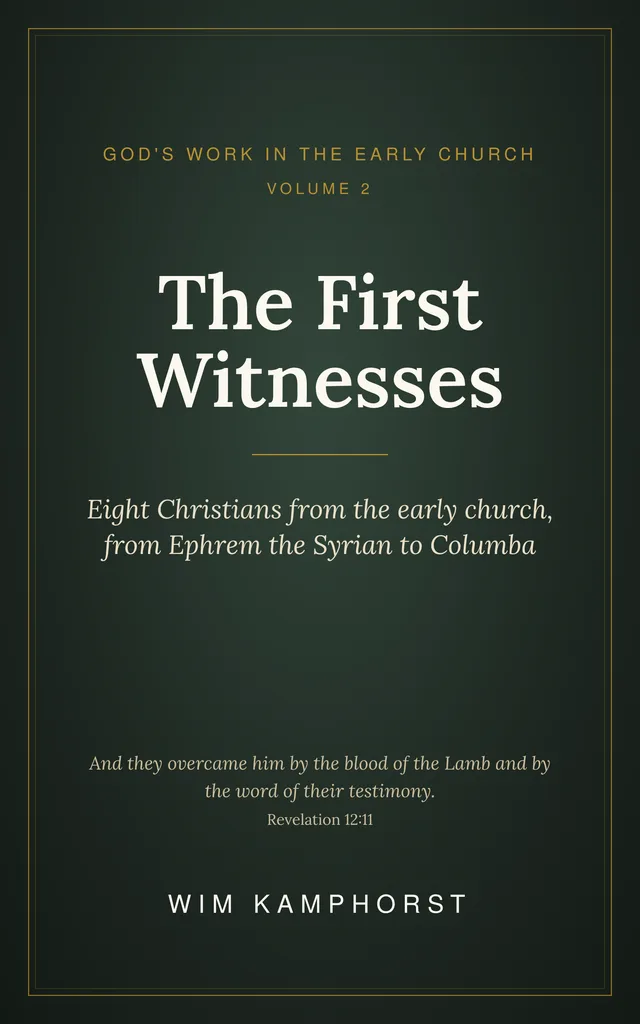
The First Witnesses volume 2
God's work in the early church
Eight Christians from the early church, from Ephrem the Syrian to Columba.
Introduction: after the persecution
This is the second volume of The First Witnesses. The first volume began in the second century, with Christians who held on to their faith when it could cost them their lives. In this volume that time is over. Around 313 the emperor Constantine gave Christians freedom of religion. That did not make things easier. The church became deeply divided over the question of who Jesus is, and emperors took sides.
This book is about eight Christians from the fourth to the sixth century. A Syrian deacon who wrote hundreds of hymns and set up three hundred beds during a famine. A Roman soldier who cut his cloak in two at a city gate. An eldest daughter in Pontus who turned her family’s house into a community of women. Her brother, a bishop who told the emperor’s prefect that he owned nothing but a cloak and a few books. A governor in Milan who became bishop before he was baptized. A scholar who translated the Old Testament from Hebrew in Bethlehem. A preacher from Antioch who died by the roadside as an exile. And an Irish monk from a royal family who crossed the sea to a small island off the coast of Scotland.
Facts first, especially here
For many of these people we are dealing with lives of saints, which scholars call hagiography. Such a book wants to show how holy someone was. It was written by a friend, a disciple or a family member, and is often full of miracles that no one else recorded. Around such books even more grew later: stories that turn up only centuries after someone’s death, like Jerome’s lion. I have always tried to show where a story comes from: from their own letters and hymns, from someone who knew them, or from a much later tradition. After each chapter you will find what is certain, what is known only from their own words or from later stories, and what is unconfirmed. The sources are listed there too.
Some of them also wrote things that may shock a reader today. I have not left those pages out. Dates are often uncertain. Where scholars disagree, I say so.
Of all the churches
These people lived before the church split into East and West, and long before the Reformation. Eastern Orthodox Christians, Roman Catholics and Protestants all appeal to them, sometimes in different ways. I have tried not to claim them for one church, and not to read later quarrels back into their time.
How you can read this book
The order is the order of time, from Ephrem, born around 306, to Columba, who died on Iona in 597. Each chapter stands on its own. If you know volume 1, you will sometimes meet old acquaintances, such as Augustine and Patrick. Read it with an open Bible beside you, and with a question in the back of your mind: what did God ask of them, and what is He asking of you?
Chapter 1 Ephrem the Syrian: the deacon who made the city sing
Hunger gripped the city of Edessa. The grain was there, but it lay in the hands of people who would not give it away. The poor were dying in the streets. An old deacon came out of his cell outside the city and went to the rich. He asked them why they let the poor perish when there was enough.
They had an answer ready. They were quite willing to give, they said, but they knew no one they could trust. Who could guarantee that the money would not disappear into the wrong pockets?
The deacon looked at them and asked a question of his own: “What think you of me?”
That is how the church historian Sozomen tells it, around the year 445. A generation earlier, around 420, Palladius had already written down the same story in his book about monks and hermits. According to him, the rich gave their money. The deacon had some three hundred beds set up in the colonnades of the city. He cared for the sick and buried the dead, for a whole year, until the famine was over.
The deacon’s name was Ephrem. He was in his sixties by then. He had spent half his life in a border city that was besieged three times, and he had been forced to flee when his city was handed over to the enemy. He wrote hundreds of hymns in Syriac, the language of his people. They gained a fixed place in the worship of the Syriac churches. Roman Catholics call him a Doctor of the Church, Orthodox Christians pray a prayer in Lent that carries his name, and in the churches of the Middle East he is known as the Harp of the Holy Spirit.
It began in Nisibis, on the edge of the Roman Empire.
Born in the way of truth
Ephrem was born around 306 in Nisibis or in the area around that city. Nisibis is now called Nusaybin and lies in southeastern Turkey, right on the border with Syria. No one wrote down his birth, so the year is approximate.
There are two stories about his parents. A saint’s life from the sixth century says that his father was a pagan priest and that the boy ended up on the street as a teenager. Ephrem himself sings something different. In his hymns he calls himself someone who was “born in the way of truth”. So he came from a Christian family, and that is also how Pope Benedict XVI saw it in a talk about Ephrem in 2007.
He was baptized as a boy. He probably belonged to the “sons of the covenant”, men in the Syriac churches who remained unmarried and gave themselves to the service of the local church. It was an early form of what later became monastic life, in the middle of the city.
From that same sixth century comes a story about a dream the boy had. It goes back to a Testament that carries Ephrem’s name. He saw a vine growing out of his mouth. The vine bore clusters and leaves. The clusters, so the dream was later explained, were his sermons, the leaves his hymns. Whether he told it that way himself cannot be proved. Anyone who reads his work understands why the story stuck.
A city between two empires
To understand Ephrem, you need to know where Nisibis lay. To the west was the Roman Empire, which was becoming Christian in those years. Under the emperor Constantine, Christians received freedom of religion in 313. To the east was the Persian Empire of the Sassanids, under King Shapur II. Nisibis was a fortress city on the fault line between the two. Rome had not held the region for very long.
In that city Ephrem grew up under Bishop Jacob of Nisibis. Jacob became bishop in 308 and died in 338. His name is on the list of bishops who attended the Council of Nicaea in 325, the great church assembly in what is now İznik in Turkey. Later it was said that the young Ephrem traveled with him.
Jacob made Ephrem a teacher, in Syriac a malpana. At some point he was also ordained a deacon. In the early church a deacon was someone who helped the bishop: in worship, in the care of the poor and the sick, and in teaching. When Ephrem became a deacon, we do not know. We do know that he remained one all his life. Sozomen writes that he never received a higher ordination.
Such a life had a price. Ephrem chose a life without a wife and without possessions, and he took it seriously. Sozomen tells a scene that has been retold often in the centuries since. One day a woman looked at him. Ephrem rebuked her: was she not ashamed to look at him like that? She answered that he was the one who should look at the ground, for he had been taken out of it. She was allowed to look at him, for she had been taken out of man. The Syriac saint’s life has Ephrem answer this with a smile: if the women were so wise, how much wiser must the men be. So the teacher of Nisibis himself was taught a lesson.
“The city stands on the water”
When Constantine died in 337, Shapur attacked. Nisibis was besieged in 338, in 346 and in 350. Ephrem lived through all three sieges.
During the first, Jacob was still bishop. In his Hymns on Nisibis, Ephrem writes that the city was saved by this man’s prayer. A later writer, Theodoret, tells what people saw of it: when the bishop prayed on the wall, a swarm of gnats and flies came over the Persian army, until the elephants and horses went wild and the siege was lifted. The Syriac Life of Ephrem also has him pray for that swarm. After Jacob’s death Ephrem wrote poetry about him as the first vinedresser of the city, who let its branches grow all the way to heaven.
Even Jacob’s grave was a protection for Ephrem. The city laid the body within its walls, he sings about his bishop, and outside them it became a wall. He calls on the daughters of Nisibis to lay the living body within themselves, so that it may become a wall for their lives too.
In 350 Shapur diverted the river Mygdonius, so that the water struck against the city walls. Part of the wall gave way. Ephrem saw it happen and wrote about it. According to his hymns, the wall fell on the Sabbath and stood up again on the Lord’s day. The city repaired the breach in a short time, and he credits this to the prayer of the bishop of that day, Vologeses. He sings about the rescue as about a victory that came from above. The song of victory sounds different from what you would expect of a historian. The river outside, he sings, deceived the city, but the spring within saved it. In another hymn he compares Nisibis to Noah’s ark, surrounded by walls, weapons and waves, and still afloat.
Those hymns on Nisibis have survived. In one of them Ephrem compares Jacob and the two bishops after him to three lamps, each in a dark time of siege. Each of them, according to the hymn, opened a different door: one for battle, one for kings, one for envoys and mercy. For Ephrem the bishop, the prayer and the wall of the city could not be separated from one another.
A language Jesus could have understood
Ephrem wrote in Syriac, a form of Aramaic, the language spoken in large parts of the Middle East in the time of Jesus. Syriac arose in Edessa and became the language of the Christians in Mesopotamia, the land between the Euphrates and the Tigris. They had their own Bible translation, the Peshitta, and their own harmony of the Gospels, the Diatessaron of Tatian. Ephrem wrote a commentary on that Diatessaron.
This Syriac church is unfamiliar ground for many readers. It lived on the edge of the Roman Empire and partly beyond it, in Persia. Later it would grow apart into different churches. In the west of the region the Syriac Orthodox Church, the Maronite Church and the Syriac Catholic Church came into being. In the east, the Assyrian Church of the East and the Chaldean Church. There are also Christians in the south of India who belong to this family. All these churches honor Ephrem. Those divisions came only after his death. In his time they did not yet exist.
Syriac gave Ephrem something that Greek and Latin could not give him. He thought in images and contrasts. Pope Benedict XVI pointed out that Ephrem brought theology and poetry together, and explained the faith with paradoxes and images.
Take the pearl. Ephrem picks one up in his hand and writes: I laid it, brothers, on the palm of my hand, so that I could look at it. He turns it over. From every side he sees the same light, and so he begins to read the pearl as an image of the Son, whose depth you cannot measure and whom you cannot divide into pieces. A song about a stone becomes a song about God.
Or take Christmas. About Mary he sings that the Lord came into her as a servant, and that the Word went into her and became silent. About the bread of the Lord’s Supper he sings that in Your bread the Spirit is hidden who cannot be consumed, and in Your wine the fire that cannot be swallowed. He also sings that He who feeds all went into her and learned what hunger is. About the garden of Eden he sings that the gardener Himself became food for our soul. Whoever sings this does not need a textbook to know what the church believes. The words tell it, and the melody carries it.
Hymns with a refrain
The greater part of his work consists of madrashe. The word means something like teaching songs. A madrasha is made of stanzas with a fixed number of syllables, and between the stanzas the congregation sings a refrain. Almost four hundred such hymns by Ephrem have survived, in about fifty different verse forms. Each hymn had its own melody. Those original melodies have all been lost. We only have the words.
He also wrote memre, poems in fixed lines of seven syllables that were recited. That verse form became so closely tied to him that it came to be called “the meter of Mar Ephrem”. That had a consequence: later, many poems were put under his name that are not his. He also wrote in prose, including commentaries on Genesis and Exodus and refutations of teachers whom he regarded as false teachers.
Why hymns? Sozomen gives an explanation. A good century earlier Bardaisan had lived in Edessa, a thinker who founded a movement of his own. His son Harmonius, Sozomen writes, knew Greek learning and was the first to pour his mother tongue into meters and melodies. Choirs sang those verses, and down to Sozomen’s own time the Syrians still sang them, to the same tunes. But Harmonius let views about the soul and the body ring through his hymns that did not belong to the church.
Ephrem saw what was happening. The Syrians let themselves be enchanted by the sound, and with the sound the teaching came along. He did not know Greek learning, Sozomen writes, but he learned to understand the meter of Harmonius and wrote hymns in the same form, with the teaching of the church in them. He also wrote songs of praise for holy men. From then on the Syrians sang the hymns of Ephrem to the tunes of Harmonius.
How much did he write? Sozomen mentions three hundred thousand lines of verse, adding that this is what is said. No one has ever been able to count them. What is certain is that he left behind so much that his work was translated into Greek during his own lifetime, and that Basil of Caesarea, one of the great Greek church fathers, admired him.
A corpse before the gate
In 363 the end of Ephrem’s life in Nisibis came. The emperor Julian, who had wanted to reverse the Christian course of his predecessors, marched into Persia with a great army. In June 363 he was killed. The army chose a new emperor, Jovian. He made peace with Shapur, and the price was high. Nisibis was handed over to Persia. The Christian inhabitants had to leave the city.
Ephrem wrote a series of hymns against Julian about this. He describes how he saw the embalmed corpse of the emperor lying before the city gate, while a Persian flag flew over the citadel.
What must it have been like to see that? He was almost sixty. He had lived in this city all his life, had defended it with prayer and hymns, had served its bishops. Now she passed into other hands through a treaty that he had not made. He picked up and went.
Perhaps he went first to Amida, the present Diyarbakir. After that he settled in Edessa, the present Sanliurfa in southeastern Turkey. There he would live for the last ten years of his life.
On the mountain near Edessa
Edessa was the old capital of Syriac Christianity. It was also a city full of movements. There were followers of Arius, who taught that the Son was less than the Father. There were followers of Marcion, who rejected the Old Testament. There were Manichaeans, followers of the Persian prophet Mani. And there were still people who sang the hymns of Bardaisan.
According to tradition, Ephrem lived in a cell on the hill outside the city and taught there. In Edessa he wrote many of his hymns about the faith. He held fast to what had been confessed at Nicaea: the Son is truly God, just like the Father. Against the other movements he wrote hymns and refutations in prose.
I must be honest here about something that may sound sharp to readers today. Ephrem could write fiercely about those who believed differently. An English scholar around 1900 even called his polemical hymns a sorry addition to Christian literature. Anyone who reads him comes across those pages. They belong to him, just as his tenderness does.
Women who sang
One of the best-known stories about Ephrem is about women. More than a century after his death, Bishop Jacob of Serugh, who died in 521, wrote a long poem about him. In it he tells that Ephrem founded choirs of women who sang his hymns. According to Jacob, Ephrem saw that the women in church were silent, and wanted to give their voices a place in the praise. He taught them the hymns and their melodies.
What is certain is that in the fifth century there were choirs of “daughters of the covenant” in Edessa. These were unmarried women who had dedicated themselves to the church, just like the sons of the covenant. In the church rules of Bishop Rabbula of Edessa, from the first half of that century, they were given the task of singing psalms and madrashe. The Syriac Life has the sisters sing his hymns in the churches in the morning and in the evening.
Pope Benedict XVI said in 2007 that the role of women was important to Ephrem. In his hymns Ephrem speaks of Mary with great reverence. Because the Son of God dwelled in the womb of a woman, he wrote, God had honored all women.
Something in this touches me. A deacon in a border city takes the songs that his opponents use, makes new ones out of them, and has them sung by the people who until then had to be silent. What would it sound like if the teaching in your church were sung, by everyone who has a voice?
Three hundred beds
In the last years of Ephrem’s life a famine broke out in Edessa. If he died in June 373, it must have been in 372 and 373.
Palladius tells it around 420 in his collection of stories about monks and hermits. Ephrem, he writes, came out of his cell and spoke to the rich. He spoke to them about what they were doing: they held on to their wealth while people around them were dying. Sozomen adds that Ephrem explained to them where such holding on leads. Whoever piles up what he does not share brings judgment on his own head, and it costs him his soul, which is worth more than all the money in the world. Their deeds showed, he said, that they thought their own soul worth nothing.
They listened. They respected the man. But they said what people say: they were not out for gain, they simply did not know to whom they could entrust it. Almost everyone who gets money into his hands wants to keep something of it for himself.
Then came Ephrem’s question. “What think you of me?” They answered that they thought him good and capable, a man who was exactly what his name promised. Palladius has him say: “See, on your behalf I appoint myself hospitaller.”
He received the money. He had the colonnades of the city screened off and set up about three hundred beds there. He nursed those who were ill and buried those who died. Strangers and residents received food and care every day, for a whole year. When that year was over and there was enough again, everyone went home. Ephrem returned to his cell.
In his hymns about Christmas he had already sung it: He who feeds all knew hunger. Now he himself stood with bread among the beds.
Try to picture it. A man of almost seventy, who wrote hymns for a whole people, walks along rows of beds. He lifts, washes, feeds, buries. The city sings his hymns and he nurses its sick, and the one belongs to the other.
Sozomen also tells a story that looks less sober. When people once came to fetch Ephrem to ordain him a bishop, he pretended to be mad. He ran across the marketplace, dragging his clothes behind him, and ate in the street, until they gave up. That is how he got free. Whatever we make of it, it fits how he lived: he wanted to remain a deacon and hold no church office. He never became a bishop or a priest.
June 373
Shortly after the famine, Ephrem died. Palladius says: after a month. Sozomen says: after a few days. A later tradition, which Pope Benedict XVI also mentioned, says that he caught an illness while caring for the sick.
The Chronicle of Edessa, a Syriac history from the sixth century, gives the date as June 9, 373. Jerome, who made a short list of Christian writers in 392, places his death under the emperor Valens. Valens reigned from 364 to 378, so that fits.
A Testament has come down under his name, and what it contains is a last song about humility. He asks for no honor. Do not lay me among the martyrs, he says, for I am a sinner and not worthy. He wants to go to the burial ground where the broken hearts lie, and he wants to be wrapped in his own cloak and hood. No spices, no perfumes, for they do him no good. Take nothing of mine as a keepsake, my beloved, my brothers, my sons. Whoever wants to remember him, he says, can pray, and can give to the poor what he would have spent on his funeral.
Whether that text is really his is not certain. It does fit the man who walked among the sick in a colonnade.
I like to read that Testament aloud. A man who taught a city to sing asks at the end not to be sung about. No coffin with spices, no grave among the martyrs, no keepsake in a pupil’s pocket. He wants you to pray, and to give the money to someone who is hungry. What would you say about someone who lived like that?
What was said of him later
About two hundred years after his death, in the sixth century, an extended Life of Ephrem was written in Syriac. It is a saint’s life full of beautiful stories. According to this Life, Ephrem traveled to Caesarea in Cappadocia, the present Kayseri in Turkey, to meet the great bishop Basil. In a dream he had seen a pillar of fire, and when he stood in Basil’s church on Epiphany, he saw a dove sitting on the bishop’s shoulder and speaking through his mouth. Ephrem cried out for joy. He is said to have been able to speak Greek there all at once, and Basil ordained him a deacon. He is also said to have lived for eight years in Egypt, among the desert monks.
Such stories are beautiful. They do not lie about what Ephrem meant, even if they lie about what he did. Later Christians wanted to see the Syriac poet and the Greek theologians together. They felt that they belonged together.
Something similar happened with his work. In Greek a large collection of texts arose under the name of Ephrem. Part of it consists of translations of genuine works, but the greater part is by others. From that Greek tradition comes the short prayer that Orthodox Christians pray during Lent, in which they ask God to free them from laziness and the lust for power and to give them humility, patience and love. It stands under his name, and it is prayed again every year.
On October 5, 1920, Pope Benedict XV declared him a Doctor of the Church for the whole Catholic church. His encyclical takes over a number of the later stories, such as the ordination by Basil. Even a Doctor of the Church sometimes receives his life story with legends attached.
A harp in the colonnade
Ephrem is now celebrated on June 9 in the Roman Catholic Church and in the Church of England, on June 10 in the Episcopal Church in the United States, and on January 28 in the Eastern Orthodox churches. The Syriac churches remember him on their own days. Few Christians of the fourth century are honored in so many churches at once.
He was not a bishop and not a martyr. He did not preach before emperors and did not win debates in the capital. He was a deacon who wrote hymns for his city, and when that city was taken from him, for another city.
What remained of him? Words without melody. Almost four hundred hymns of which no one knows any more how they sounded. And two short reports of something he did at the end of his life, when the hymns were for a moment not enough.
The last image that the earliest sources give of him is not an image of a pulpit. It is a colonnade in Edessa, where three hundred beds stand between the pillars. An old man walks among them. When the year is over, the beds are taken away, and the colonnade is empty again.
What is certain and what is told
Certain (several independent sources): birth around 306 in or near Nisibis; disciple of Bishop Jacob of Nisibis (died 338); the Persian sieges of 338, 346 and 350; the handing over of Nisibis to Persia in 363 and Ephrem’s departure for Edessa; deacon until his death, never bishop or priest; almost four hundred madrashe and other works in Syriac; his help during the famine in Edessa with some three hundred beds (Palladius around 420, Sozomen around 445); death in Edessa, according to the Chronicle of Edessa on June 9, 373; Doctor of the Church since October 5, 1920.
Only from own testimony or later tradition: his Christian background (from his own hymns); the rescue of Nisibis through Jacob’s prayer and the corpse of Julian before the gate (from his own hymns); the vine dream (Testament under his name, via the Syriac Life); the meeting with the woman who contradicted him (Sozomen and the Syriac Life); the women’s choirs as his initiative (Jacob of Serugh, a good century later); the feigned madness to escape the office of bishop (Sozomen); the illness he caught while caring for the sick; the Testament.
Unconfirmed: a pagan father; his presence at the Council of Nicaea; the swarm of insects at the siege of 338 (Theodoret; it does not appear in Ephrem’s own hymns on the siege, as far as I could determine); the journey to Basil, the pillar of fire, the dove and his ordination by Basil; eight years in Egypt; the Prayer of Ephrem as his own work; most of the Greek texts under his name.
Where the sources differ: Sozomen may have taken the famine from Palladius, so they are not necessarily two independent witnesses. Both writers lived within eighty years of Ephrem’s death, and the story sounds sober. Feigned madness looks very much like what David did before the king of Gath (1 Samuel 21); John Gwynn wrote in 1898 that the story was probably shaped after that example. The American historian Susan Ashbrook Harvey calls Jacob of Serugh’s poem about the women’s choirs an idealized justification of a custom of his own time. Whether Ephrem himself began the choirs, we cannot verify; it does fit what we know of him. Sidney Griffith dates the hymns against Julian still in the year of the emperor’s death, in Nisibis itself. On the death, Palladius (after a month) and Sozomen (after a few days) give different periods; some writers think of 378, most scholars hold to 373. The journeys to Basil are legend according to scholars: Basil became bishop only at the end of 370, so a visit could only fall in Ephrem’s last two years, and the earliest sources are silent about it. Eight years in Egypt fits nowhere in a life that lay in Edessa from 363. The reference work on the Syriac tradition from Beth Mardutho points to a mix-up: the Syrian about whom Basil wrote was another man, Eusebius of Emesa. Sozomen said only that Basil admired Ephrem, which may have come through translations. The encyclical of 1920 itself takes over part of the legends.
Interpretation: that the sieges of Nisibis were beaten back by prayer is Ephrem’s own interpretation in faith. In his eyes, the Roman defense and the defense through prayer do not exclude each other. The hymn quotations in this chapter are my own rendering after English translations (Gwynn in NPNF 13, Benedict XVI), not a translation from the Syriac.
Sources for this chapter
- Sozomenus, Kerkgeschiedenis, book III, chapter 16 (New Advent)
- Palladius, Lausiac History, chapter 40: Ephraim
- Gorgias Encyclopedic Dictionary of the Syriac Heritage, “Ephrem” (Beth Mardutho)
- Gorgias Encyclopedic Dictionary of the Syriac Heritage, “Basil of Caesarea” (Beth Mardutho)
- Susan Ashbrook Harvey, “Revisiting the Daughters of the Covenant”, Hugoye 8.2
- Pope Benedict XVI, general audience on Saint Ephrem, November 28, 2007
- Paus Benedictus XV, encycliek Principi Apostolorum Petro, 5 oktober 1920
- Schaff-Herzog Encyclopedia, “Ephraem Syrus” (CCEL)
- John Gwynn, NPNF 13: material for his biography (CCEL)
- John Gwynn, NPNF 13: historische kritiek op de middeleeuwse aanvullingen (CCEL)
- Efrem, Hymnen over Nisibis, XIII: over Mar Jakob (CCEL)
- Gwynn, introduction NPNF 13 (Tertullian.org)
- Testament van Efrem (Sanidopoulos)
- SPEAR, Syriac Persons, Events and Relations: Efrem
- On Efrem’s Hymns against Julian (with Griffith 1987)
- Encyclopaedia Britannica, “Saint Ephraem Syrus”
- OrthodoxWiki, “Ephrem the Syrian”
- Wikipedia, “Ephrem the Syrian” (starting point)
- Wikipedia, “Syriac Christianity” (starting point)
Chapter 2 Martin of Tours: the soldier with half a cloak
It was winter in Amiens, in the north of Gaul, present-day France. At the city gate sat a man with no clothes. The cold was so hard that many people did not survive it. Everyone who passed by walked on. A young Roman soldier stopped. He had nothing left with him except his weapons and his military cloak, because he had already given away the rest. He drew his sword, cut the cloak in two, and gave one half to the beggar. The other half he wrapped around himself again.
Some of the bystanders laughed. A half cloak looked ridiculous. Others were ashamed, because they had more and had done nothing.
That night the soldier dreamed. He saw Christ, dressed in the half of the cloak that he had given away that day. And he heard Him say to the angels around Him: “Martin, who is still but a catechumen, clothed Me with this robe.”
We know this scene from Sulpicius Severus, a Gallic writer who knew Martin personally and put his life story on paper while Martin was still alive, shortly before 397. It is the oldest source we have. It is also a saint’s life: a book that wants to show how holy someone was.
The soldier became a monk, bishop of Tours, and one of the best-loved Christians of the West. In the Netherlands, children walk from door to door with lanterns every year on November 11 in his honor. In Utrecht the cathedral, the Dom, carries his name, and the red and white city flag refers to his cloak.
But it began in an army camp, with a father who did not want to give his son to the church.
A boy from Sabaria
Martin was born in Sabaria, in the Roman province of Pannonia. Today that city is called Szombathely and lies in the west of Hungary. His parents were pagans, Sulpicius writes. His father was a soldier and later became a military tribune, an officer. The family moved to Ticinum, now Pavia in northern Italy, and there Martin grew up.
Gregory of Tours, a later bishop of the same city, wrote at the end of the sixth century that Martin was born in the eleventh year of the emperor Constantine’s reign. That works out to about 316. The historian Clare Stancliffe considers 336 more likely. For the ordinary reader it matters how young the man was who would soon lay down his sword: around twenty, or around forty.
It was a remarkable time to become a Christian. Around 313 Constantine had ended the persecutions. Churches could exist openly, and more and more Romans were baptized. But most of the countryside of Gaul was still pagan, and inside the church itself a hard struggle was raging over the question of who Jesus is. One party, the Arians, saw in Jesus an exalted creature. The other held on to what had been declared at Nicaea in 325: that the Son is one in being with the Father.
Sulpicius tells that the ten-year-old Martin walked to a church against the wishes of his parents and asked to become a catechumen. A catechumen was someone who received instruction in the faith and prepared for baptism. At twelve he already wanted to go into the desert as a hermit. Only his age held him back, and his thoughts stayed with the church, so Sulpicius writes.
An imperial order required the sons of veterans to enter the service. Martin was about fifteen when he took the military oath. It was his own father who reported him. He was put in chains and had to swear.
He had one servant, but the master was mostly the servant: he pulled the servant’s boots off and ate with him at the table. A large part of his pay he gave away to whoever needed it. Sulpicius writes that in all those years he remained unstained by the roughness of the soldiers.
So he ended up with his unit in Amiens, at that city gate.
One of the least of these
Sulpicius tells the story of the cloak with a clear purpose. He himself makes the connection with the words of Jesus about the last judgment. There the King speaks to those who fed the hungry and clothed the naked: And the King will answer and say to them, “Assuredly, I say to you, inasmuch as you did it to one of the least of these My brethren, you did it to Me.” (Matthew 25:40)
The dream turns on one word: catechumen. Martin was not yet baptized. Formally he did not yet belong to the congregation. And yet in the dream Christ tells the angels that it was precisely this not-yet-baptized man who clothed Him. Martin did not become proud of it. He saw God’s goodness in it and soon afterward had himself baptized, at about twenty years of age.
How would you have walked past that gate? I ask myself that question every time I read this story. The cloak was not the sacrifice of a rich man. It was half of the last thing he had.
The story became more famous than anything else he did. Centuries later the Frankish kings kept a cloak that passed for the cloak of Martin as their most precious relic. In 679 it is mentioned in their treasury. In Latin such a cloak was called a cappa. The priest who watched over it was called a cappellanus, and the little building where it lay a capella. From those words come our English words chaplain and chapel.
Soldier of Christ
After his baptism Martin stayed in the army for about two more years. Then came the moment when he stepped out. It happened at the city of the Vangiones, present-day Worms in Germany. The Germans were invading Gaul, and Julian, who ruled Gaul as junior emperor, gathered his troops. Before the battle he handed out a gift of money to the soldiers, a donative.
Martin would not accept it. He went to Julian and said, as Sulpicius tells it: “I am the soldier of Christ: it is not lawful for me to fight.” Until now he had served the emperor, he said, and now he wanted to serve God. Whoever wanted to fight could keep the gift.
Julian was furious. He called it cowardice: Martin was afraid of the next day’s battle, and was looking for a religious pretext. Martin would not be driven. If this conduct of his was ascribed to cowardice and not to faith, he answered, he would stand unarmed in front of the line the next morning. Armed with nothing but the sign of the cross, he would walk through the enemy. Julian had him locked up, to hold him to his word.
The next day, Sulpicius tells, the enemy sent envoys. They surrendered and left their land to Rome. Not a sword had to be drawn. Sulpicius sees God’s work in this directly: the Lord did not want His soldier to have to show how he would go unarmed onto a battlefield. After that Martin received his discharge.
I do not want to pass judgment here on Christians in the army. Churches think differently about that to this day, and in Martin’s time they did too. His name was later tied precisely to soldiers: he is their patron saint. What stands out in the story is something else. He did not accept money for something he could no longer do.
With Hilary in Poitiers
Martin traveled to Poitiers, in the west of present-day France. Hilary was bishop there, a defender of the creed of Nicaea. Hilary wanted to give him a higher place in the church, Sulpicius writes, but Martin kept refusing. He was not worthy of it, he said. Then Hilary made him an exorcist, a lower task: praying over people who were tormented by evil spirits. This task Martin did accept, because it did not seem to raise him too high.
After that he wanted to see his parents. He traveled back east. On the way, in the Alps, he was attacked by robbers. One of them raised an ax over his head, but another robber held back the arm. They tied Martin’s hands behind his back and gave him to one of them to be robbed. The robber asked who he was. A Christian, said Martin. Was he afraid? No, said Martin, never had he felt so safe, for he knew that God’s mercy is nearest in danger. And he felt pity for his captor, who was deprived of Christ’s compassion. Then he told him the gospel. The man became a Christian, brought him back to the road and asked him to pray for him. That is how Sulpicius tells it, and he adds that Martin told it himself. At home Martin brought his mother to the faith. His father remained a pagan.
In Illyricum, in the Balkans, he clashed with the Arians, who led the church there. He was publicly flogged and sent away. In Milan bishop Auxentius, also an Arian, drove him out of the city. Hilary himself had been banished in those years to the east of the empire. Martin withdrew to Gallinaria, a small island off the coast of Liguria, now Isola Gallinara in Italy. He lived there on roots and herbs. Once he ate hellebore, a poisonous little plant. He felt death coming and prayed, and the pain went away.
A cell near Ligugé
Around 360 or 361 Hilary received permission to return. Martin went after him and found him in Poitiers. Not far from the city he set up a simple hermitage. Sulpicius does not name the place. Later sources and the Catholic Encyclopedia call it Ligugé. An abbey still stands there, and the place counts as one of the oldest monasteries in western Europe.
The idea of monastic life came from Egypt and Syria. There men and women went into the desert to live for God in prayer and simplicity. In Gaul it was still new. Martin brought it to the west, and other men came to live with him.
At Ligugé takes place one of the stories to which Sulpicius gives the most weight. A catechumen who lived with Martin fell ill while Martin was away, and died unbaptized. When Martin came back, he found the brothers mourning around the body. He sent everyone away, closed the door, lay down on the dead body and prayed. After about two hours he felt, Sulpicius writes, that God’s Spirit came upon him. He raised himself and looked at the face of the dead man. The man opened his eyes. The brothers came in and saw alive the one they had left behind.
The man was baptized and lived many more years. Later he told what he had experienced: he had been brought before the Judge and condemned to the dark places. Two angels had said that Martin was praying for him, and the Judge had ordered him to be sent back. Sulpicius says that from that moment Martin’s name became known to everyone.
Sulpicius tells of a second raising, of a slave who had hanged himself on the estate of a certain Lupicinus. Again Martin closed the door and prayed. The slave stood up, took Martin’s hand and walked with him to the front hall of the house, while the people outside stood watching.
Already in Martin’s own time there were people who accused Sulpicius of exaggeration. In a letter from around 396 Sulpicius defended himself against such a critic. So the book was read by people who had known Martin.
A bishop with untidy hair
In 371 or 372 the bishop of Tours, on the Loire, died. The city wanted Martin. He did not want it. So a citizen, Rusticius or Ruricius, lured him to Tours with the pretext that his wife was sick and needed prayer. On the way Martin was met by a great crowd, from Tours and from the towns around. They proclaimed him bishop. That the people chose a bishop was normal in those days.
Not everyone was pleased. A few bishops, who had to help with the ordination, found him unfit. According to Sulpicius they called him a despicable person, poorly dressed, with untidy hair. Their spokesman was named Defensor. When the reader did not show up in the service, a bystander took the psalter and read the first verse he saw. It was Psalm 8, about the praise from the mouths of children and infants, with which God silences the enemy. The people saw it as a sign. The opposition fell silent. According to the Catholic Encyclopedia, Martin was ordained on July 4.
The story says much about the tension that followed him all his life. The common people loved him. Some of the bishops thought him a disgrace to the office. At the end of the Life, Sulpicius writes that Martin wept over his opponents, and that a number of them were bishops.
Even in his new office he did not change. He remained the same man, with the same humility and the same simplicity, Sulpicius writes. His authority was great, but he carried it without ceremony.
Two miles outside the city
As bishop Martin remained a monk. At first he lived in a cell next to the church. When that became too busy, he moved about two miles outside the city, on the other side of the Loire. There the monastery arose that would later be called Marmoutier. On one side stood a steep rock face, on the other side flowed the river. Only one narrow path led there. Martin lived in a wooden cell. Many brothers had hewn out a cave in the rock.
Sulpicius counts eighty disciples. No one had personal property. Everything was held in common. They drank wine only when they were ill. Most wore clothing of camel hair. The younger ones did the copying, the older ones prayed. From this monastery, according to Sulpicius, many bishops later came. What city or congregation, he asks, did not have a priest from the monastery of Martin?
Temples in the countryside
Most of the stories in the Life are about Martin’s work in the countryside. He traveled through the villages, preached and had pagan shrines torn down. On the site of a temple he often had a church or a monastery built.
Sulpicius tells of it with many miracles. At a sacred pine tree, villagers told Martin that they would chop the tree down themselves if he would stand under it. He did. As the tree came crashing toward him, he made the sign of the cross, and the tree swung the other way. The pagans who were watching, so Sulpicius writes, cried out that they accepted the faith.
In Trier, in present-day Germany, he healed a paralyzed girl with blessed oil. In Paris he kissed a man with leprosy, who was healthy afterward. He drove an evil spirit out of a servant of Tetradius, a man of rank, who promised to be baptized. Threads from his clothing, Sulpicius writes, helped the sick who tied them around a finger or a neck.
The tearing down of temples often happened against the will of the villagers. A pagan came at him with a sword. Martin threw open his garment and offered his neck. The man fell backward and begged for forgiveness. What Sulpicius mainly shows is that Martin did not spare his own life and that many people in the countryside became Christians through him. He gives no numbers.
How he dealt with dangerous people, Sulpicius also tells in his Dialogues, a conversation between friends that he wrote around 404. Martin once went to the governor Avitianus, a hard man who mistreated prisoners. He was not let in and lay down in front of the threshold at night. An angel woke Avitianus. After that he set all the prisoners free and left the city. Martin had let him know that his anger was not aimed at him, but at the one who bowed over his neck in all his terror.
The same Dialogues tell of a monk, Brictio, who had scolded Martin harshly and later repented. Martin wanted to keep him. “If Christ bore with Judas, why should not I bear with Brictio,” he said. That is how he treated his opponents. Gregory of Tours names a Brictius as his successor in Tours, and many scholars see in him the same man.
These are stories from the genre of the saint’s life. I cannot verify them. At any rate they show how the people around him saw him.
“I will not believe Christ”
A story in the Life that I find remarkable is about the night the devil posed as Christ. Martin was sitting in his cell praying when a light came into the room. A figure stood before him in a royal purple robe, with a diadem of gold and precious stones, and shoes with gold on them. The figure said: “Acknowledge, Martin, who it is that you behold. I am Christ.” He wanted to show himself to Martin first.
Martin was silent for a long time. Then he spoke. The Lord Jesus, he said, had never said that He would come in purple and with a crown. He would not believe that Christ had come, he said, unless He appeared in the form in which He suffered, bearing the marks of the cross. The figure vanished like smoke, and the cell was full of stench.
Martin told it himself later, Sulpicius writes. He knew Christ not from power and gold, but from a wound.
A sword against heretics?
In 385 Martin came to the court at Trier, where Magnus Maximus was emperor. Maximus had seized power in the west. In Trier a case was underway against Priscillian, a Spanish bishop. He was accused of heresy and sorcery. His fiercest accuser was bishop Ithacius.
Martin did not defend the teaching of Priscillian. But he asked the emperor not to let a worldly judge decide a church matter, and certainly not with death. Maximus promised that. When Martin had left again, Ithacius and his allies talked the emperor around. Priscillian and several followers were beheaded. Ambrose, the bishop of Milan, had also opposed a death sentence.
One of the best-known stories from his time at court is about a meal. Maximus invited Martin, and he came. When the cup went around, the emperor hoped to receive it from Martin’s hand. Martin passed it to his own priest. No one, he said, was worthy to drink before this man. Sulpicius writes that the court was amazed at his boldness.
A year later Martin was in Trier again. He came to plead for two men, Narses and Leucadius, and above all against a plan of the emperor to send officers with power over life and death to Spain, hunting followers of Priscillian. Martin refused to celebrate communion together with the bishops around Ithacius. According to Sulpicius the emperor became angry and gave the order for the executions.
At night Martin hurried to the palace. He promised to take part in communion with those bishops if the prisoners were spared and the officers recalled. The emperor agreed. The next day Martin joined in the communion at the ordination of a new bishop, Felix. He did not sign a statement.
On the way back he sat sorrowing under the trees at a place called Andethanna. He knew he had done something that gnawed at him. There an angel appeared and said to him: “Justly, O Martin, do you feel compunction.” He had had to give in to save lives, the angel said, but he must take courage again. From that day Martin never went to a gathering of bishops again. He lived another sixteen years after that, Sulpicius writes. According to Sulpicius he told his disciples that for a time he had less power to heal.
Perhaps this is the most human part of his life. A saint who makes a compromise to save lives, and wrestles with it afterward. What would you have done?
“Lord, if I am still needed”
In the fall of 397 Martin went to Candes, a village in his own diocese, at the confluence of the Vienne and the Loire. It is now called Candes-Saint-Martin. He knew that his end was near, but the clergy of that place were at odds with one another, and he wanted to bring peace. So Sulpicius writes in a letter to his mother-in-law, following what people told who had been there.
On the way he saw birds on a river greedily catching fish out of the water. It reminded him of the devil, who ambushes his victims. He ordered the birds to leave the pool, and they flew away to the mountains and the woods.
After the reconciliation he began to fail. He told the brothers that he was going to die. They wept and begged him not to leave them unprotected. Tears ran down his cheeks. Then he prayed: “O Lord, if I am still necessary to your people, I do not shrink from toil: your will be done.” He did not know which he preferred, says Sulpicius, and left the choice to God.
He developed a fever. He kept on praying, often all night. He lay on a bed of sackcloth and ashes. When the brothers wanted to slip some straw under the sackcloth, he refused. A Christian should die among ashes, he said. When they asked him to turn onto his other side, to make it lighter, he said they should let him keep his eyes turned toward heaven. In his last moments he saw the devil standing next to him. “Why do you stand here, you bloody monster?” he said. The devil would find nothing in him. “Abraham’s bosom is about to receive me.” With that he gave up his spirit.
That is how the people who were there passed on his dying. The usual date is November 8, 397, in his twenty-sixth year as bishop, says Gregory.
Those who were there said that his face looked like the face of an angel and his limbs were white as snow. Many people came, from the whole city and from the surrounding area. Sulpicius writes that about two thousand monks accompanied the procession. The monks wept, the virgins restrained themselves, and there was sorrow and joy together.
“He is ours”
Gregory of Tours, who wrote almost two hundred years later, tells what happened next. People from Poitiers and from Tours stood around the body. The people of Poitiers said: “He is ours”, for he had been a monk and abbot among them. The people of Tours said that God had given him to them. At night, while the group from Poitiers slept, the people of Tours took the body away, laid it in a boat and sailed over the Vienne and the Loire to their home. It shows how strong the bond was that ordinary people felt with him.
He was buried in Tours. His successor Brictius built a chapel over his grave, and in 470 a basilica followed. It became one of the greatest pilgrimage sites of the West. In 1562 Protestants plundered the church during the wars of religion in France, and in 1793 the French Revolution tore it down. In 1860 the grave was found again. A smaller basilica stands there now.
From Tours to Utrecht
How does a bishop from France end up in Utrecht? Through the Franks. For the Frankish kings Martin was their own saint, the protector of their kingdom. They carried his cloak with them into battle.
Around 630 the Frankish king Dagobert founded a small church inside the walls of the old Roman fort in Utrecht. About twenty years later the Frisians destroyed it. In 695 Willibrord, the English missionary who became the first bishop of Utrecht, restored the little church. According to the heritage department of the city of Utrecht, he dedicated it to Saint Martin, as a tribute to the Frankish rulers who protected his work. Later this church became the seat of the bishop. The Romanesque and then the Gothic cathedral were both dedicated to Saint Martin. The cathedral chapter owned relics: a vertebra from 1173 and part of an arm bone from 1519.
The red and white of the Utrecht coat of arms refers to the cloak, according to the same source. Emperor Charles V had the image of the saint removed from the arms and the banner in 1528. In 1948 Saint Martin returned to the city flag and the banner. On November 11 children in the Netherlands and Flanders walk from door to door with lanterns and sing songs about him.
So Martin is one of the few early Christians who still walks through our streets. He is the patron saint of France and of soldiers. His story is a shared possession of Christians from all churches, including Protestants who do not venerate saints but do recognize themselves in a soldier who shared his cloak.
Half a cloak at the gate
Sulpicius visited Martin at Marmoutier. In the Life he writes that the bishop washed his feet himself in the evening. Sulpicius did not have the courage to refuse. He was a young, learned, well-off man from Aquitaine. The other was an old bishop in a wooden hut.
A soldier who left the army, a monk who became a bishop without wanting to, a man who pleaded against the death penalty for heretics and made a compromise for it that he regretted. And at the beginning a city gate in winter, with a naked man whom no one saw, and a soldier who stopped, drew his sword and wrapped half of his cloak around him.
What is certain and what is told
Certain (several independent sources): birth in Sabaria in Pannonia (now Szombathely, Hungary) to pagan parents; youth in Ticinum (Pavia); service in the Roman army and leaving the army because of his faith; disciple of Hilary of Poitiers; hermitage near Poitiers (Ligugé) around 360/361; bishop of Tours from 371 or 372; founding of the monastery of Marmoutier; his plea in Trier against having Priscillian tried by the emperor, and the execution of Priscillian in 385; death in Candes, probably on November 8, 397; burial and veneration in Tours; the derivation of the words chapel and chaplain from the cloak relic; patron of the Dom and the city of Utrecht.
Only from own testimony or later tradition: the story of the cloak at Amiens and the dream that followed (only Sulpicius, around 397); his words to Julian at Worms and the enemy who surrendered without a fight; the robbers (Sulpicius says Martin told it himself), the conversion of his mother, the hellebore on Gallinaria; the two raisings from the dead; the pine tree, the healings in Trier and Paris; the devil as Christ in purple; the number of eighty disciples; the meal with Maximus and the cup; the angel at Andethanna and his diminished power to heal (Dialogues, around 404); the stories about Avitianus and Brictio (Dialogues); his deathbed with the prayers and the words to the devil, and the two thousand monks (Sulpicius, third letter, from the report of those present); the struggle over his body between Poitiers and Tours (Gregory of Tours, end of the sixth century).
Unconfirmed: his year of birth (316 according to Gregory, 336 according to Clare Stancliffe, among others) and with it his age at death and the length of his service (scholars dispute whether he served three years or almost thirty, Christianity Today wrote in 2015); the year of death, 397 or 400 (the Catholic Encyclopedia calls 397 the most likely); the question whether the cloak of the Frankish kings was really Martin’s. For the dedication of the Utrecht church to Saint Martin by Willibrord in 695 I have seen only the heritage publication of the city of Utrecht, not the early medieval sources themselves.
Where the sources differ and some notes of caution: Sulpicius gives no year at all. From his story it follows that Martin left the army under Julian, who ruled in Gaul as junior emperor from 355 to 360. For that reason Stancliffe considers 336 more probable: with 316 Martin was around forty at his discharge, with 336 around twenty. The sixteen years that Martin lived after the gathering at Andethanna (according to Sulpicius) fit poorly with a year of death of 397 and show how uncertain the dates are. That the people chose a bishop was normal; the opposition of the bishops around Defensor is known only from the Life. The name of the city of the Vangiones is written Vaugiones in the old text; the usual reading is Worms. The confirmation that Martin left the army and that he did it for his faith is in all the sources; the outcome with the enemy who surrendered, only in Sulpicius. The angel from the Dialogues does not appear in the Life; the Priscillian affair is also described by other sources. Already in his own time critics accused Sulpicius of exaggeration; he defended himself in a letter from around 396. There is no second source from that time for the story of the cloak; it was, however, written down very early, by someone who still spoke with Martin.
Interpretation: Sulpicius Severus was a friend and admirer of Martin. His Life is the oldest and most important source, and at the same time a saint’s life that wants to persuade. Whether the miracles he describes happened is a question of faith that historians cannot answer. The quotations from Sulpicius in this chapter are taken from the English translation of Alexander Roberts.
Sources for this chapter
- Sulpicius Severus, Life of St. Martin (translation A. Roberts, NPNF II/11, New Advent)
- Sulpicius Severus, Dialogues, Dialoog III (New Advent)
- Sulpicius Severus, Brief 3 aan Bassula over de dood van Martinus (Roman Letters)
- Gregory of Tours, History of the Franks, book I (excerpt)
- Catholic Encyclopedia (1910), “St. Martin of Tours”
- Encyclopaedia Britannica, “Saint Martin of Tours”
- Encyclopaedia Britannica, “Sulpicius Severus”
- Wikipedia, “Martin of Tours”
- Christianity Today, 11 november 2015, “Veterans Day: Meet Soldiers of Church History”
- Gemeente Utrecht, Erfgoed, “In het voetspoor van Sint-Maarten”
Chapter 3 Macrina the Younger: the teacher on the plank
She was not lying in a bed. When Gregory reached his family’s estate in Pontus in the year 379, he found his oldest sister on the ground. Someone had laid a sack over a board, and a second board held her head up. She had a high fever. She could no longer walk to him, so she propped herself on her elbows and tried to raise herself to greet him.
Gregory had not seen her for almost eight years. He was by now bishop of Nyssa, a small town in Cappadocia, and he came straight from a church council in Antioch. A few months earlier their brother Basil had died, the famous bishop of Caesarea. Gregory came to mourn together with her. He soon noticed that he was the one being comforted.
He wrote it all down. A few years later he made a book of it, the Life of Macrina, and after that a second one: a conversation about the soul and the resurrection, in which his sister is the teacher and he is the student. That is how we know her. Almost everything we know about Macrina comes from the pen of one brother, who loved her and saw her as a saint. What he saw himself in those last days, he also described himself, and that is more than we have for most women of the fourth century.
She was born into a family that still carried the persecutions in its memory.
A grandmother who lost everything
The fourth century was a century of great change. Just before Macrina’s birth the emperor Constantine had put an end to the persecution of Christians. Twenty years earlier it had still been different. In the east of the Roman Empire, under emperors like Galerius and Maximinus, Christians were hunted down, imprisoned and killed.
Macrina’s grandparents on her father’s side had lived through that. According to Gregory they lost their property because of their faith. The grandmother was named Macrina, and the granddaughter received her name. This older Macrina is called a confessor: someone who stayed faithful to Christ in the persecution and suffered for it, without dying.
Here we have, for once, a second witness. Basil himself wrote, in a letter to the Christians of Neocaesarea (now Niksar, in northern Turkey), that his grandmother taught him the faith as a child. She passed on to him the words of “the blessed Gregory”. He probably meant Gregory the Wonderworker, the man who had founded the church in Pontus a century earlier.
Pontus was the land along the southern coast of the Black Sea, in what is now northern Turkey. The family had estates there, and also in Cappadocia, the highland in the middle of present-day Turkey. According to Gregory their properties lay spread over three provinces, each with its own governor. It was a rich, distinguished family. The father was an orator and a lawyer, well known in the courts of Pontus. His name was Basil, and the mother was called Emmelia. In the Life of Macrina, Gregory does not name them, but the names are known from other sources.
Ten children were born. Macrina was the oldest.
A secret name
Her mother later told what happened before the birth. Just before the delivery she fell asleep, and she dreamed that she was carrying the child in her hands. A figure in shining clothes appeared. He did not address the unborn girl by the name Macrina, but by Thecla. He said the name three times, and then he vanished. The birth went smoothly.
That name was used in secret. Openly the girl was called Macrina, after her grandmother. Gregory himself explained the dream as a pointer to the life his sister would lead.
Thecla was a beloved figure in Asia Minor in those days. According to an old story, the Acts of Paul and Thecla, she was a young woman who heard Paul preach, gave up her engagement and dedicated her life to God. Everyone around Macrina knew her story. How would you read such a dream, if you heard it afterward from a mother who had watched her daughter grow into who she became?
What Macrina herself took from that dream, we do not know. We do know what her upbringing looked like. Her mother taught her herself. She was not given plays or pagan poets to read, which would have been normal for a girl from a rich family. She learned the Bible. Gregory mentions especially the book of Wisdom of Solomon, a book that is in the Roman Catholic and Orthodox Bible and that Protestants count among the apocryphal books. And she knew the whole book of Psalms. She recited them at fixed times, all through the day, in everything she did: when she got up, at her work and at bedtime. She also learned to work wool. The Psalms, Gregory writes, were her constant companion.
A fiancé who did not come back
When Macrina was twelve, the marriage candidates were already coming by. Gregory says she was so beautiful that a whole procession of suitors came. That sounds young to our ears, but in the Roman world girls were often engaged around that age. Her father chose a young man from the circle of the family, someone with a good name as an orator who had just come out of school. Before the marriage could be concluded, he died.
After that Macrina refused every other candidate. According to Gregory she said that her father had promised her, and that this was as good as a marriage. Her fiancé was not dead to her. He was, she said, absent only, and he lived to God. She wanted to remain faithful to the man to whom she had been promised.
You can read that as the grief of a girl of twelve. You can also read it as the first step of a woman who chose her own way, in a world where women rarely could choose. Gregory presents it as the second. Macrina herself left no writing in which she explains it.
She decided to stay with her mother. After her father’s death, around 340 or a little later, she took on a large part of the care for the family and the estates. She prepared the bread for her mother herself and helped care for her brothers and sisters. Gregory writes that mother and daughter cared for each other: the mother for her daughter’s soul, the daughter for her mother’s body.
The brother who came home from school
Basil was the second in the family. A chapter of its own in this book is about him. Here it is about one moment: his return from school. He had studied rhetoric and he came back as a promising orator.
According to Gregory, Basil was at that time very full of himself and of his own eloquence, “puffed up beyond measure with the pride of oratory”. Macrina took him in hand. She drew him, Gregory writes, so quickly to philosophy that he gave up worldly fame. By philosophy Gregory meant a life of prayer, simplicity and self-control, directed toward God. Basil chose manual labor and gave away his property.
Basil wrote hundreds of letters, and he also described his own turnaround. In a letter to Eustathius he tells that he had wasted years on wisdom that yielded nothing, and that he then woke up “like a man roused from deep sleep”. He mentions his mother and his grandmother Macrina. His sister he mentions nowhere. Scholars have tried to explain that silence, down to this day. In those years Basil was also impressed by Eustathius of Sebaste, a well-known leader of hermits in the region. It is quite possible that both influences were there.
Slave women who became sisters
What Macrina changed at home is the heart of her story. After the other children were married and Basil had returned, she persuaded her mother to give up the comforts of a rich household. The women went to live together with their female slaves and maids, and treated them as sisters of equal rank. They shared their food, their beds and their way of life.
In the Roman world that was a big thing. Slaves were property. A woman from a senatorial family did not eat at the same table as her maids. Gregory describes the house as a place where people tried to live like the angels. There was no quarreling, no envy, no anger. The only thing that counted was prayer and the singing of psalms, day and night.
The estate where this happened lay near Annesi, in Pontus, on the river Iris (now the Yeşilırmak, in Turkey). Gregory does not mention the place name in the Life, but from other sources we know that the family lived there. On the other side of the river Basil started a community of men. Some scholars, like the Australian Anna Silvas, see in Macrina’s house an early model of the monastic life that later became tied to Basil’s name. Those rules for living together in a community are, in the Eastern churches, the basis of monastic life to this day.
Was it a monastery? The word does not quite fit. There was no monastic rule on paper, as far as we know, and the house remained family property. It was a large household of women who wanted to live together for God, and that gradually became a community.
A brother by the river
There was one more brother whom Gregory describes with warmth: Naucratius, the second of the four sons, right after Basil. He was handsome, strong and a good speaker, and had a fine career ahead of him. Around his twenty-first year he left all that behind. He withdrew to a lonely place on the bank of the Iris, together with a servant named Chrysapius. He cared for poor old people in the neighborhood and caught fish to feed them. He also obeyed his mother, Gregory writes, in everything she asked of him.
After about five years he did not come back from one of those trips. He died suddenly, together with Chrysapius, and both were brought home dead. Their mother was three days’ journey away when the news came. Gregory describes her as an athlete felled by an unexpected blow: she collapsed, and her breath and her voice failed her.
According to Gregory it was Macrina who held her upright. She had grief of her own too, he writes, but she stayed standing and helped her mother bear the sorrow. She spoke to her until she could bear the blow.
Gregory compares his sister’s life to gold that is tested in a furnace. More trials would come.
The youngest as the tenth part
The youngest of the family was Peter. He was born around the time the father died. Macrina took his upbringing upon herself, from his infancy. She was for him, Gregory writes, father, teacher, guardian and mother all at once. Peter grew up in his sister’s community. He learned a trade and knew much of what ordinary people pick up through practice, and his sister remained his great example. When Basil became bishop of Caesarea, he ordained Peter a priest. So the community received a priest in its midst. Later Peter himself became bishop of Sebaste (now Sivas, in Turkey).
Gregory tells that a famine came, probably around 369. People came from all over to the estate, drawn by the reputation of the care that could be had there, and Peter saw to it that they got food. Because of the number of visitors, Gregory says, the lonely place looked like a city. According to him the grain in the storehouse did not shrink, however much was handed out. He heard this miracle story from others. The ordinary part is easy to picture: a rich household opening its supplies to hungry neighbors.
When the mother grew old and was dying, she blessed her children. She prayed to God with words that Gregory has handed down: she gave Him her first child and her last. In her words she gave the fruit of her womb as both first-fruits and tenths, Macrina as the first-fruits and Peter as the tenth part. Those are terms from the sacrifices of the Old Testament. She asked to be buried next to her husband. According to Gregory, Basil died eight years after her.
Macrina remained behind as leader of the women. She gave away her share of the inheritance. She kept nothing.
Gregory comes too late for his brother
Meanwhile the church in the east was divided. There was a struggle over the question of how Jesus Christ relates to God the Father: is He fully God, or a higher creature? The emperor Valens, who ruled the east from 364 to 378, supported the party that thought the second. Bishops who disagreed with that had a hard time. Basil held his ground in Caesarea, but Gregory was driven out of Nyssa. He himself later calls it his banishment by the emperor Valens, for the faith.
In 378 Valens was killed in battle. Shortly after, probably on January 1, 379, Basil died.
Nine months later Gregory was in Antioch (now Antakya, in southern Turkey), at a gathering of bishops. After that he traveled to Pontus. On the way he dreamed, so he tells, that he had relics of martyrs in his hands, and that a bright light came from them, like from a mirror with the sun shining in it. He did not understand it. When he came closer to the estate, he heard that his sister was ill. Their brother Peter was not there that day. The brothers greeted him, and the sisters waited modestly in the church.
And so he came in and found her on the plank.
“Not sorrowing as the others”
When Macrina saw him, she tried to get up out of respect for his office. Gregory walked quickly to her, took her in his arms and laid her down again. She lifted her hands to heaven. “This favour also Thou hast granted me, O God,” she said, and You have not denied me my wish. All those years she had hoped to see him once more.
Gregory told her about his exile, the unrest in the churches and his grief for Basil. Who Macrina was showed in her answer. She did not comfort him with soft words. She asked whether he still wanted to remain blind to what God was giving him. She reminded him of their father, who was known only in Pontus. Her brother was being called by churches from all kinds of cities to help and to lead them. Did he not see that this was grace? His standing, she said, came mostly from the prayers of their parents.
It is a moment I recognize. You are tired, you see mostly what went wrong, and then someone who has the right to say it says: look at what you have been given. Gregory wrote it down himself, against himself.
What else was said in those days, we know from two texts of Gregory. In the Life of Macrina he tells that they spoke about the soul, about why we live in a body, about death and about the resurrection. In the second book, On the Soul and the Resurrection, he works that conversation out. He keeps calling his sister the Teacher there.
It begins with his grief for Basil. According to the book she first lets him weep, like a skilled charioteer who lets his horse run before he draws the reins. Then she points him to what the apostle Paul wrote to the church in Thessalonica: But I do not want you to be ignorant, brethren, concerning those who have fallen asleep, lest you sorrow as others who have no hope. (1 Thessalonians 4:13) Only someone without hope, she says, feels like that. She spoke as if death were something to think about and not something to run away from.
The book then becomes a long conversation. The sick woman answers the questions of her brother, who brings forward the objections of the philosophers of his day. What is the soul? Her answer: the soul is “an essence created, and living, and intellectual”. Whoever denies the immortality of the soul, she says, gives up virtue with it. And for someone who wants to know himself, the soul itself is a good teacher. They speak about the resurrection of the body, about the judgment, about the rich man and Lazarus.
After that she sent him off to rest. She had him say that she was doing better. That was not true, he writes. The next day he saw that she was weaker and that the end was near. Still she kept speaking through the fever about the soul, the resurrection and dying. Gregory compared her to Job, who suffered pain and still kept thinking clearly. At that moment she seemed to him an angel in human form.
The last prayer
Her bed was turned to the east. She no longer spoke to the people around her, but to God. Gregory stood close and wrote the prayer down later. It is long and full of biblical images. She thanked Him that He has freed us from the fear of death, and that He has made the end of this life the beginning of true life for us. She prayed that God would let the body sleep for a time and wake it again at the last trumpet. She asked for forgiveness and for an angel to accompany her.
Then she made the sign of the cross on her eyes, her mouth and her heart. Her voice grew weaker and faded away. Only her lips still trembled, and her hand moved.
It became evening. A lamp was brought in. She opened her eyes and looked at the light. She tried to join in singing the evening prayer, but her voice was gone. She finished it in her heart and with her hands. Then she made the sign of the cross, drew a deep breath, and it was over. Her life and her prayer, Gregory writes, ended together.
According to the church calendar it was July 19. The year was probably 379; some sources say 380. How old she was, Gregory does not write. If she was born around 327, she was about fifty.
The women of the community broke out in wailing. Gregory tried to calm them. He closed her eyes and laid her hands on her chest. Two women helped him prepare the body: Vestiana, a widow from a senatorial family who lived in the community, and Lampadia, a deaconess who led the sisters. A deaconess had a fixed task in the church in the east in those days, especially in the care of women.
Gregory asked whether there was anything in the storeroom for a fitting burial. Lampadia said there was nothing. What she was wearing was all she possessed. You have in front of you all her treasure, she said. Around her neck they found a little iron cross and an iron ring. In the ring, so it was told, was a tiny splinter of the cross of Christ. Gregory took the ring with him himself.
Vestiana wanted to wrap her in bridal clothing, but Lampadia thought that was too much. The body received a dark mantle. Gregory writes that light seemed to come from her face, as in his dream.
One of the women showed Gregory a small scar, just below her neck. She told him that years earlier Macrina had had a tumor. She had refused to be treated by a doctor and had prayed through a night, with her tears as mud on the spot. Her mother had, at her request, made the sign of the cross over the spot. The tumor disappeared. The scar remained as a reminder of God’s help. We know this story only from that one sister, through Gregory.
A day for little more than a kilometer
The news spread. People came from the surrounding area, and all night there was singing, as at the vigil for a martyr. Gregory placed the men and the women apart, so that the psalms could sound in order: the women with the virgins, the men with the monks.
The next morning the local bishop Araxius, his priests and Gregory himself carried the bier. The church of the martyrs, where their parents lay buried, was seven or eight stadia away, a little more than a kilometer. The crowd was so large that the journey took most of the day. There was singing and candles were carried.
In the church there was prayer first. Then the weeping broke out again. Gregory had the grave of his parents opened. He did not want to see their bodies and laid a linen cloth over them, out of reverence. He laid his sister next to her mother, as they had both asked: those who had been together in life were not to be separated in death. Then he himself fell down on the grave and embraced the earth.
On the way back he met an officer from Sebastopolis, a small town in Pontus. The man told that his little daughter had had an eye disease. His wife and he had come to the monastery with her, and Macrina had promised that she would be healed if they stayed to eat. The woman forgot that promise, but when she came home, she saw that the child was better. “It is the healing that comes from prayer,” she said. Gregory writes that he had heard many more stories like these, but left them out. He was afraid that readers who found them unbelievable would begin to doubt God Himself.
A mother in place of a mother
A few years later Gregory received a request from a monk, Olympius, to write about his sister. He had met him in Antioch, on his way to Jerusalem. That is how the Life of Macrina came about. In a letter from the same years he calls her a teacher of how to live, and “a mother in place of our mother”.
Roman Catholics, Orthodox and Anglicans remember her on July 19. On the well-known icons of the three holy hierarchs, Basil, Gregory of Nazianzus and John Chrysostom, she is not shown. Whoever wants to find her has to open her brother’s little book.
There she still lies: on a plank on the ground, her head raised a little, her face to the east, while someone brings in a lamp.
What is certain and what is told
Certain (several independent sources): the existence of the family in Pontus and Cappadocia, with Basil, Gregory of Nyssa and Peter of Sebaste as brothers; the grandmother Macrina who taught Basil in the faith (Gregory and Basil himself); the community on the family estate near Annesi on the Iris; Basil’s turn to a life of asceticism; the banishment of Gregory under Valens; the death of Basil around January 1, 379.
Only from own testimony or later tradition: nearly everything about Macrina herself comes from one source, her brother Gregory, in the Life of Macrina (ca. 381 to 383), a letter and On the Soul and the Resurrection. As an eyewitness he describes her sickbed, the conversation, her last prayer, her death, the preparation of the body and the burial. From the family or from the sisters he heard: the dream about the name Thecla, the death of her fiancé, her influence on Basil and on her mother, the death of Naucratius, the words of the dying mother, the grain that did not shrink, the healing of the tumor (through a sister) and the healing of the eye of the girl from Sebastopolis (through the officer).
Unconfirmed: the year of birth (around 327) and the year of death (379, sometimes 380) are reconstructions by later scholars; the year of the father’s death also differs per source. That Macrina was decisive in Basil’s conversion is found only in Gregory; Basil himself mentions his sister nowhere and also points to Eustathius of Sebaste. Whether Macrina herself knew the Thecla dream, cannot be said. What the mother really dreamed, we cannot check.
Interpretation: On the Soul and the Resurrection is a literary dialogue after the model of Plato’s Phaedo, in which Socrates speaks with his students about the soul on the day of his death. Gregory wrote it a few years after her death. How much of the words of the Teacher come from Macrina herself, we do not know. Some scholars see in her mainly a mouthpiece for Gregory’s own thinking; others see little reason to doubt that she really was his teacher. That a bishop of the fourth century wrote a book about the deepest questions of the faith with a woman as the teacher was rare. Gregory passed on the miracle stories as what was told to him. The quotations in this chapter are my own rendering after English translations of Gregory.
Sources for this chapter
- Gregorius van Nyssa, Life of St. Macrina (translation 1916, tertullian.org)
- Gregorius van Nyssa, On the Soul and the Resurrection (New Advent)
- Basilius, Brief 204 aan de Neocaesareeërs (New Advent)
- Basilius, Brief 223 aan Eustathius (New Advent)
- Ellen Muehlberger, “Salvage: Macrina and the Christian Project of Cultural Reclamation”, Church History 81:2 (2012)
- Brepols, Anna M. Silvas, Macrina the Younger, Philosopher of God (2008)
- Estudios Eclesiásticos 98 (2023), on women in the work of Basilius
- Simonetta Carr, “Macrina the Younger, The Fourth Cappadocian”, Place for Truth (2018)
- Anxious Bench (Patheos), “Mothers of the Church: Macrina the Younger”
- Orthodox Church in America, Venerable Macrina, 19 juli
- Wikipedia, Macrina the Younger
- Wikipedia, Basil of Caesarea
Chapter 4 Basil the Great: the bishop with a cloak and a few books
The prefect had all the power that the Roman Empire could give to one man. His name was Modestus, and he had come to Caesarea in the name of the emperor Valens, the capital of Cappadocia, in the middle of present-day Turkey. He had the bishop of the city brought before him. That bishop refused to bow to the creed of the emperor, and that had to stop.
Modestus demanded that Basil conform to the emperor’s faith. He listed what he could do: confiscate property, banish, torture, kill. The bishop answered calmly. From someone who has nothing, you cannot take anything, except some worn clothes and a few books. Banishment is not possible, for the whole earth belongs to God and he is at home everywhere. Torture means little to a body that is almost used up. And death, he said, is a benefactor, for it sends me all the sooner to God. The prefect said in amazement that no one had ever spoken to Modestus so boldly. The answer: “Why, perhaps, you have not met with a Bishop.”
Toward everyone he was modest, Basil said. But where God was concerned, he knew no fear of fire, sword or wild beasts. Modestus understood that he could accomplish nothing. He went to the emperor, admitted his defeat and advised against violence.
That is how it stands in the funeral oration that Gregory of Nazianzus gave a few years after the death of his friend. The conversation also returns with the church historians Sozomen and Theodoret, around the middle of the fifth century, and the core is the same everywhere: this bishop would not be frightened.
His name was Basil. Later he received the nickname “the Great”. Outside his city he built a complex where the poor, strangers, the sick and lepers were taken in. He wrote rules for monks, and Benedict, the father of Western monasteries, saw him as his teacher. He wrote a book about the Holy Spirit that helped put into words what Christians in all the great churches now confess. Orthodox, Roman Catholics, Anglicans and Lutherans remember him on their calendars.
But before he could answer the prefect like that, he first had to lose his own pride.
Seven years in the forests of Pontus
Basil was born around 329 or 330 in Caesarea, the city that is now called Kayseri. His father was also named Basil, his mother was named Emmelia. They had ten children. Four of them we know by name from church history: Macrina, the oldest daughter, and the brothers Naucratius, Peter and Gregory, who later became bishop of Nyssa.
It was a family with a history of persecution. Gregory of Nazianzus tells that the grandparents on his father’s side fled their home in the time of the emperor Maximinus, at the beginning of the fourth century. They lived for about seven years in the forests of Pontus, the mountain country on the north coast of Turkey. We know that only through Gregory, and he had it from the family. Grandmother Macrina, after whom the oldest granddaughter was named, helped raise the children.
Whoever was born in those years grew up in an empire that was changing fast. The great persecutions were over. But the church itself was divided over a question that touched everything: is Jesus, the Son, truly God as the Father is God? A priest from Alexandria, Arius, had taught that the Son was created. The Council of Nicaea had confessed in 325 that the Son is of one being with the Father. The struggle over that was not over with that. Emperors took sides, bishops were deposed and banished, and ordinary believers sometimes no longer knew whom to follow.
In that world Basil grew up, in a family known for its care for the poor and its hospitality. That is at least how Gregory describes it. A funeral oration likes to exaggerate, but the rest of this life fits that beginning.
One soul in two bodies
His father taught him first himself. After that Basil studied in Caesarea, in Constantinople (now Istanbul) and finally in Athens, in Greece, the city where the best teachers of the Greek world worked. He learned rhetoric, philosophy, astronomy, geometry and medicine there, Gregory writes. That knowledge of medicine would later come in handy.
Gregory of Nazianzus also tells how the meeting went. He was already studying in Athens, a city that he calls golden, when Basil came from Constantinople. Newcomers got a rough reception in Athens. Older students took the new boy to the bathhouse, pretended not to want to let him in, pounded on the doors and frightened him, in order to take him in afterward as an equal. Gregory saw to it that Basil was largely spared that, and Basil received more honor than a newcomer usually got.
Another time former classmates of Basil challenged him with questions that aimed more at quarrel than at wisdom. Gregory first sided with the Athenians, out of pride in the city. When he saw that it was jealousy, he switched to Basil, who won the discussion. After that their friendship grew from a spark into a fire, he writes. They knew only two roads in Athens: the one to the church and their Christian teachers, and the one to their studies. Feasts and the theater they left alone. We had one great business and name, Gregory writes, to be and to be called Christians.
In Athens he became friends with a young man from Nazianzus, also in Cappadocia: Gregory, whom we now call Gregory of Nazianzus. The friendship became so close that Gregory later wrote that they seemed to have one soul in two bodies. In the same years a cousin of the emperor, Julian, studied in Athens. He later became emperor and is remembered as Julian the Apostate.
Around 356 Basil returned to Caesarea. He was a celebrated young talent and taught rhetoric for a short time. A fine career lay open before him.
“Like a man roused from deep sleep”
What happened next we know from two sources that complement each other.
Basil himself described it about twenty years later in a letter. He had, he wrote, wasted much time on vain things and on wisdom that produced nothing. Then he woke up, “like a man roused from deep sleep”. He saw the light of the gospel. He read it, wept over his former life and prayed for a guide. He read about selling what you have and sharing with the poor, and he understood that this was a way. After that he traveled to Egypt, Palestine, Syria and Mesopotamia to see how monks lived there. He admired their prayer and their self-control. They carried, he wrote with the words of Paul, the dying of Jesus in their body: always carrying about in the body the dying of the Lord Jesus (2 Corinthians 4:10).
His younger brother Gregory of Nyssa tells it differently, or rather: he tells who stood behind that awakening. In his biography of their sister Macrina he writes that Basil came back from school “puffed up beyond measure with the pride of oratory”. Macrina took him in hand. She drew him so quickly to a life of prayer and simplicity that he gave up his fame and went to work with his hands. Other writers also point to the influence of Eustathius of Sebaste, a leader of an ascetic movement in Asia Minor, with whom Basil would later break.
What is striking is that Basil himself does not mention his sister in that letter. Gregory of Nyssa wrote as a brother, with great admiration for Macrina. Probably they are both right, each from his own side. I tell more about Macrina in a chapter of her own.
Can you point to who once shook you awake? Sometimes it is someone who lives very close by.
Around this time Basil was baptized, probably by bishop Dianius of Caesarea.
A house on the Iris
Around 358 Basil withdrew to a piece of land belonging to the family near Annesi, on the river Iris in Pontus. His mother and Macrina lived nearby with a group of women. Basil founded a community there with other men.
He wrote Gregory a letter to persuade him. He described a remote place with only one entrance. The finest thing the land produced, he thought, was quiet. Gregory came for a time. Together they made an anthology from the works of Origen, a Bible interpreter of the third century, which they called the Philocalia.
Here Basil began to think about how monks should live. In Egypt he had seen hermits who lived alone in the desert. He admired them, and he also saw a danger. In his later Longer Rules he asks whether someone who leaves the world can better live alone or together with brothers. His answer is clear: together. Whoever lives alone has no one to correct him, and he cannot do many commandments, such as hospitality and feeding the hungry. He referred to Ecclesiastes, where it says: But woe to him who is alone when he falls, for he has no one to help him up. (Ecclesiastes 4:10) And he put a question to the hermit that stays with you: “Whom, therefore, will you wash? To whom will you minister?” The question points to Jesus, who washed the feet of His disciples.
Gregory of Nazianzus later wrote that Basil brought the life of the hermit and life in community together, so that they no longer stood in each other’s way. Those rules are called the Short and the Long Rules. Through a Latin translation by Rufinus they reached the West as well at the end of the fourth century. Pope Benedict XVI said in 2007 that Benedict of Nursia, the father of Western monasteries, saw Basil as his teacher.
A second Joseph
Basil did not stay in his mountain valley. He became a deacon and then a priest in Caesarea. The sources differ about the year of his ordination as a priest: 363, 364 or 365. There was tension with his bishop, Eusebius, and Basil withdrew to Pontus for a time. In 365 he came back, and from that moment he did a large part of the work in the diocese.
Around 368 a severe famine struck Cappadocia. Gregory calls it the worst that had ever been recorded. Caesarea lay inland and could get help from nowhere. According to Gregory, Basil gathered the hungry, gave them food and cared for them, after the example of Jesus who washed the feet of His disciples. Gregory calls him a second Joseph, the man from Genesis who distributed grain in Egypt. With one difference: Joseph sold the grain, Basil gave it away.
From the same years we have sermons by Basil himself. He preached about the famine and about the rich who had their barns full while others perished. The bread that the rich man keeps belongs to the hungry, he said, and the coat in the closet to the naked. Whoever does not clothe the naked when he can, he called a thief. About the man in the parable who wanted to tear down his barns to build bigger ones, he said: “Tear down with your own hands what you have wrongly built.” Gold he called “the gallows of souls”. These are hard sermons.
Bishop, not without difficulty
In 370 bishop Eusebius died. Basil became his successor, according to tradition on June 14. It did not happen automatically. Gregory writes that it did not go without difficulty and that other bishops worked against him. Gregory’s own father, old and sick, had himself brought to Caesarea to cast his vote.
As bishop of Caesarea, Basil was also metropolitan: he had authority over the bishops of a large region in Asia Minor. That made him important to the emperor.
That emperor was Valens. He had ruled the eastern half of the empire since 364. He was a Christian, but he supported a group that called the Son “like” the Father, without the words of Nicaea. Modern historians see in him mostly a ruler who wanted peace in the empire. For bishops who held to Nicaea, his policy meant pressure, and sometimes banishment. In the first years of Basil’s time as bishop that pressure came to Caesarea. That is where the scene with Modestus comes from, with which this chapter began.
Bread and salt
What did Basil mean when he said he had nothing to be taken? Gregory describes how he lived. He had one tunic and a worn cloak. He slept on the ground. His favorite meal was bread with salt. Sozomen writes that Basil told the prefect he possessed nothing but a cloak and a few books.
I know this comes from a funeral oration, and funeral orations like to make people larger. But Basil came from a rich family, and that he had given away his property fits what he himself wrote about his conversion. The answer to Modestus was therefore no pose. A man who had already let go of everything could no longer be blackmailed.
According to Gregory the prefect reported to the emperor that this bishop could not be broken by any threat. Valens did not want to use violence himself either, but he did refuse to have communion with Basil. On the feast of Epiphany, the feast of Jesus’ appearing, the emperor himself came to the church in Caesarea. He stood with his retinue among the people. Gregory describes how Basil led unmoved while the congregation sang. When Valens brought his gift to the table of the Lord’s Supper, he staggered so that someone had to support him. After that he spoke with Basil behind the altar rail, and after that the persecution decreased sharply, Gregory writes. Sozomen tells only that the emperor brought gifts to the altar and then spoke with Basil, and that he praised him for the order in his church.
The emperor’s child
Then comes a story in which the sources diverge. It is good to show that honestly.
Gregory of Nazianzus, the earliest source, tells that the emperor’s child became ill. When Basil came, the illness lessened. Socrates, a church historian who wrote around 439, tells that the empress Dominica had restless dreams and thought the illness was a punishment for what her husband was doing to Basil. Basil said, according to him, that the child would live if the church became one again. Shortly after, the child died. Sozomen names the son, Galates, and has him die. After that he tells of a son of the emperor who became seriously ill and recovered when Basil came. Theodoret, around 450, says that Basil promised recovery if the boy were baptized by orthodox believers. Valens had him baptized by Arian clergy, and the boy died.
Theodoret has another story to add. Valens is said to have wanted to sign an order banishing Basil. The pen broke. A second pen broke, and a third. Then the emperor tore the paper to pieces with both hands.
That story about the pens turns up only seventy years after Basil’s death, and Gregory, who knew him well, does not tell it. I bring it as what it is: a tradition that formed around him. What the sources do have in common is this: Valens threatened banishment, and Basil stayed in Caesarea.
The new city
Meanwhile Basil built. Just outside Caesarea, from about 369, a complex arose that was later named after him, the Basilias. In a letter to Elias, the governor of the province, Basil himself explains what he was making. There was to be a church, with a residence for the bishop and room for his helpers. There were to be lodgings for strangers, for travelers and for the sick who needed care. There were doctors, there was transport, and there were workshops where people could learn a trade to provide for their living. In letters from 373 he writes about the hospital and the church beside it as something that already exists.
Gregory of Nazianzus calls it the new city, a storehouse of piety, where the rich together put in their money. He describes especially the lepers. In those days they were driven from their homes and shunned as living corpses. Basil greeted them as brothers, embraced them and cared for them with his own hands. Gregory later defends him against the reproach that he was proud: how can someone be proud who kissed lepers?
The American physician Thomas Heyne wrote in 2015 that the Basilias was probably the first real hospital: a place where the sick stayed, where skilled caregivers worked, and where it cost nothing. He judges as a historian of medicine, and it depends on how you define a hospital. What is certain is that such Christian institutions spread rapidly in the century after. Basil’s study of medicine in Athens found a place here.
Sasima
Basil could be hard, even toward friends. In those years he was at odds with Anthimus, the bishop of Tyana, another city in Cappadocia, over authority in the province. To strengthen his position, Basil ordained his friend Gregory in 372 as bishop of Sasima, a small place in Cappadocia.
Gregory did not want that. He later called Sasima a dreadful hole. He felt used as a pawn in a struggle that was not his, and he did little there. The friendship from Athens cooled. Still, after Basil’s death Gregory gave the funeral oration from which we know most about him.
There were more ruptures. Eustathius of Sebaste, the ascetic leader whom Basil had once admired, became an opponent. The letter in which Basil describes his own conversion, he wrote precisely to defend himself against Eustathius. And in 371 strict monks reproached him for not openly calling the Holy Spirit “God”. Athanasius of Alexandria, the old fighter for Nicaea, then took his side.
I do not write this to make him smaller. Whoever led a church in those years stood between emperors, bishops and monks who distrusted one another. Basil made mistakes in that struggle, and his best friend suffered from it.
“With the Son, together with the Holy Spirit”
The reproach about the Holy Spirit did not let go of him. Around 375 he wrote a book to his friend Amphilochius. It is called On the Holy Spirit.
The occasion sounds small. When Basil prayed with his congregation, he closed with a doxology in two forms: glory to the Father through the Son in the Holy Spirit, and glory to the Father with the Son, together with the Holy Spirit. Critics found that second form new. Basil wrote that small words in the faith have great consequences. Whoever calls the Spirit only “in” or “through” and never “with” makes Him something less than the Father and the Son. The glory of Father and Son is shared, he wrote, and you may not separate the Spirit from them. You cannot worship the Son without the Spirit.
Two years after his death, in 381, a council gathered in Constantinople. It added to the creed of Nicaea a section about the Holy Spirit: He is worshiped and glorified with the Father and the Son. Historians see in this the influence of Basil, his brother Gregory of Nyssa and his friend Gregory of Nazianzus, who together are called the Cappadocians.
Basil wrote more: sermons on the six days of creation, letters and books against the theologian Eunomius. The sermons on creation he gave for ordinary people in the city, morning and evening, with the hearers coming straight from their work. He had them look at birds, plants and stars as the work of a Maker, and let the biblical text speak in peace. Whoever reads that hears a bishop who takes his congregation seriously.
He also left behind a prayer for the Lord’s Supper that carries his name.
January 379
On August 9, 378, the emperor Valens was killed in a battle against the Goths at Adrianople, now Edirne in Turkey. Basil outlived him only a few months. According to tradition he died on January 1, 379, in Caesarea, not yet fifty years old. Historians differ on the exact date.
Gregory of Nazianzus describes the last days. Basil was exhausted, but spoke about the faith to the very end and still ordained a number of his best helpers as priests, so that they would not lack the office. The choir stood ready. The city begged God to spare him. His last words were those of Jesus on the cross: Father, “into Your hands I commit My spirit.” (Luke 23:46) Even before his death he instructed those standing around him.
The bier was lifted high by holy men. People wanted to touch the hem of his garment, or his shadow, or the bier. Marketplaces, colonnades and houses were full. Tens of thousands followed him, and the singing was drowned out by weeping. In the crush people were hurt and some died. He was laid in the tomb of his fathers. Gregory writes that since then he sees his friend in nightly visions. He himself was ill and could not come to the funeral. According to the Catholic Encyclopedia his death was felt as a loss for the whole city, and Jews, pagans and strangers also came to pay him honor. His sister Macrina died half a year later, in the summer of 379. Her brother Gregory of Nyssa wrote that she was deeply grieved by so great a loss.
In the Eastern churches Basil is remembered on January 1, and on January 30 together with Gregory of Nazianzus and John Chrysostom as one of the three great teachers. The Roman Catholic Church has remembered him since 1969 on January 2, together with Gregory of Nazianzus. The two friends who no longer agreed at Sasima thus stand on the same day of the calendar. The Church of England keeps the same date. Lutherans in America remember him on January 10.
What remained of the bishop who said he had nothing? A stack of books, a rule for monks, a prayer with his name. And just outside the city that is now called Kayseri stood a new city where lepers were allowed in and were greeted as brothers.
What is certain and what is told
Certain (several independent sources): birth around 329 or 330 in Caesarea in Cappadocia (now Kayseri); the family with Macrina, Gregory of Nyssa and Peter; studies in Caesarea, Constantinople and Athens and the friendship with Gregory of Nazianzus; the monastic community near Annesi in Pontus; bishop of Caesarea from 370; the pressure from the emperor Valens and his prefect Modestus; the building of the Basilias (his own letters 94, 150 and 176 and Gregory’s funeral oration); the Short and Long Rules; On the Holy Spirit (around 375); the rupture with Gregory over Sasima (372); death in 379.
Only from own testimony or later tradition: his conversion as an awakening (his own letter 223, some twenty years later); the role of Macrina (only her brother Gregory of Nyssa); the grandparents in the forests of Pontus (only through Gregory of Nazianzus); the literal conversation with Modestus (Gregory’s funeral oration, taken over later); Valens’ staggering at Epiphany; his clothing, sleeping place and bread with salt (funeral oration).
Unconfirmed: the story of the three broken pens (only with Theodoret, around 450); what exactly happened to the son of Valens (the sources contradict one another); the exact date of his death and of his ordination as a priest.
Where the sources differ: about the sick son of Valens, Gregory of Nazianzus (the child recovers and dies later, because the emperor also consulted Arian doctors), Socrates (the empress Dominica and the promise about the unity of the church), Sozomen (the son Galates) and Theodoret (the baptism by Arian clergy) diverge. The hunger sermons are quoted from English translations via an article by John Sanidopoulos and Metropolitan Hierotheos (Mystagogy Resource Center); the sermon from which each quotation comes is not always indicated there. The scenes from Athens, the words of Basil to Modestus and his deathbed come from Gregory’s funeral oration (Oration 43), my own rendering after the English translation.
Interpretation: whether the Basilias was the first hospital depends on the definition; that judgment is that of modern historians, not of the sources themselves.
Sources for this chapter
- Gregorius van Nazianze, Oratie 43, lijkrede op Basilius (New Advent)
- Gregorius van Nazianze, Oratie 43 (St-Takla, NPNF2-07)
- Gregorius van Nazianze, Oratie 43 (Tertullian Project, NPNF2-07)
- Gregorius van Nyssa, Leven van Macrina
- Basilius, Brief 223
- Basilius, Brief 14 aan Gregorius
- Basilius, Brief 94 aan Elias
- Basilius, Grote Regels
- Basilius, Over de Heilige Geest
- Socrates, Kerkgeschiedenis 4.26
- Sozomenus, Kerkgeschiedenis book 6
- Theodoretus, Kerkgeschiedenis book 4
- Catholic Encyclopedia (1907), St. Basil the Great
- Britannica, Saint Basil the Great
- Benedictus XVI, algemene audiëntie 4 juli 2007
- Thomas Heyne, Hektoen International (2015), on the Basilias
- Orthodox Outlet for Dogmatic Enquiries, on the Basilias
- Mystagogy Resource Center, on Basilius’ sermons during the famine
- Wikipedia, Basil of Caesarea
- Wikipedia, Gregory of Nazianzus
- Wikipedia, Macrina the Younger
- Wikipedia, Valens
- Wikipedia, First Council of Constantinople
Chapter 5 Ambrose of Milan: the governor who made his church sing
It was the year 386, in the city of Milan. The imperial court wanted to take over a church. Inside sat ordinary Christians, day and night. They refused to go home. One of them was an African widow, Monica. Her son Augustine, not yet a Christian at the time, wrote about it a good ten years later in his Confessions. The believers kept guard in the church, “prepared to die with their bishop”. His mother, he writes, bore a chief part of those cares and watchings, and lived in prayer.
To keep the people awake and brave, something new happened. They began to sing. Hymns and psalms, sung in turns, “after the manner of the Eastern Church”, Augustine writes. The point was that no one in the church should pine away in grief. The custom remained, he adds, and almost all congregations in the world took it over.
The man it was all about was the bishop of the city, Ambrose. Twelve years earlier he had still been a governor, an official of the emperor, and not even baptized. Now he stood face to face with the imperial court. He would bring an emperor to penance, baptize a young teacher from Africa whom we know as Augustine, and write songs that have survived. He would also write things that make a reader today flinch.
It began at a cradle in the north of the empire.
Bees on a cradle
Ambrose was born around 339 or 340 in Augusta Treverorum, present-day Trier in Germany. At that time it was the capital of the province of Gallia Belgica. Arles and Lyon in France later also claimed him as a son of their city.
His father was also called Ambrose. He was prefect of Gaul, the highest administrator of a region that included France, Spain and Britain, or he held a high post in that administration. The family was Christian. There was an older sister, Marcellina, and a brother, Satyrus. After the father died, the mother moved to Rome with the children.
The world of these children was different from that of the martyrs in volume 1. Since Emperor Constantine, at the beginning of the fourth century, Christians were no longer persecuted. Emperors built churches. Anyone who wanted a career in government could pursue it as a Christian. But the church was deeply divided. A large group followed the teaching of Arius, a priest from Alexandria who taught that the Son was less than the Father. The Council of Nicaea had rejected that in 325. The struggle went on, and in Milan too the bishop was an Arian.
About little Ambrose, his secretary Paulinus told a story that was passed around in Milan. The baby lay asleep in his cradle when a swarm of bees settled on his face. Some of them went in and out of his mouth. His father came to look and said that this child, if he lived, would become something great. Then the swarm rose up, high into the air, until no one could see it anymore.
A governor in Milan
In Rome Ambrose learned Greek and read Greek literature. After that he studied law. He became an advocate at the court of Anicius Probus, a powerful prefect. Probus saw to it that around 372 he became governor of Liguria and Emilia, a large region in northern Italy. His seat was Milan.
In those years emperors often lived in Milan with their court. Whoever was governor there stood close to power.
When he left, Probus gave the young governor a piece of advice, Paulinus tells us. Ambrose was to do his work like a bishop, and not like a judge. At that moment no one could know how that would turn out.
A child’s voice in the church
In 374 the bishop of Milan, Auxentius, died. He had been an Arian. Now a successor had to be chosen, and both parties wanted their own man. A riot threatened. As governor, Ambrose went to the church to keep order. He addressed the crowd.
In the middle of his speech, Paulinus tells us, the voice of a child rang out: “Ambrose bishop!” The whole crowd took it up, Catholics and Arian believers alike. Ambrose was not even baptized yet. He was a catechumen, someone preparing for baptism who had still put off that moment.
He tried to get free. According to Paulinus he tried to get out of it in all kinds of ways, and he even fled the city. It did no good. The emperor, Valentinian I, confirmed the choice. Ambrose gave in. He did want to be baptized by a priest who held to Nicaea. Eight days after his baptism he was consecrated bishop, on December 7, 374.
Years later he wrote himself, in a book for his priests, De officiis, how he was taken from the judgment seat and from the garb of office to become a priest. “So it happened that I began to teach before I began to learn”, he wrote. So he had to learn and teach at the same time.
I find that an honest sentence. A bishop who admits that he was behind. Do you know that feeling, of being put somewhere you do not feel ready for?
The bishop who read in silence
He sold his estates and his gold and silver, and gave the proceeds to the poor. He set part aside for his sister Marcellina, who lived as a virgin consecrated to God. His brother Satyrus gave up his own career and took care of Ambrose’s affairs. When Satyrus died, Ambrose gave a funeral oration for him, which has survived.
He lived simply, fasted, prayed for a large part of the night and read. He read the Bible and the Greek church fathers, whom he could read in their own language. In this way he brought much of their thought into the Latin church. He preached often and gave a lot of time to the catechumens. In 381 he led the Council of Aquileia, where two Arian bishops, Palladius and Secundianus, were deposed.
Augustine, who came to live in Milan in 384, saw him up close. In the chapter on Augustine in volume 1 you can read how he found Ambrose: reading, with his eyes moving over the pages and his mouth closed. Those who came in often did not dare to disturb him. So many people came to the bishop with their worries that little time was left for a young seeker.
An altar in the senate
Ambrose became bishop at a turbulent time for the empire. In 383 the young emperor Gratian was murdered by a general who had proclaimed himself emperor, Maximus. In the West, Valentinian II remained, still a boy, with his mother Justina beside him. Ambrose traveled to Maximus as an envoy to negotiate. In the East ruled Theodosius, a strong emperor who was loyal to Nicaea.
Meanwhile a highly symbolic question was on the table in Rome. In the senate house there had been an altar to Victoria, the goddess of victory. In 382 Gratian had stopped state support for the old pagan religions, and the altar had disappeared. After his death the prefect Symmachus, a prominent pagan, asked Valentinian II to put the altar back and to pay for the sacrifices again.
Ambrose wrote the young emperor two letters. In the first, Letter 17, he wrote that a Christian emperor could not make such a decision without sacrilege. The request was refused. You can read this as a struggle for freedom of religion, and then you may find yourself on the side of Symmachus. You can also read it as the question of whether the state should pay for pagan sacrifices. For Ambrose the answer was clear: no.
“The palaces belong to the Emperor”
The greatest conflict came from close by. Empress Justina was an Arian, like a large part of the court in Milan. She wanted a church in the city for Arian worship. In the spring of 385 or 386 the court let it be known that Ambrose had to give up a basilica. At first it was the new, large basilica inside the walls. Later, as a compromise, the Portian basilica outside the walls.
Ambrose refused. What happened in that Holy Week he described himself in a long letter to his sister Marcellina, Letter 20. I read it like a diary, written by someone who had not yet caught his breath.
He tells how the merchants of the city were fined two hundred pounds of gold, to be paid within three days. Counts and tribunes, high officers, came to press him. Could he not persuade the congregation? He answered: “Do you wish to cast me into chains, or to give me to death? It will be a pleasure to me.” To the Gothic tribunes, soldiers of foreign descent who served in the Roman army, he asked whether they had been given Roman citizenship in order to disturb the public peace.
Before dawn soldiers surrounded the church. Ambrose stayed in the old basilica and the people stayed with him. “The Basilica was surrounded by the groaning of the people”, he writes, and he himself began to weep bitterly and begged God for help during the Eucharist.
He wrote that he would give his property and even his body if the emperor asked for them. What belonged to God he would not give. He quoted the words of Jesus: Render therefore to Caesar the things that are Caesar’s, and to God the things that are God’s. (Matthew 22:21) And to the emperor he sent word: “Exalt not yourself, but if you desire to reign long, submit yourself to God.” And he summed it up in one sentence: “The palaces belong to the Emperor, the churches to the Bishop.”
Then something remarkable happened. The soldiers who stood around the church said themselves that they had come for prayer and not to fight. They came inside. In the service the book of Job was read, and Ambrose told his congregation that he had climbed into the pulpit to praise Job alone, and that now he found a Job in every one of them. The next day Jonah was read. He addressed his children, he writes, to whom he offered the sacrifice every day. Meanwhile boys in the city cut the imperial curtains to pieces, in mockery.
On the day the Lord was delivered up, he wrote, the message came that the emperor was withdrawing the soldiers and canceling the fines. The soldiers rushed to the altars and kissed them as a sign of peace. The joy of the whole people, he wrote, was great. The emperor himself, Ambrose reports, is said to have told his soldiers: if Ambrose bade you, you would deliver me up to him in chains.
A bishop describing his own victory naturally sees things through his own eyes. But the heart of his story is confirmed by Augustine, who was living in the city at the time.
Singing against fear
In 386 the conflict flared up again. The court now had its own Arian bishop, who also called himself Auxentius. Ambrose and his congregation again shut themselves up in the church. This is the siege with which this chapter began, the nights in which Monica kept watch.
To get through the long hours, Ambrose had the people sing. His later biographer Paulinus writes that antiphonal singing, hymns and night vigils began in the church of Milan at that time, and spread from there over the whole West. Augustine says in effect the same thing. Ambrose wrote the texts himself. Four hymns are attributed to him by Augustine. One of them is Aeterne rerum conditor, “Eternal Maker of all things”, a song for the break of day.
Outside stood the soldiers, inside the congregation sang: Eternal Maker of all things, You who rule night and day. Further on in the song the rooster crows. When the rooster crows, hope returns, the sick regain their health, the robber’s sword goes back into its sheath, and those who fell find their faith again. And then a prayer the whole congregation could sing along with: Jesus, look on those who stumble, and lift us up with Your gaze. When You look, our missteps fall away, and through tears the guilt dissolves.
Another hymn is Deus creator omnium, “God, Creator of all”. What the songs did to Augustine we know from himself. After his baptism, he writes, he wept at the hymns and songs of the church: “How greatly did I weep in Your hymns and canticles”, deeply moved by the voices of Your sweet-sounding church. The truth flowed into his heart and his devotion overflowed in tears.
And when his mother Monica died in 387, he still held back his tears at the funeral. Later, lying alone on his bed, there came into his mind “those true verses of Your Ambrose”, from Deus creator omnium. The hymn prays that the night will give rest to weary limbs, lighten the mind that is tired, and loosen anxious grief. He fell asleep, and when he woke up, his grief was a good deal less. After that he could weep, he writes, for her and for himself, in the sight of God.
The melodies we now call Ambrosian cannot be shown to be his. The famous Te Deum, which was often attributed to him, is not his work either. But that a whole congregation sings together, in a fixed alternation of group against group, became normal in the Latin church partly through him.
Two graves beneath the chancel screen
In those same months something else happened, which Ambrose again described to his sister himself, in Letter 22. He wanted to dedicate a new church, and the people asked whether that could be done with relics of martyrs, as in Rome. “Certainly I will if I find any relics of martyrs”, he answered. Then, he wrote, a kind of prophetic ardor came into his heart.
He had the ground dug up in front of the chancel screen in the church of the martyrs Felix and Nabor. His clergy were afraid. They found two men of unusual height, such as were known from ancient times, with all their bones intact and much blood. Augustine tells that God had shown Ambrose the place in a vision. According to Ambrose they were the martyrs Gervasius and Protasius. People streamed in, for two days. The bodies were kept for one night in the basilica of Fausta and the next day moved to the new church, which is now called Sant’Ambrogio. The people called out that they should be laid to rest only on Sunday. Ambrose agreed and postponed it by a day.
During that move, Ambrose writes, a blind man got his sight back. His name was Severus and he was a butcher. He had touched the hem of the cloth that lay over the relics. “I who could not see now see”, Ambrose has him say. Augustine tells the same thing: the blind Milanese touched the bier with his handkerchief, pressed it to his eyes, and they opened at once. People tormented by unclean spirits are also said to have been healed.
Ambrose preached about it on Psalm 19. The heavens that declare the glory of God, he said, are the martyrs and apostles. He called the martyrs “princes of His people” and said that the church of Milan, which had never known martyrs, had now become the mother of many children. He wanted defenders, he wrote, who can defend but do not want to attack.
The Arians mocked it. These are not martyrs, they said, and the healings are not real. Ambrose answered that whoever denies the healing denies the benefit that they cannot refute.
Here you have two eyewitnesses from the same city, and both on one side. There was of course no independent investigation. I tell it the way they told it, and I believe with them that God was close to His church in Milan in those days.
In the years 384 to 387 the young orator Augustine regularly sat under his preaching. On Easter night in 387 he was baptized in Milan, together with his friend Alypius and his son Adeodatus. According to the established tradition it was Ambrose who baptized him. How that went, you can read in volume 1. Ambrose could not know how great the influence of this one man on the Western church would become.
A synagogue on the Euphrates
Now I come to a part of his life I do not want to avoid.
In 388 Emperor Theodosius defeated the usurper Maximus. After that he stayed in Milan for a while. That same year a report came from Callinicum, a city on the Euphrates, now Raqqa in Syria. Christians there had set fire to a synagogue, urged on by their bishop. Elsewhere monks had burned down a chapel of a Christian sect. Theodosius ordered that the culprits be punished, and the bishop was to have the synagogue rebuilt at his own expense.
Ambrose wrote him a letter, and that letter, Letter 40, has survived. He believed that a bishop could not be forced to build a house of prayer for another faith. Then that bishop would have to either fall away or become a martyr. He went further still. He wrote: “I declare that I set fire to the synagogue, or at least that I ordered those who did it.” That was rhetoric, because he had not been there. He called the fire a judgment of God. He called the synagogue “a home of unbelief”. He pointed out that under Emperor Julian churches had been burned by Jews, without punishment. And he wrote that judgment had to yield to religion.
When Theodosius did not give in at once, Ambrose preached in the church where the emperor was sitting, and he described that later to his sister in Letter 41. Afterward the emperor said to him: “You spoke about me.” Ambrose did not go to the altar to celebrate the Eucharist. He stood there until the emperor promised to stop the whole investigation. Only then did he go on. To his sister he wrote that everything had gone as he wished.
I write this with a heavy heart. A Jewish community in Syria lost its house of prayer, and the man we honor in this book as a witness of God made sure that the bishop did not have to restore it and that the investigation into the culprits was stopped. By today’s standards he was harsh and intolerant here. He wrote elsewhere with respect about Jewish scholars, such as Philo of Alexandria. Both things are true. Anyone from any church who looks at Ambrose must also read this letter.
“I dare not offer the sacrifice”
Two years later Ambrose again stood up to Theodosius, and this time on the side of the victims.
In Thessalonica, present-day Thessaloniki in Greece, an army commander was murdered by an angry mob in 390. His name was Butheric. According to the church historian Sozomen, the only one who tells it, he had had a popular charioteer arrested. Theodosius took revenge. His soldiers carried out a massacre among the population. How many people died is told by the Greek church historian Theodoret, who wrote around 450: seven thousand, it was said.
Ambrose had pleaded for the city beforehand, he later wrote, but he had been shut out of the emperor’s council. After the massacre he left Milan. He was ill, he wrote. From a distance he sent the emperor a letter, written in his own hand and meant for his eyes only.
It is a strikingly tender letter, Letter 51. He calls the deed something of which no similar record is known. He reminds the emperor of King David, who after a grave sin was confronted by the prophet Nathan and confessed his guilt: I have sinned against the LORD. (2 Samuel 12:13) He calls Theodosius to repentance, with tears. Then he writes the sentence that matters most: “I dare not offer the sacrifice if you intend to be present.” As long as the emperor did not do penance, Ambrose would not celebrate the Eucharist in his presence. He closes with his love and his prayer.
Theodosius gave in. He did public penance, came to church without his imperial robes, and at Christmas was admitted to communion again. Augustine mentions that penance briefly in his great work The City of God. According to some historians it lasted about eight months.
You may have a different picture of this event, with Ambrose stopping the emperor in the doorway of the church and sending him away with harsh words. That story comes from Theodoret, sixty years later. In Ambrose’s own letter there is no door and no public humiliation. There is a bishop who appeals to his emperor’s conscience in a private letter, and shows him a way back.
Arms spread out like a cross
When Theodosius died, Ambrose gave the funeral oration. In 397 he fell ill himself.
Paulinus, who was there, wrote about his last days. In the afternoon before his death, around five o’clock, Ambrose lay on his bed praying with his arms spread out in the shape of a cross. Paulinus and the others saw his lips move, but did not hear his voice. Honoratus, the bishop of Vercelli, was sleeping upstairs in the house. According to Paulinus he was woken by a voice that told him to get up, because Ambrose was about to die. He came down and gave him the Eucharist. Shortly afterward Ambrose died.
That was in the night of April 3 to 4, 397, the night from Good Friday to Holy Saturday. He was about fifty-seven years old. On Easter morning he was buried in the church he had built, beside Gervasius and Protasius. His body still lies there, in Sant’Ambrogio in Milan.
Augustine tells of a sentence that Ambrose is said to have spoken in his last days. He was not afraid to die, “for we have a good Lord”.
In the Roman Catholic Church he counts as one of the four great doctors of the Western church, alongside Jerome, Augustine and Gregory.
The rooster in the night
In Aeterne rerum conditor Ambrose sings about the rooster that crows in the dark. At that sound hope returns and the sailor gains new strength. Peter is in it too, who realized his denial when the rooster crowed. It is a song for people who have to get through the night.
I think of that church in Milan, with the court against it and a mother from Africa inside. They did not know how it would end. They sang. Somewhere among them stood a bishop who twelve years earlier had not yet been baptized, and who would later write things that make us flinch. He taught his congregation to sing together, and that singing went on, beyond the walls of the church.
When somewhere in the early morning a church full of people sings a psalm in turns, that night in Milan still echoes a little.
What is certain and what is told
Certain (several independent sources): birth around 339 or 340, probably in Trier (Arles and Lyon are also named); father a high official in Gaul (or the prefect himself, historians differ); sister Marcellina and brother Satyrus; study in Rome and governorship of Liguria and Emilia around 372; chosen as bishop in 374 after the death of the Arian bishop Auxentius, as an unbaptized catechumen; consecration on December 7, 374; the Council of Aquileia (381); the struggle over the basilicas with Empress Justina and the congregation keeping watch in the church, with Monica among them; the introduction of hymns and antiphonal singing in Milan; four hymns attributed to him by Augustine; the refusal to restore the Altar of Victory; the baptism of Augustine on Easter night 387 in Milan; his letters about Callinicum (388) and his stand against Theodosius; the massacre in Thessalonica (generally dated 390), his letter to Theodosius and the emperor’s public penance; his death on April 4, 397 in Milan and his grave in Sant’Ambrogio.
Only from own testimony (his letters 17, 20, 22, 40, 41, 51) and from Augustine: the details of Holy Week in 385 or 386 (Letter 20: the fine of two hundred pounds of gold, the encirclement, the soldiers who prayed along, the reading of Job and Jonah, the curtains, the withdrawal); the finding of Gervasius and Protasius and the healing of the blind Severus (Letter 22 and Augustine, both involved; Augustine mentions the vision); the words about the sacrifice in Letter 51; Callinicum and the sermon before the emperor (Letters 40 and 41). The translations in this chapter are my own rendering of the English text from New Advent. The lines from the hymns are my translation of the Latin; the content of the stanzas of Aeterne rerum conditor I checked on preces-latinae.org, and that of Deus creator omnium in Augustine, Confessions 9.12 (New Advent).
Only from Paulinus (around 422, a saint’s life) or later tradition: the bees on his cradle and the advice of Probus; the child’s voice at his election and his attempts to flee; his words on his deathbed and the voice that woke Honoratus (Paulinus and Augustine); that Ambrose personally baptized Augustine (established tradition; Augustine does not name the one who baptized him in the Confessions). I could not open the full text of Paulinus myself; I work with summaries, among others from the Vatican.
Unconfirmed or disputed: the number of dead in Thessalonica (seven thousand in Theodoret, as a rumor); the scene at the church door (only Theodoret, around 450; seen by modern historians as an invention); the exact length of the penance; the exact year of the first basilica crisis (385 or 386); which emperor confirmed the election (Valentinian I according to one account, a letter from Gratian according to another); his age at death (57 or 58); the year of the dispute over the Altar of Victory, which is not in my sources.
Interpretation: whether the healings at the relics were a miracle of God is a question of faith. Historians judge Callinicum harshly; some point to a mixed picture, because elsewhere he wrote with respect about Jewish scholars. His letter about the synagogue remains what it is.
Sources for this chapter
- Catholic Encyclopedia, “St. Ambrose” (New Advent)
- Ambrosius, Brief 20 aan zijn zus (New Advent)
- Ambrosius, Brief 22 over Gervasius en Protasius (New Advent)
- Ambrosius, Brief 17 aan Valentinianus II (New Advent)
- Ambrosius, Brief 40 aan Theodosius over Callinicum (New Advent)
- Ambrosius, Brief 41 aan zijn zus (New Advent)
- Ambrosius, Brief 51 aan Theodosius (New Advent)
- Ambrosius, De officiis, book 1 (New Advent)
- Augustinus, Belijdenissen, book 9 (New Advent)
- Theodoretus, Kerkgeschiedenis, book 5 (New Advent)
- Philip Schaff, History of the Christian Church III, “Ambrose” (CCEL)
- Nicene and Post-Nicene Fathers II/10, Prolegomena: Life of St. Ambrose (CCEL)
- Benedict XVI, general audience on Ambrosius, October 24, 2007 (Vatican)
- Patrick Boucheron, “La Vita Ambrosii ou le mentir vrai”, Collège de France 2016
- A. J. Christie, introduction “Life of St. Ambrose” to On Holy Virginity, 1843 (Internet Archive)
- Encyclopaedia Britannica, “Saint Ambrose”
- Wikipedia, “Ambrose”
- Wikipedia, “Massacre of Thessalonica”
- Wikipedia, “Paulinus the Deacon”
- Wikipedia, “Aeterne rerum conditor”
Chapter 6 Jerome: the Ciceronian with the sharp pen
In the year 403 Augustine, bishop of Hippo in North Africa, wrote a letter about a church service that had gotten out of hand. It happened in Oea, present-day Tripoli in Libya. A bishop there had read aloud in the service from a new Latin translation of the book of Jonah. At one word it went wrong. Jonah sat under a plant that God made spring up, and for years the congregation had known that plant as a gourd. The new translation said something else. An uproar broke out, especially among the Greeks in the church. They shouted that the text had been falsified.
The bishop asked the Jews of the city what the Hebrew said. They agreed with the people, Augustine wrote. The bishop had to put back the old reading, or he would have lost his congregation.
The man behind that new translation lived far away, in a monastery in Bethlehem. His name was Jerome. He had put the Hebrew text of the Old Testament into Latin himself, and in doing so he had set many people against him. He answered Augustine a year later with a long letter, and it was not friendly.
Jerome became one of the greatest Bible scholars of the early church. For centuries his translation was the Bible of Western Europe. He was also a man with a razor-sharp pen, who lost friends and made enemies. Both sides belong to his story.
It began with a boy who was in love with beautiful sentences.
A small town the Goths destroyed
About his origins Jerome himself wrote one sentence, in a book about Christian writers that he completed around 392. He was the son of Eusebius, born in the town of Stridon, which had been destroyed by the Goths and once lay on the border of Dalmatia and Pannonia. We know hardly anything more about it. No one knows exactly where Stridon was. Researchers look for it in the north of Croatia, near Ljubljana in Slovenia, or in the west of Bosnia.
His year of birth is uncertain too. Prosper of Aquitaine, a fifth-century chronicler, gives 331. Later scholars arrive at a year between 340 and 347. Many modern biographers settle on about 347.
In those years the Roman Empire had only recently become Christian. Emperor Constantine had ended the persecutions a generation earlier. Churches were being built, bishops gained power, and anyone who wanted a career had to be good at speaking and writing. Jerome’s parents were Christians with enough money to let their son study. Around 360 they sent him to Rome.
Sunday in the catacombs
In Rome Jerome joined the class of Aelius Donatus, the most famous language teacher of his time. There he learned Latin at the highest level, the speeches of Cicero, the poems of Virgil. He also went to the law courts to hear how advocates spoke.
He later admitted himself that he did not live a pure life in those years. There was something else too. On Sundays he went with other young Christians to the graves of the martyrs in the catacombs, the underground burial places outside the city. In Rome he was baptized. According to a nineteenth-century introduction to his works, that probably happened in 366, possibly by Pope Liberius.
After Rome he went with his friend Bonosus to Trier, in present-day Germany. There he copied out books by the theologian Hilary. Around 370 he lived in Aquileia, in the northeast of Italy. He belonged there to a circle of young men who together sought a life of prayer and study. One of them was Rufinus, who became his best friend.
“You are a Ciceronian”
In 373 that circle broke up. Jerome left for the East with a few friends. In Antioch, in the south of present-day Turkey, one of his traveling companions died. He himself fell seriously ill.
What happened then, he told ten years later, in 384, in a long letter to the young Eustochium. He had left home, parents, sister, friends and good food behind to serve God, he said, and he wanted to go to Jerusalem. His bookcase he could not do without. He fasted, and then he read Cicero. After nights of prayer and tears he picked up Plautus. When he came to himself again and opened the prophets, he found their language rough.
In the middle of Lent, the time of fasting before Easter, he came down with a high fever. His body grew cold, he wrote, and only around his chest was a faint warmth still to be felt. People were already thinking about his funeral. Then he was brought in the spirit before a judgment seat. The light that came from the Judge was so dazzling that he threw himself on the ground and did not dare to look up. He was asked who he was. He answered that he was a Christian.
The Judge said: “You lie. You are a follower of Cicero and not of Christ.” And the words of Jesus followed: For where your treasure is, there your heart will be also (Matthew 6:21).
He was silent, he wrote. While he was being flogged, and the blows hurt less than the pain in his conscience, he cried out: “Have mercy upon me, O Lord: have mercy upon me.” The bystanders fell at the feet of the Judge and asked mercy for his youth. There was room for repentance, they said, if from now on he would leave worldly books alone. He swore: “Lord, if ever again I possess worldly books, or if ever again I read such, I have denied You.”
When he woke up, his eyes were wet. His shoulders were black and blue, he wrote. It was no dream that you forget, he added, and he pointed to the judgment seat where he had stood and the welts he felt. From that moment on he read the books of God with more zeal than he had ever given to other books.
Was this a dream, a vision, a fever image? Jerome himself called it a dream. No one else was there. It became one of the best-known calling stories of the early church, because it is so honest about what really occupied him. He loved language more than God, and he was told so.
With this story I always wonder what my Cicero is. What is your treasure, the thing you store up with more love than the Bible?
Scorpions and dancing girls
After he recovered he went into the desert of Chalcis, east of Antioch in Syria. Hermits lived there, Christians who lived alone in order to pray and fast. He stayed about four or five years.
He later described that time himself too, and he did not make a hero’s tale of it. In the same letter to Eustochium he told how he had placed himself in a deserted spot. His body was stuffed into a sack of coarse cloth. His skin, from long neglect, had become as black as an Ethiopian’s. Every day he wept and groaned. When sleep overcame him, his barely-holding-together bones knocked against the bare ground. His company was scorpions and wild beasts.
And yet, he wrote, in his thoughts he often found himself amid dancing girls. His body was already almost dead from fasting, but his mind burned with desire. In his thoughts he threw himself at the feet of Jesus, wetted them with his tears and dried them with his hair. He feared his own cell, as if it knew his thoughts. The desert did not take his desires away. Sometimes, he wrote, he saw choirs of angels in prayer, and then he sang for joy.
He looked for an antidote. In a letter from 411 to Rusticus, a young monk from Toulouse, he wrote how he asked a brother who had once been Jewish to teach him Hebrew. He had to learn the alphabet all over again, with sounds that were harsh and guttural. It was hard work. “How often I despaired, how often I gave over and then in my eagerness to learn commenced again”, he wrote, and he still remembered it exactly. It helped him, he said, to tame his restless thoughts.
So Jerome, half by accident, ended up with the language of the Old Testament.
In the same letter to Rusticus he gave the young monk advice for life in a monastery, and you can hear his own desert years in it. A town is a prison, he wrote, and solitude a paradise. But stay in a community and do not trust your own judgment. Make sure the devil never finds you empty-handed: weave baskets, tend a garden, graft trees, keep bees, copy books. The work you begin out of duty, you will do unasked, and you will enjoy it. Keep your book at hand, learn the psalms by heart and pray without ceasing.
In 379 he returned to Antioch. The church there was divided. There were several men who called themselves bishop, and Jerome took the side of Paulinus. Paulinus ordained him a priest. Jerome did set one condition: he did not want to carry out ordinary priestly duties, and he remained a monk and a scholar.
After that he went to Constantinople, present-day Istanbul in Turkey, the new capital of the empire. There he got to know Gregory of Nazianzus, one of the great Greek theologians. In those years he translated the world chronicle of the church historian Eusebius from Greek into Latin.
“Damasus spoke no words but mine”
In 382 he traveled along to Rome, to a church council of Pope Damasus. He stayed there three years and became a confidant of the pope.
It is often said that he was the secretary of Damasus. In 409 Jerome himself wrote that he had helped Damasus with his church correspondence. No official title for this has come down to us. What is certain is that Damasus put Bible questions to him and gave him a task. The Latin Gospels in circulation differed widely. Jerome was to compare them with the best Greek manuscripts and produce a reliable text. Around 384 he had finished.
It was also the time of his greatest influence. When he had to leave Rome, he wrote to a friend that Damasus “spoke no words but mine”. Many people at that time considered him fit to become a bishop, he added in the same letter. That is how he saw it himself. It also shows how highly he thought of himself back then.
Marcella kept asking
In Rome a group of women from the highest circles asked him for Bible teaching. Marcella was a widow who led a secluded life of prayer with a friend. Years later, when she was dead, Jerome wrote about her in a letter to Principia. Marcella had turned down a rich former consul, Cerealis, because she did not want to marry for an inheritance. She wore simple clothes, gave her money to the poor, had little to do with the high circles and lived, he wrote, always with the thought that she must die.
She did not simply let him talk. “She never came to me without a question about the Scriptures”, he wrote. She pushed back against his explanations, wanted to hear the strongest objections and kept asking. After he left Rome, people came to her with their Bible questions. She gave her answers as the insight of others, because she thought a woman should not teach men. Paula, also a widow, came with her daughters Blaesilla and Eustochium.
Jerome took his students seriously. He was also strict. He set his ideal of fasting, virginity and poverty so high that ordinary Christianity looked poor beside it, and in his letters he mocked clergy who in his view lived worldly lives. That made enemies.
Then Blaesilla died. She was young, recently widowed, and had chosen a strict ascetic life. According to later historians she grew weak and died within a few months. At her funeral the anger broke loose. Jerome himself told in a letter to Paula what was being whispered in the crowd about the monks: “Why do we not stone them or hurl them into the Tiber?”
It is hard to read this story without thinking of the mother. Jerome wrote to her that she should not mourn too long. In Rome many held that against him.
On board at Ostia
In December 384 Damasus died. Jerome lost his protector. An inquiry was opened into his dealings with Paula, and rumors were spread. He decided to leave.
In August 385 he stood in Ostia, the port of Rome, about to go on board. There he wrote a letter to Asella, one of the women of the circle. He had taught Paula and Eustochium the Bible, he wrote, and now he was called a deceiver. Someone who had lied about him had withdrawn his accusation. People preferred to believe the lie.
What truth there was in the accusations, we can no longer find out. There is not a single source that shows anything immoral happened. What his own letter does show is how deeply hurt he was, and how little he asked himself whether his own sharpness had anything to do with the hostility.
Paula left shortly after him. That moment too he described later himself, in the long memorial letter he wrote after her death. Her young son Toxotius stretched out his hands to her on the quay. Her daughter Rufina begged her to wait until she was married. Paula kept her eyes dry and looked up, toward heaven. A mother who leaves her children behind: Jerome praised it as love for God. A reader today swallows hard at that, and that is allowed.
By way of Cyprus and Antioch, Paula, Eustochium and Jerome traveled through Palestine and Egypt, past the holy places and the monasteries of the desert. In Jerusalem Paula threw herself down before the cross, as if she saw the Lord hanging on it. At the empty tomb she kissed the stone that the angel had rolled away from the entrance. In Bethlehem she saw with the eyes of faith the child in swaddling cloths, crying in the manger. “Hail Bethlehem, house of bread”, she said, “wherein was born that Bread that came down from heaven.” In 386 they settled there, in the village where Jesus was born, in what is now the West Bank.
Paula paid for everything. For three years she lived in a shabby inn, while cells, monasteries and a guesthouse for pilgrims were built. There was a monastery for men, which Jerome led, and a convent for women in three groups, led by Paula. They worked separately and came together to sing the Psalms and to pray.
A letter that went to Marcella under the names of Paula and Eustochium, but that bears his handwriting, shows how they saw themselves. They called the cave a humble inn, “this poor crevice of the earth”, where the Creator of heaven was born, and they found it holier than the Tarpeian rock in Rome. Pilgrims came from Gaul, Britain, Persia, India, Egypt and Armenia, in all kinds of languages with the same faith. No one was praised for heavy fasting, no one judged another, and there was no gossip. Even the farmers and shepherds sang psalms at their work. Marcella was begged to come. Without her they felt like chicks without their mother hen, alone and in danger. Together they would go to the cave, to the Mount of Olives, the Jordan, Nazareth, Cana and Galilee, and there promise to hold on to Christ and never let go again.
Here, in a village on the edge of the empire, Jerome did the work for which he became known.
By night, like Nicodemus
At first he still translated from the Greek translation of the Old Testament, the Septuagint. That translation had been made centuries earlier by Jews in Alexandria, and most Christians regarded it as inspired by God. The apostles had used it too.
Around 390 Jerome chose a different path. He wanted to go back to the source, to the Hebrew text itself. He called that the hebraica veritas, the Hebrew truth. To learn to read that text well, he took lessons in Bethlehem from a Jewish scholar, Baraninas. In a letter from 400 he told how much effort and money that cost. The lessons were at night, because Baraninas was afraid of his own people. Jerome compared him to Nicodemus, who also came to Jesus in the dark.
Between about 390 and 405 he translated almost the whole Old Testament from Hebrew in this way. After his death his work grew into the Latin Bible of the West. His translation received the name Vulgate, the common Bible, only much later, from the thirteenth century on. Nor is everything in that Bible his work: the rest of the New Testament, from Acts to Revelation, was probably revised by someone else. In 1546 the Council of Trent declared his translation the official text for the Roman Catholic Church.
He also left a saying that now stands in the Catechism of the Catholic Church, and that evangelical Christians could just as well sign. He wrote it in the introduction to his commentary on Isaiah. “Ignorance of the Scriptures is ignorance of Christ.”
Jonah’s gourd
The new translation did not make everyone happy. Augustine, the young bishop of Hippo in present-day Algeria, asked in his letters whether Jerome would not do better to translate from the Greek. Churches would be thrown into confusion if their Latin Bible came to differ from the Greek one everyone knew. The incident in Oea was proof of that for him.
Jerome answered in 404. He explained that the Hebrew word referred to a shrub that had no name in Latin. He had chosen ivy, just like an older Greek translator. And if the Jews in Oea had said something else, then in his view they either did not know better or did not want to be honest. In that letter he called himself an old man, a soldier long since retired, and Augustine a young man. Every line shows that he would not let himself be corrected by someone younger.
They went on disagreeing about the Septuagint. They also went on writing.
Two friends and a dead theologian
More painful was the break with Rufinus. The two friends from Aquileia had both gone to the Holy Land. Rufinus led a monastery on the Mount of Olives near Jerusalem, paid for by another wealthy Roman woman, Melania. So the old friends lived close to each other again.
The quarrel was about Origen, a Greek theologian from Alexandria who had lived a century and a half earlier. He had explained the Bible thoroughly, but some of his ideas were later rejected. Jerome had translated and admired Origen. When in 394 Bishop Epiphanius of Salamis openly attacked Origen, Jerome took the side of Epiphanius. Rufinus went on defending Origen.
In 397 they were reconciled. It did not last long. In Rome Rufinus translated a major work of Origen and wrote in his preface that Jerome was an admirer of Origen. Jerome felt betrayed. In a letter from 400 he wrote: “I have read Origen, I repeat, I have read him; and if it is a crime to read him, I admit my guilt.” He had never been a follower of his errors, he added.
After that the two friends wrote books against each other. Rufinus even rubbed in the old dream: Jerome still quoted Virgil and Cicero, so he had broken his oath. Jerome answered in 401 or 402 that his promise applied to the future and could not wipe out his memory. What he had learned as a boy was simply there.
Augustine read it with sorrow. In 404 he wrote to Jerome that nothing had made him tremble so much as the break between two men who had once been such good friends. He would gladly throw himself at their feet, he wrote, to beg them to stop. It did no good. Rufinus died in 411 in Sicily. No reconciliation has come down to us.
I do not want to judge this as if I would do better. Anyone who has ever seen a friendship break down over wanting to be right knows how that goes. But it is in the sources, from both sides, and that is why it belongs here.
Psalms in three languages
Paula fell ill. She would not let anyone persuade her to drink a little wine for her recovery, not even when the doctors asked. Bishop Epiphanius, who was visiting, tried to convince her and made a joke of it: he said that he himself, old as he was, had been almost persuaded to drink no more wine. So Jerome writes it. She stayed cheerful, even in her illness.
Paula died in Bethlehem on January 26, 404, after sunset on a Tuesday. Her daughter Eustochium had sat beside her day and night, fanning cool air toward her, supporting her head and warming water. At the end, Jerome wrote, Paula whispered psalm verses about longing for the house of the Lord, answered those around her only in Greek and said she was in no pain. She made the sign of the cross on her lips and died praying.
Bishops carried her body to the church by the cave of the Savior. People came from all over Palestine. For a week the mourners sang the psalms, one after another, now in Greek, now in Latin, now in Syriac. Eustochium kissed her mother on the eyes and the forehead, embraced her body and wanted to be buried with her. Paula was buried beneath the church, close to the cave of the Lord.
Paula had given her fortune to the monasteries and to the poor. According to Jerome she left her daughter so many debts that she would never be able to pay them off herself, and a household of people she could not let go. He wrote a long memorial letter about her life, which we still have. He had the letter written down in two nights, he wrote, because his own hand could not do it.
“The City which had taken the whole world”
In 410 something happened that no one had thought possible. The Gothic king Alaric took Rome and let his men plunder the city. Jerome described it two years later in a letter to Principia, the friend of Marcella, who had been there. A city that was besieged, bought its freedom and was besieged again, with hunger and worse. He wrote that his voice stuck in his throat and that, as he dictated, sobs choked his utterance. “The City which had taken the whole world was itself taken.”
Soldiers forced their way into Marcella’s house and demanded gold. She showed them her simple clothes, but they did not believe her and beat her. She thanked God that the taking of the city had found her poor, not made her so. Hunger was no longer to be feared, she said, for Christ fulfilled her needs. She begged the soldiers with tears not to take Principia from her. The soldiers brought them both to the basilica of Paul, where they would be safe or at least find a grave. A few days later Marcella died. Principia held her as she died. Marcella smiled, he writes, Principia wept.
Jerome was silent for two years. Then he wrote the letter in one night. Refugees from the West came to Bethlehem. Meanwhile he kept working on his commentaries on the prophets.
Bethlehem did not stay safe either. In his last years Jerome wrote against the teaching of Pelagius, a monk who taught that a person can choose the good by his own strength. In 416 or 417 the monasteries in Bethlehem were attacked, plundered and partly set on fire. Pope Innocent wrote that he knew what had been destroyed and by whom. In Jerome’s circle, followers of Pelagius were seen as the culprits. Exactly who they were is not stated in the surviving letter.
Eustochium died in 418 or 419. Jerome was old and his eyesight was poor. His commentary on Jeremiah remained unfinished.
A lion that was never there
Jerome died in 420 in Bethlehem. The church remembers him on September 30. He was buried near Paula and Eustochium, close to the cave where according to tradition Jesus was born. Later it was said that his bones had been moved to the church of Santa Maria Maggiore in Rome. That rests on tradition, not on a source from his time.
In almost every painting a lion lies beside him. That story does not come from his own time. It appears in full form in the Golden Legend, a collection of saints’ lives that Jacobus de Voragine compiled around 1275, eight hundred years after his death. A lion with a thorn in its paw came into the monastery, Jerome healed it, and the lion stayed. Almost the same story was told about Gerasimus, a fifth-century monk by the Jordan. In later Latin Jerome was called Geronimus, and possibly the two names were mixed up. Jerome himself never wrote about a lion.
The Roman Catholic Church honors him as a doctor of the church, the Anglican Church remembers him on the same day, and in the Orthodox Church he is remembered on June 15. Protestants who translate the Old Testament from Hebrew are doing what he began in Bethlehem.
Whoever is looking for the real picture has to leave the lion out. Then what remains is a man who as a sick young man promised to read the books of God, who learned to pronounce harsh Hebrew sounds in the desert and took lessons by night. Somewhere in Libya a church was turned upside down over one word of his. It was about a plant that gave shade to a prophet.
What is certain and what is told
Certain (several independent sources): birth in Stridon (location unknown); study in Rome with Donatus and baptism in Rome; stays in Trier, Aquileia, Antioch and the desert of Chalcis; ordination as a priest by Paulinus in 379; stay in Constantinople; work for Pope Damasus in Rome (382 to 385) and the revision of the Latin Gospels; departure from Rome in August 385; settling in Bethlehem with Paula and Eustochium in 386; translation of the Old Testament from Hebrew (about 390 to 405); the uproar in Oea (told by Augustine in 403); the correspondence with Augustine; the break with Rufinus and their books against each other (401 to 404); death of Paula (January 26, 404); sack of Rome (410); attack on the monasteries in Bethlehem (416 or 417); death in Bethlehem in 420.
Only from own testimony (his letters; my translation from the English text of New Advent where no wording is quoted): the dream of the Ciceronian, the flogging, the oath and the black and blue shoulders (Letter 22, 384, only his own testimony); his inner struggle in the desert (the same letter); learning Hebrew from a converted Jew (Letter 125); the night lessons with Baraninas; the statement that Damasus “spoke no words but mine”; the whispering at Blaesilla’s funeral; Paula’s farewell to her children on the quay, her visits to the holy places, her illness, deathbed, the psalms in three languages and her debts (the memorial letter, Letter 108); the life of Marcella, her last days and the capture of Rome (Letter 127); the invitation to Marcella (Letter 46, under the names of Paula and Eustochium, but probably from his hand); the advice to Rusticus (Letter 125). The moving of his bones to Rome rests on later tradition.
Unconfirmed: his year of birth (estimates from 331 to 347); the exact day of his death (September 30 is the usual date, an old edition reads September 20); the title “secretary” of Damasus (he helped with the correspondence, an official position has not been proven); who attacked the monasteries in 416 or 417; the lion (a legend from the thirteenth century, probably borrowed from the story of Gerasimus); the year of baptism 366 and the one who baptized him (only from a nineteenth-century introduction); whether he dictated the letter about Paula in two nights (so he writes himself, no one can check it).
Interpretation: whether the dream was a message from God, a fever image or both, no historian can establish. Jerome himself saw it as a turning point, and the rest of his life shows that from then on he put the Bible above everything.
Sources for this chapter
- Hiëronymus, Brief 22 aan Eustochium (New Advent)
- Hiëronymus, Brief 22.30, Latin text (Early Church Texts)
- Sententiae Antiquae, “Read Cicero and go to hell” (translation of letter 22.30)
- Hiëronymus, Brief 45 aan Asella (New Advent)
- Hiëronymus, Brief 123 aan Ageruchia (New Advent)
- Hiëronymus, Brief 39 aan Paula (New Advent)
- Hiëronymus, Brief 108 aan Eustochium over Paula (New Advent)
- Hiëronymus, Brief 125 aan Rusticus (New Advent)
- Hiëronymus, Brief 84 aan Pammachius en Oceanus (New Advent)
- Hiëronymus, Brief 127 aan Principia over Marcella (New Advent)
- Hiëronymus, Brief 46, Paula en Eustochium aan Marcella (New Advent)
- Hiëronymus, Apologie tegen Rufinus, book I (New Advent)
- Augustinus, Brief 71 aan Hiëronymus (New Advent)
- Hiëronymus, Brief 75 aan Augustinus (New Advent)
- Augustinus, Brief 73 aan Hiëronymus (New Advent)
- Pope Innocent to Aurelius, on the attack on Bethlehem (Roman Letters)
- NPNF II/6, Prolegomena bij het leven van Hiëronymus (CCEL)
- NPNF II/6, Chronologische tabel (CCEL)
- Catholic Encyclopedia, “St. Jerome” (New Advent)
- Dictionary of Greek and Roman Biography, “Hieronymus” (Perseids)
- Catechismus van de Katholieke Kerk, 133 (Vatican)
- Legenda Aurea, het leven van Hiëronymus (Christian Iconography)
- St. Jerome and the Lion (University of Rochester)
- Wikipedia, “Jerome”
- Wikipedia, “Stridon”
- Wikipedia, “Vulgate”
- Wikipedia, “Tyrannius Rufinus”
- Wikipedia, “Paula of Rome”
- Wikipedia, “Gerasimus of the Jordan”
Chapter 7 John Chrysostom: the golden mouth that would not be silent
It was spring in the year 387, in Antioch. The great city lay silent. Shortly before, people had risen up against a new tax. They had pulled down statues of Emperor Theodosius and Empress Placilla. In the Roman Empire that was more than vandalism. Whoever attacked the emperor’s image attacked the emperor himself. The city was waiting for his punishment.
In the church a priest of about forty stood up to preach. He began with a question. “What shall I say, or what shall I speak of?” This was a time for tears, he said, not for words. He described what everyone could see. The city looked like a beehive from which the swarm had flown away. Where the crowd used to stream through the streets, now at most one or two people walked, heads bowed, glancing around carefully. The forum, the marketplace that was always full, had become closed to ordinary people. Citizens were seized in the middle of the square and dragged before the judge without ceremony. Whoever could, fled the city. Whoever stayed sat behind closed doors and asked each other who had been arrested that day, and how. “There is a silence big with horror, and loneliness everywhere”, he said. People were already dead with fear.
We know this because that sermon has survived, together with more than twenty others he gave in those weeks. Later historians, such as Theodoret around 450, also describe the riot. The priest’s name was John. Only a century and a half after his death did he receive the nickname by which the whole church knows him: Chrysostom, Greek for golden mouth. He became the most famous preacher of the ancient church, and later archbishop of the imperial capital. He died as an exile, exhausted, beside a road in the north of present-day Turkey.
It began in the same city, more than thirty years earlier.
A widow of twenty
Antioch, present-day Antakya in the south of Turkey, was one of the largest cities of the Roman Empire. Pagans, Jews and Christians lived side by side there. Here the followers of Jesus were first called Christians, as the book of Acts tells. In the fourth century Christianity was no longer persecuted. Emperor Constantine had made it legal, and most emperors after him were Christians.
When exactly John was born, we do not know. The old Catholic Encyclopedia gives 347, the church historian J.N.D. Kelly settles on 349, and other scholars give years from 344 on. His friend and first biographer Palladius, who wrote around 408, tells that his father held a high military post in Syria. John had one older sister. According to later sources his father was called Secundus and his mother Anthusa. In the texts of his own that I read, he does not give her name.
His father died shortly after his birth. His mother did not remarry. John tells about it later in a letter to a young widow. His pagan teacher once asked him how old his mother was and how long she had been a widow. Forty, John answered, and twenty years without a husband. The teacher was astonished and cried out to the people around him: “Heavens! what women there are among the Christians.”
That teacher was probably Libanius, the most famous orator of Antioch and a convinced pagan. With him John learned to speak, says the church historian Socrates around 440. Sozomen, a few years later, tells an anecdote that you should read with some caution. When Libanius lay dying, friends asked who should be his successor. John, he is said to have replied, “had not the Christians taken him from us”.
Four years with Syrus, two years in a cave
At eighteen John left the schools of rhetoric. Bishop Meletius of Antioch took him in, baptized him and made him a reader, someone who reads aloud from the Bible in church. The year of his baptism lies around 368 or 372.
John wanted more. He wanted to live as a monk. In his book On the Priesthood he describes how his mother held him back. She took him to her room, sat down on the bed where she had given birth to him and told him how hard life as a widow had been. She asked him one thing: “wait for my death”. He stayed, for the time being.
In the same book he confesses something few saints write about themselves. There was a rumor that he and his friend Basil would be made bishops. John let his friend believe that they would go forward together. He himself went into hiding. Basil was consecrated, John was not. He admitted that he had deceived his friend, and in the book he even tried to defend it. Whoever reads it sees a young man with a great mind and a conscience that did not make things easy for him.
Later he did go into the mountains around Antioch. Palladius tells that he lived for four years with an old ascetic, Syrus. After that he lived alone in a cave for two years. He hardly allowed himself any sleep. His body could not keep it up. His health was damaged, and he returned to the city.
Twelve years in the pulpit of Antioch
In 381 Meletius ordained him a deacon. Five years later, in 386, Bishop Flavian ordained him a priest. For twelve years he would preach in Antioch, Palladius writes.
He preached book by book through the Bible, often on the letters of Paul, whom he admired. His sermons sometimes lasted half an hour, sometimes two hours. About six hundred sermons and two hundred letters have survived. He spoke about money, about power and about the poor, and he said it in such a way that the rich and the poor in the church both knew it was meant for them. People applauded when he preached, and that annoyed him. They clapped out of habit, he complained, and for the charioteers in the circus they clapped louder.
What was the secret of his words? When I read his sermons today, I am struck by how well he knew his listeners. About the poor he spoke, in a sermon on the Gospel of Matthew, to his own congregation too. Would you honor the body of Christ? Then do not leave Him naked. What is the use, he asked, when His table is full of golden cups, but He perishes with hunger? First fill Him, being hungry, and then abundantly deck out His table also. It is a sentence you do not forget when you sit in a church with golden candlesticks.
When the Feast of Tabernacles draws near
From those same first years as a priest, the autumn of 386 and the year 387, also come eight sermons I cannot skip. In Latin they are called Adversus Judaeos, Against the Jews.
The reason is stated in the sermons themselves. The Jewish autumn feasts were coming: the Feast of Trumpets, the fast, the Feast of Tabernacles. Part of his own congregation joined in the celebrations. Christians, especially women too, visited the synagogue on the Sabbath and feast days, and some kept the Sabbath. John called that a “Judaizing disease” among part of his congregation. He wanted to root it out before the feasts began.
He did so with words that are painful to read today. He compared the synagogue with a theater, with a brothel, with a den of robbers. “There is no difference between the theater and the synagogue”, he said. It went further than that. He said that demons lived there and that he hated the Jews.
How should you deal with that? Scholars do not agree. The church historian Robert Wilken reads the sermons as aimed at Christians in his own church. Other experts on the church fathers point out that John used a fixed form of invective that orators learned at the time, the psogos, and therefore do not find the word antisemite fitting for his time. Others find that too mild. In 1934 the historian James Parkes called the sermons the most violent denunciations of Judaism he knew of from a Christian theologian. The theologian Ian Birch, who draws here on the patristics scholar Wendy Mayer, also reads in the sermons hostility toward Jews as people. In his view they are above all a warning for everyone who preaches.
What is certain: the sermons have cast a long shadow. They contributed to the idea that the Jews as a people were guilty of the death of Jesus. During the Second World War the Nazis quoted and reprinted them to win over Christians in Germany and Austria. After the war churches condemned that use.
I do not write this to settle accounts with John. I write it because it is true, and because even a great preacher can do damage with his words that goes on for centuries. That applies to everyone who speaks. To me too.
The silence of 387
Then came the spring of 387, with which this chapter began. Bishop Flavian traveled to the emperor in Constantinople to plead for the city. John stayed behind with a frightened congregation.
He preached all through Lent. Shake off that discouragement, he told the people. Whoever believes stands on the rock, and the waves do not reach it. As the sun breaks through a cloud, he said, so he hoped to break through their grief with his words. God would see their steadfastness and turn the storm into a calm.
Theodoret tells how meanwhile the monk Macedonius, a simple man with no knowledge of worldly affairs, spoke to the imperial commissioners who were to investigate the matter.
Around Easter Flavian came back. In his sermon John could tell what had happened at court. The bishop had come in silently, with his face covered, weeping. He had admitted that the city was guilty. And he had reminded the emperor of the words of Jesus on the cross, when He asked forgiveness for those who did not know what they were doing. Theodosius forgave the city. John began his sermon with the words: blessed be God.
A ride to Pagras
Ten years later, in the autumn of 397, Nectarius, the bishop of Constantinople, died. Constantinople, present-day Istanbul, was the new capital of the eastern empire. Whoever became bishop there stood close to the emperor.
The most powerful man at court was Eutropius, a eunuch. He wanted the famous preacher from Antioch. According to Sozomen the people of Antioch might have risen up to keep him. He tells how it was solved. General Asterius sent for John, put him in his carriage and drove with him to Pagras, a military post outside the city. There he was handed over to imperial officials. By the time Antioch heard of it, he was gone.
On February 26, 398 he was consecrated bishop in Constantinople. Theophilus, the powerful bishop of Alexandria in Egypt, had had a candidate of his own. He cooperated only because Eutropius put pressure on him, writes Socrates. Palladius writes that Theophilus was fiercely against him from the start.
A bishop who ate alone
John began cleaning up at once, starting with the lives of his own clergy. He looked into the finances of the church and the care for widows. The large budget of the bishop’s household he spent on the poor and on hospitals. According to Palladius he had the large sums intended for the bishop’s table transferred to the hospital, and he set up still more hospitals for sick strangers, with priests, doctors and helpers. He preached openly against injustice by the rich and powerful.
The people loved him. Part of his clergy and of the court did not. The church historian Socrates, who lived in Constantinople himself, is honest about his character. John was strict and harsh, he writes, and an old friend saw in him a tendency to irritability rather than to modesty. He did not want to eat with anyone. That earned him reproaches.
How can one man arouse so much love and so much resistance? Perhaps because he said what he thought, to anyone at all.
“Vanity of vanities”
In January 399 Eutropius fell from favor. The man who had brought John to the capital had been, until shortly before, the most powerful man in the empire. Now he ran to the great church and clung to the altar. John described it himself from the pulpit, before a church full of people, with the man still beside the pillar. He told how Eutropius looked: the chattering of his teeth, the quaking and quivering of his whole body, more terrified than a hare or a frog, nailed fast to yonder pillar, without bonds. Outside, soldiers were brandishing their spears and shouting that he must be handed over. The emperor himself had addressed them, shedding streams of tears from his gentle eyes, and had reminded them of the holy table where the man had sought protection.
John used his sermon to show the people something. Vanity of vanities, all is vanity, he said. That saying ought to be written on our walls and garments, in the market place and in the house, on the doors, and above all on the conscience of each one. Where were the brilliant torches of the festive days of his consulship, the dances, the banquets, the cheering? To the rich in the church he said they could draw profit from seeing this fall. And to everyone he asked not to be hard on the man. He asked for mercy.
John stood up for Eutropius. Eutropius was later banished and killed after all.
A villa called The Oak
In 403 everything came together. A group of Egyptian monks, called the Tall Brothers, had been driven out of Egypt by Theophilus. They sought help in Constantinople. Theophilus was summoned to the capital to answer for himself. He came, but he turned the case around.
Outside the city lay a villa called The Oak. There Theophilus met with a group of bishops. They summoned John to answer for himself. He refused to appear before a court of his opponents. Thereupon they deposed him. Palladius, who took John’s side and never hid it, describes it as a conspiracy. Sozomen, who stood at more of a distance, says that they deposed him because he did not appear.
John gave himself up and left quietly, three days after the verdict. In the middle of the city he was seized at night, he later told the bishop of Rome, while a crowd accompanied him. He was put on a ship that sailed in the dark, while he had still been asking for a synod. Then unrest broke out in the city. Empress Eudoxia, the wife of Emperor Arcadius, had him called back. A synod of about sixty bishops declared the decisions of The Oak invalid. John was back.
“Herodias is again enraged”
The peace did not last long. Close to the great church a silver statue of the empress was set up, with games and noisy celebrations. The noise disturbed the services in the church. John spoke out about it openly.
According to Socrates and Sozomen he then began a sermon with the words: Herodias is again enraged, again she dances, again she seeks to have the head of John on a platter. The comparison with the empress was obvious. Herodias was the woman who according to the Gospels wanted the death of John the Baptist. Her daughter said to King Herod: Give me John the Baptist’s head here on a platter. (Matthew 14:8) Both historians wrote some forty years after the fact. Whether he spoke exactly these words, no one can check anymore. That the relationship with the empress was damaged beyond repair is certain.
On Easter night in 404 something happened that John himself described in a letter to Innocent, the bishop of Rome. Soldiers burst into the churches while baptisms were taking place. Clergy were beaten away. Women who had undressed for baptism fled outside naked. “The baptismal pools were filled with blood”, he wrote. The congregation left the city and celebrated the feast outside the walls, and the churches stood empty. Sozomen confirms the attack on Easter night.
In June 404 John was banished for the second time. The sources give June 20 or 24. Shortly afterward the great church went up in flames, and the senate house next to it. His supporters were blamed. John asked for a trial about the fire, but he did not get one.
Letters from Cucusus
His place of exile was Cucusus, a place on the border of Armenia, now Göksun in the east of Turkey. Part of the time he stayed in Arabissus, present-day Afşin, nearby.
From those years his letters to Olympias have survived, a woman from Constantinople who remained loyal to him. They show a man who is ill and cold. He kept a constant fire going, he wrote, set screens about the chamber where he lived and piled rugs over himself, and stayed inside. The winter was harsher than usual, and he sat in one room under everything he had, not daring to set a foot outside the threshold. For two months he had headaches, vomiting, no appetite and no sleep. He called himself “no better than one dead, nay worse”. On the road to Caesarea he caught a fever, and when the Isaurians overran the region, monks forced him out of the city in the middle of the day, still feverish. That night a priest pulled him on foot over rough terrain, with the torches put out, for fear that the robbers would see them.
But he comforted her more than she comforted him. One of his letters begins with an invitation: come, let me soothe the wound of your discouragement. She was not to grieve for him, he wrote. Patience, he said, is the queen of virtues and the perfection of crowns. He sent her a writing with the thought he believed himself: no one can harm the man who does not injure himself. She was to reread it often. About her own courage he wrote: “I rejoice, and leap for joy.” Her steadfastness was his greatest comfort in his loneliness. And he asked her to say kind words to her household.
I read those letters with awe. A sick man in a frozen room, with death on the threshold, writes courage into another. That is what a shepherd looks like who has lost his flock and still does not let go of it.
Palladius tells that during a famine in Cucusus he gave food to many poor people. More with words than with grain, he adds. Bishop Innocent of Rome kept supporting him. He sent five bishops and two priests to the court to ask for a fair council. The envoys were imprisoned.
White for the last journey
In 407 the order came. John was to go to Pityus, present-day Pitsunda on the Black Sea in Abkhazia. A desolate place at the end of the empire. Soldiers were to take him there, with a deadline and a fine if they were late.
Palladius describes the journey in detail. The soldiers drove the old man on at a fast pace. They said they would get promoted if he died on the way. One of the two guards was secretly kind. The other wanted him to die on the way. He made him set out in heavy rain, so that the water ran over his neck and chest. On hot days he made him walk in the sun, knowing that his head ached. In towns with a bathhouse he was not allowed to stop. The journey took three months. John remained unchanged, Palladius writes, like fruit ripening in the sun.
They passed through Comana, a city in Pontus, close to present-day Tokat in the north of Turkey. They crossed the town the way you cross a bridge, Palladius writes, and spent the night five or six miles further on at a chapel for the martyr Basiliscus. That bishop of Comana had died for his faith around 312.
That night, Palladius tells, Basiliscus appeared to John. He told him to be of good cheer: “Be of good cheer, brother; tomorrow we shall be together.” We know this story from Palladius, and Sozomen mentions it later too. According to his friend, John himself saw it as a sign. He had no plan left, no church, no city. He had a promise from a martyr who had himself died for his faith, and it met him on that very spot.
The next morning he asked whether he could stay until eleven o’clock. The soldiers refused. After about thirty stades, five to six kilometers, he became so ill that they had to go back to the chapel.
There he asked for white clothes. He took off everything he had on, down to his shoes, and handed out his old clothes to the people around him. He received the Lord’s Supper. Then, in the presence of those standing there, he prayed his last prayer. He ended it with the words he always used: “Glory to God for all things.” At the last amen he made the sign of the cross. Then he died.
It was September 14, 407. He was buried in the same chapel as the martyr. Virgins, hermits and believers came from Syria, Cilicia, Pontus and Armenia, so many that Palladius says it looked as if they had been summoned by a sign.
An emperor who asked forgiveness
Thirty years later, on January 27, 438, his remains were brought to Constantinople. Emperor Theodosius II, the son of Arcadius and Eudoxia, publicly asked forgiveness for what his parents had done. Only in 553, in a document of Pope Vigilius, does the nickname that stuck appear for the first time: Chrysostom.
In 1204 crusaders from the West carried off most of his relics. On November 27, 2004 Pope John Paul II gave part of them back to the church of Constantinople. He spoke of an opportunity to purify wounded memories.
Today Orthodox, Roman Catholic, Anglican and Lutheran Christians honor him. In Orthodox churches the liturgy that bears his name is heard on most Sundays, although scholars do not know how much of it is really his. Someone in an evangelical or Pentecostal church may not know his name. But anyone who has ever heard a sermon that went line by line through a book of the Bible and then said what that means for your wallet and your neighbors has heard something of his way of working.
He was not a saint without blemishes. His own contemporaries found him harsh. His words about the Jews hurt real people, centuries after him. And yet the last thing we hear from him is not a complaint and not an accusation.
A sick man in white clothes, in a chapel beside the road. He has given his clothes away. He has nothing left. He says the words he has said all his life.
Glory to God for all things.
What is certain and what is told
Certain (several independent sources): birth in Antioch around 344 to 349; training in rhetoric; baptism by Meletius; years as an ascetic outside the city; deacon in 381, priest in 386; the riot over the statues in 387 and his sermons about it; the eight sermons against the Jews in 386-387 and their content; his election as bishop of Constantinople and consecration on February 26, 398; the fall of Eutropius in January 399; the opposition of Theophilus; the Synod of The Oak in 403, the first banishment and return; the conflict with Empress Eudoxia over the silver statue; the violence on Easter night 404; the second banishment in June 404 and the fire; exile in Cucusus and Arabissus; the support of Innocent of Rome; the forced journey to Pityus and his death near Comana on September 14, 407; the transfer to Constantinople in 438; the return of relics in 2004.
Only from own testimony (my translation from the English text of New Advent where no wording is quoted): the description of the empty city (second homily on the statues) and the comfort in it; the sermon on the fall of Eutropius; the words about the golden cups and the naked Christ (Homily 50 on Matthew); his teacher’s exclamation about Christian women and his mother’s request; the trick played on Basil (his own book); the letters to Olympias with the cold, the illness, the raiders and his comfort; his letter to Innocent about Easter night and his own banishment. What he said about the Jews stands in his own sermons.
Only from others or later tradition: the words of Libanius on his deathbed (only Sozomen, around 445); the names Secundus and Anthusa (later tradition); the appearance of Basiliscus, the white clothes and his last words (only Palladius, a friend and supporter, around 408; Sozomen also mentions the appearance); the cruelty of the guard and the words of the soldiers (Palladius); the work for hospitals (Palladius); the three months of travel and the crowd at the grave (Palladius).
Unconfirmed: the exact words of the Herodias sermon (only Socrates and Sozomen, about forty years later); the exact date of the second banishment (June 20 or 24, 404); his year of birth and of baptism; how much of the liturgy bearing his name really comes from him.
Interpretation: whether the sermons against the Jews were aimed mainly at Judaizing Christians in his congregation or also at Jews themselves, and whether they may be called antisemitic, is disputed among scholars. That they were later used to feed hatred of Jews, also by the Nazis, is certain.
Sources for this chapter
- Johannes Chrysostomus, Preek 2 over de standbeelden (387)
- Johannes Chrysostomus, Preek 21 over de standbeelden (387)
- Johannes Chrysostomus, Brief aan een jonge weduwe
- Johannes Chrysostomus, Over het priesterschap, book 1
- Johannes Chrysostomus, Eerste preek tegen de Joden (386)
- Johannes Chrysostomus, Brieven aan Olympias
- Johannes Chrysostomus, Briefwisseling met Innocentius I (404)
- Johannes Chrysostomus, Preek over Eutropius (New Advent)
- Johannes Chrysostomus, Preek 50 over Mattheüs (New Advent)
- Palladius, Dialoog over het leven van Johannes Chrysostomus, translation H. Moore 1921, ch. I tot IX
- Palladius, Dialoog, introduction by H. Moore
- Palladius, Dialoog, ch. XI: ballingschap en dood
- Socrates, Kerkgeschiedenis book 6
- Sozomenus, Kerkgeschiedenis book 8
- Sozomenus, Kerkgeschiedenis book 8, ch. 28
- Theodoretus, Kerkgeschiedenis book 5
- Catholic Encyclopedia (1910), St. John Chrysostom
- Dictionary of Christian Biography, Basiliscus
- Christianity Today, John Chrysostom
- Fordham Medieval Sourcebook, Chrysostom, Eight Homilies Against the Jews (with J. Parkes, 1934)
- Ian Birch, The Performative Preaching of John Chrysostom, Journal of European Baptist Studies 23:2 (2023)
- John Paul II, letter on the return of relics, November 27, 2004
- Wikipedia, Adversus Judaeos
- Wikipedia, John Chrysostom
Chapter 8 Columba: the dove who went over the sea
In Dublin, in the collection of the Royal Irish Academy, lies an old book of psalms. It is a damaged manuscript on parchment, with the Latin psalms from Psalm 30 to Psalm 105. Before each psalm stands a short heading that explains how you can read it. On the basis of the handwriting, experts date it to the late sixth or early seventh century. It is one of the oldest Irish books still in existence.
The book has a strange name: the Cathach, the Battler. Between 1062 and 1098 it was given a shrine to protect the parchment. The Irish family O’Donnell later used it as a kind of talisman. They carried it three times around a battlefield. According to tradition it was written by the hand of Columba himself.
Whether that is true, no one knows for sure. The Royal Irish Academy writes that modern scholars doubt it, and that there is probably a historical core to it all the same. Columba was in any case a man of books. He was born into an Irish royal family. He became a monk, was excommunicated by a church assembly around the age of forty, and left Ireland. On a small island off the coast of Scotland he founded a monastery whose abbots became the most important leaders of the church in Scotland. According to his biographer he died there while copying the psalms.
How did a book of psalms get the name Battler? For that we have to go back to Donegal.
A dove from Donegal
Columba was born around 521 in Gartan, by a lake in what is now County Donegal, in the northwest of Ireland. Irish tradition gives December 7 as his birthday. His father was called Fedlimid, his mother Eithne. They belonged to the Cenél Conaill, a branch of the powerful Uí Néill, the family that supplied the kings of the north of Ireland in those centuries. Later genealogies make him a great-great-grandson of Niall of the Nine Hostages, the ancestor of the Uí Néill. Historians see Niall himself as half legend.
His name was Colum, after the Latin word for dove: columba. In Irish that later became Colum Cille, the dove of the church. Some Irish sources say that he was first called Crimthann, which means fox. His biographer Adomnán thought that Colum was his name from birth.
I have to tell you something about that biographer right away, because he keeps coming back in this chapter. Adomnán was the ninth abbot of the monastery Columba founded. He wrote the Life of Columba between about 697 and 700, a hundred years after Columba’s death. He could draw on an older text about Columba’s miracles, from around 640, attributed to an earlier abbot, Cumméne. He did not arrange his book by time. He made three parts: prophecies, miracles and visions of angels. Adomnán wanted to give the monks an example, not dates. It remains the most important text we have about him.
Adomnán begins even before the birth. Eithne was visited in a dream by an angel. He brought her a cloak of great beauty, with colors that looked like all the flowers together. The angel stood beside her, took the cloak, spread it out and let it fly away through the air. “Why do you take this beautiful cloak from me so quickly?” she asked sadly. It is too precious to keep any longer, said the angel. The cloak grew as it drifted away, until it was larger than plains, mountains and forests. A voice told her not to grieve. She would have a son who among his people would be called a prophet and whom God had destined to lead countless souls to heaven.
That is how Adomnán tells it, and the monks of Iona have passed it on with love. You see a mother who loses something precious, and behind it a son who would be there for many people.
A student of two Finnians
Ireland at that time was a land without towns. The Roman army had never been there. There were many small kingdoms, with kings from great families. Christianity had been there for a little more than a century. Patrick, whom you can read about in volume 1, had preached and baptized in Ireland in the fifth century. In the generations after him monasteries with schools arose, where young monks learned to read, to write and to know the psalms.
Columba went to such schools. He studied with Finnian of Moville, in present-day Northern Ireland. He was about twenty and a deacon when he left there. For a while he was a student of an old bard, a poet, called Gemman. After that he went to the monastery of Clonard, to a second Finnian. Britannica gives around 551 as the year in which he became a priest. That he became a learned monk is beyond dispute.
He also founded monasteries himself. Adomnán names the monastery by the oak wood of Calgach, which later became the city of Derry, now in Northern Ireland. Bede, the English monk who wrote a church history around 731, names a second: Dearmach, the oak field, which we now know as Durrow in the middle of Ireland. Other monasteries, such as Kells and Swords, had his name attached to them only later.
Three thousand dead at Cúl Dreimne
Then comes the year 561. In the Annals of Ulster, an Irish yearbook that gives short entries year by year, there is a short line. At Cúl Dreimne, near Drumcliff in present-day County Sligo, a battle was fought. Three thousand men fell. King Diarmait mac Cerbaill, the high king, lost. Fighting against him were clans of the Uí Néill, Columba’s own kinsmen.
What Columba had to do with it is told by the best-known story about him. You find it in almost every book about him. Columba is said to have secretly copied a book of psalms belonging to his teacher Finnian. Finnian demanded the copy. The case came before King Diarmait. He pronounced a famous judgment: “To every cow belongs her calf, therefore to every book belongs its copy.” Columba lost. He felt humiliated, called his kinsmen to battle, and so it came to the battle of Cúl Dreimne. Out of remorse he is said to have left Ireland, charged with winning as many souls for Christ as there had been dead. The copy is said to be the Cathach, the book in Dublin.
It is a wonderful story, and a late one. It was written down by Manus O’Donnell, in an Irish life from 1532, almost a thousand years after the battle. The earliest reports of the battle do not mention a book. Adomnán uses the battle only as a point of reference: Columba left in the second year after Cúl Dreimne, he writes, and about any role of Columba in the fighting he says nothing. But elsewhere he does tell that Columba was once excommunicated by a synod, for pardonable and very small reasons, and wrongly. A saint’s life prefers to keep quiet about something like that, so probably everyone knew. I leave the story of the cow and the calf here, because it belongs to Columba the way the shamrocks belong to Patrick. Whoever wants to know for sure why he left has to do without this story.
A synod at Teltown
Adomnán does tell how the excommunication ended. The synod met at Teilte, now Teltown in County Meath. Columba came there. Brendan, the founder of the monastery of Birr, saw him approaching from afar, stood up at once and bowed his head to kiss him.
A few older clergy drew Brendan aside. How could he honor an excommunicated man like that? Brendan answered that the Lord had given him a vision that day. He had seen a shining pillar, wreathed in fiery locks, going before Columba, and holy angels accompanying him across the plain. He did not dare to despise a man whom God had destined to lead a people to life.
Thereupon, Adomnán writes, the critics stopped raising objections. They treated Columba with great respect.
The vision is told the way the monks wanted to hear it. The underlying fact is probably real: there was a case against Columba, and he had defenders. What exactly the accusation was, no early source tells.
A pilgrim for Christ
In 563 Columba crossed the sea. The Annals of Ulster say it in a matter-of-fact way: the voyage of Colum Cille to the island of Í, “in the 42nd year of his age”. Adomnán gives the same year of his life. He writes that Columba left because he wanted to be a pilgrim for Christ.
A pilgrim here was someone who left his country and his family behind to serve God. For a man from a royal family that was a great deal. He did not break away completely: later in this chapter you will see him back in Ireland. Later sources speak of exile. Whether Columba went out of penance, out of calling or out of both, I leave open.
According to tradition twelve companions went with him, in a boat of wickerwork covered with leather. The island where they ended up lies off the west coast of present-day Scotland, in the Inner Hebrides. We call it Iona. He called it Í.
Scotland did not yet exist as a country. In the west, around present-day Argyll, Irish settlers lived in the kingdom of Dál Riata. They spoke the same language as Columba. In the north and east lived the Picts, a people with their own language and their own kings, and largely pagan. Who gave Columba the island? Irish tradition names Conall mac Comgaill, king of Dál Riata and a distant relative. Bede writes that the Picts gave it to him.
A gate by the Ness
Bede gives a different year than the Irish. He has Columba arrive in 565, in the ninth year of the reign of Bridius, the son of Meilochon, the powerful king of the Picts. Bede writes that Columba brought this people to the faith “by his preaching and example”. In the Irish annals this king is called Bruide, son of Maelchú. They record his death in 584.
Adomnán tells how Columba went to see this king in his fortress, near present-day Inverness. The king, proud of his kingship, kept the gate shut. Columba walked with his companions to the double doors. With his hand he made the sign of the cross on them, knocked and laid his hand on the gate. The bolts shot back with great force, and the gate flew open by itself. Columba and his men walked in.
The king and his councilors were frightened. Bridei came out, spoke kindly and reverently to Columba, and honored him until his death. Nowhere does Adomnán write that Bridei was baptized. Bede does. Probably the visit itself really happened, and for Adomnán the gate was the sign that this was no ordinary visit.
The beast in the river
With that journey belongs the story that makes Columba world-famous today, even among people who have never heard of Iona. Adomnán tells that Columba came to the river Ness. A man was just being buried there. While swimming he had been seized and bitten by a water beast. Boatmen had pulled his body out of the water with a hook, but too late.
Columba was not frightened. He asked one of his companions, Lugne Mocumin, to swim across and fetch the boat that lay on the other side. Lugne obeyed at once, took off his clothes down to his tunic and jumped into the water. The beast was not yet satisfied. It felt the stirring in the water, rose up from the depths and rushed at Lugne with wide open jaws, in the middle of the river.
Columba raised his hand, made the sign of the cross in the air, called on the name of God and spoke to the animal: “Thou shalt go no further, nor touch the man; go back with all speed.” The beast was terrified, Adomnán says, and fled faster than if it had been pulled backward with ropes. It had already come within a spear’s length of Lugne. Lugne reached the boat safely. The monks were amazed and praised God for Columba. Even the pagans standing there had to honor the God of the Christians.
Some have later identified this animal with the monster of Loch Ness. That is how Columba became the first witness of Nessie. Adomnán writes about the river, not about the lake, and he tells it as a miracle in a book full of miracles. It is not a zoological report.
I love the other stories from the land of the Picts more, the ones that are less spectacular. On the way to the Ness, according to Adomnán, Columba came far beyond the mountain ridge that cuts through Scotland, to the lake. He was prompted by the Holy Spirit and told his companions to hurry, because the angels had come to fetch the soul of a pagan, a man who had preserved his natural goodness through all his life. He wanted to baptize him before he died. He walked ahead of his companions to Airchartdan, now Glen Urquhart, on Loch Ness. There he found an old man, Emchath. Emchath heard God’s word, believed and was baptized. Shortly afterward he died, full of joy and safe from evil, accompanied by the angels who came to fetch him. His son Virolec believed too and was baptized, with his whole house.
It went the same way on the island of Skye. Columba told his companions there that, strange to say, an old pagan, who had preserved his natural goodness all his life, would that day be baptized, die and be buried on that very spot. An hour later a boat put in at the harbor. In the bow sat a frail old man, Artbranan, the head of a tribe. Two young men lifted him out of the boat and laid him at Columba’s feet. Columba taught him about God’s word, Adomnán writes, through an interpreter. Artbranan believed and was baptized at once. Immediately afterward he died, on that same ground, as Columba had said. His companions buried him there and laid stones over him. The heap of stones could still be seen on the coast in Adomnán’s time, and the river where he was baptized is still called Dobur Artbranan.
That interpreter is a small and honest detail. Columba spoke Irish. The Picts did not simply understand him. Have you ever wanted to tell something to people who did not speak your language? Then you know how slowly it goes, sentence by sentence.
A king and a book of glass
Columba remained connected with the kings on both sides of the sea. Adomnán tells of a vision he had on Hinba, an island no one knows for sure anymore. An angel showed him a book of glass, which said who was to become king of Dál Riata: Áedán mac Gabráin. Columba preferred his brother Iogenan. According to Adomnán the angel struck him with a whip, so that he bore the marks on his side for the rest of his life. The angel said that he was sent by God, and that he would strike him again if Columba kept refusing. Three nights in a row the angel came back, with the same book and the same command. Then Columba gave in. On Iona he laid his hand on Áedán’s head and blessed him as king. The Orthodox Church in America gives 574 as the year.
At that blessing Columba spoke, according to the book of Cumméne that Adomnán quotes: “Believe me, unhesitatingly, O Áedán.” None of his enemies would be able to resist him, he said, unless Áedán first acted unjustly toward him and his successors. His descendants were not to let the scepter pass from their hands through evil counsels. And if they turned against him or his relatives in Ireland, the scourge he had suffered from the angel for Áedán’s sake would bring great disgrace upon them. Adomnán reports that this was fulfilled at the battle of Mag Roth in 637.
The vision is a picture of how the monks saw their founder. That the abbot of Iona played a part in the choice of kings fits with what else we know. In 575 the Annals of Ulster record the great assembly of Druim Ceat, in Ireland, where Colum Cille was present with the high king Aed, son of Ainmire. According to Britannica Columba traveled there with Áedán. It was decided how the kingdom of Dál Riata related to the king of Ireland. The man who had left as a pilgrim was sitting at the table of his country’s high politics a few years later.
That grates a little. I also find it human. You can leave your country and still keep carrying your people.
Not an hour without work
How did he live on Iona? Bede writes that Columba was a priest and a monk, not a bishop. Yet according to Bede the abbot of Iona had authority, even over bishops. Britannica writes that the abbots of Iona became the most important leaders of the church in Scotland. Bede also has criticism. The monks of Iona calculated the date of Easter in their own way. Only in 715, almost a hundred and fifty years later, did they switch to the reckoning of Rome. Bede thought that was a mistake, but he does praise their way of life.
Adomnán describes Columba’s days in his second preface, in Richard Sharpe’s English translation. According to him Columba let no hour go by without praying, reading, writing or doing other work. Day and night he fasted and kept vigil. And he was loving toward everyone. On his face you saw a holy joy, because his heart was full of the gladness of the Holy Spirit.
A small story shows what that looked like. Cainnech, another abbot, left Iona by boat one day for Ireland. On the shore he left his staff behind. Columba found it, carried it to the house of prayer and stayed there a long time alone in prayer with the staff. When Cainnech approached the island of Oidechan, he was alarmed at his carelessness. He knelt down on the land of Aithche to pray. There his staff lay before him in the grass. He thanked God.
It is the portrait of a later abbot of his great predecessor. There is one source that stands closer to him. Shortly after his death a poet wrote a song of praise for him, the Amra Coluim Chille, attributed to Dallán Forgaill. It is counted among the oldest poems in a European vernacular language. The poet praises Columba for his study. He writes that Columba fixed the Psalms in place and made their explanation clear. That is how a contemporary saw him: as a man of the text. Three Latin hymns are attributed to him with some certainty. One of them is the Altus Prosator, a long poem in which each stanza begins with the next letter of the alphabet.
“What follows let Baithene write”
Adomnán tells the end at length, and with great love. These are the pages of an abbot about the founder of his own monastery, a century later.
Columba once told two monks that his thirty years in Britain were over. He had asked God to be allowed to die then. He saw angels coming, but they stayed standing on a rock on the other side of the strait. Through the prayers of many churches he was given four more years. That makes thirty-four years on Iona, and that fits with 563 and 597.
It was a Saturday. Columba was old and tired. Together with his servant Diarmait he went to the barn to bless a heap of threshed grain. He said he was glad: his monks would have enough grain for the year, even if he had to depart. Diarmait became sad. He had heard Columba talk about departing for some time. Columba made him promise on his knees that he would keep silent until after his death. Then he told him. It was the Sabbath, the day of rest, and the last day of his laborious life. At midnight, when Sunday began, he would die. The Lord had invited him, so He had let him know.
On the way back Columba sat down by the road, at a cross set in a millstone. A white packhorse, which carried the milk pails to the monastery, came up to him, laid its head against his chest and wept aloud, Adomnán writes. Diarmait wanted to drive the animal away. “Let it alone”, said Columba, “as it is so fond of me.” He blessed the horse, and it walked away sadly.
Then he went to his hut and went on writing in the book of psalms he was copying. He came to Psalm 34, in the Latin numbering Psalm 33. At the verse where the page ended, he stopped. In the New King James Version that verse reads: But those who seek the LORD shall not lack any good thing. (Psalm 34:10) He laid down his pen and said, according to Adomnán: “what follows let Baithene write.” Baithene was his disciple. He became his successor as abbot. The next verse calls the children to learn what the fear of the Lord is, and Adomnán finds that fitting for Baithene, who would teach after him.
After the night vigil of Sunday he went back to his room. He lay on the bare stones, says Adomnán, with a stone for a pillow, which in Adomnán’s time still stood beside his grave. To Diarmait he gave a last charge for the brothers. They were to live in peace, with sincere love for one another. If they followed the examples of the holy fathers, God would help them, and he would plead for them.
Then the bell rang for midnight. Columba got up, hurried to the church and went in alone. He knelt before the altar. Diarmait followed more slowly. Before he reached the door, he saw the whole church filled with a heavenly light around the holy man. When he reached the door, the light had gone. He called out in the dark where his father was. Only when the brothers came with lights did he find Columba lying before the altar. He lifted him up and laid his head against his chest. The monks came in and wept.
Columba opened his eyes and looked around him, Adomnán writes, with a joyful face. He saw angels coming. Diarmait lifted his right hand, so that he could bless the brothers. He could no longer speak. He moved his hand, and so he blessed the monks. Then he died. His face stayed rosy and looked more like that of a sleeper than of a dead man.
The Annals of Ulster give the date: the fifth day before the Ides of June, that is June 9, in the seventy-sixth year of his life. By the usual reckoning the year is 597. Bede gives an age of seventy-seven. One scholar, Daniel McCarthy, settles on 593. As precisely as Adomnán describes the deathbed, so vague are the numbers around it.
A book that was not finished
In 795 the first Vikings came to Iona. They came back in 802, 806 and 825. In 849 Columba’s bones were divided and taken away, part to Scotland and part to Ireland. The island lost its leading place. His name it did not lose.
He is honored on June 9, in the Roman Catholic Church, in the Anglican churches, in Lutheran and Presbyterian congregations. The Orthodox Church calls him the Enlightener of Scotland. He stands beside Patrick and Brigid as one of the three patron saints of Ireland. Christians who disagree about many things know him as one of their own.
What do we really know about him now? Less than the stories suggest. A monk from a royal family, an excommunication that was lifted, a crossing in the forty-second year of his life. An island, a king of the Picts, an interpreter.
And a book of psalms he did not finish. According to his biographer he laid down his pen in the middle of the psalm, at a verse about people who seek the LORD. The next verse he left for someone else. In Dublin there still lies a book of psalms from his time. It begins at Psalm 30, it ends at Psalm 105, and the pages in between have passed through many hands.
What is certain and what is told
Certain (several independent sources): birth around 521 in the northwest of Ireland, in the Cenél Conaill, with parents Fedlimid and Eithne; training as a monk and priest; monasteries in Derry and Durrow (Adomnán and Bede); the battle of Cúl Dreimne (560 or 561, Annals of Ulster); the crossing to Iona in 563, in his 42nd year (Annals and Adomnán); a visit to the Pictish king Bridei near Inverness (Adomnán, Bede names the same king); the assembly of Druim Ceat in 575; death on Iona on June 9, by the usual reckoning in 597; the praise poem Amra Coluim Chille from shortly after his death; his veneration in Roman Catholic, Orthodox, Anglican, Lutheran and Presbyterian churches.
Only from Adomnán (around 700, a saint’s life, a hundred years after his death; the passages are my own rendering of the English translation on CELT): his mother’s dream; Brendan’s vision at the synod of Teltown; Bridei’s gate that opened by itself; the water beast in the river Ness; the baptism of Emchath, Virolec and Artbranan; the vision of the book of glass and the angel’s whip, and Columba’s words at the blessing of Áedán (according to Cumméne, around 640); the story of Cainnech’s staff; the four extra years of life; the white horse, the blessing of the barn, the last page of the psalm book, the light in the church and the last blessing; the portrait of his way of life (second preface); the twelve companions (later sources); the birthday of December 7.
Unconfirmed: the “battle of the book” and the judgment “to every cow her calf” (only written down by Manus O’Donnell in 1532; the earliest reports of the battle do not mention a book, the annals of Tigernach name a different cause, the killing of a young man under Columba’s protection in 559, and other scholars see a power struggle between royal families); that he provoked the battle of Cúl Dreimne and left out of penance; that the Cathach was written by his hand (tradition, doubted by scholars; the Royal Irish Academy calls Adomnán, because of his aim, a flawed historical source); who gave him Iona (Irish tradition: Conall mac Comgaill; Bede: the Picts); whether King Bridei was converted (only Bede); the reason for the excommunication; the exact year of his arrival (Bede: 565) and of his death (McCarthy: 593); whether Kells and Swords were really founded by him.
Interpretation: whether the miracles in Adomnán really happened, history cannot decide. They show above all how the monastery of Iona looked at its founder a century later. Whoever believes them reads in the stories a man who listened to God’s voice and did what he was told, even when it did not suit him.
Sources for this chapter
- Adomnán, Life of St. Columba (English translation, CELT, University College Cork)
- Adomnán, Life of St. Columba, book I, Artbranan (CELT)
- Adomnán, Life of St. Columba, book I, the staff of Cainnech (CELT)
- Adomnán, Life of St. Columba, book II, the water beast (CELT)
- Adomnán, Life of St. Columba, book II, King Brude (CELT)
- Adomnán, Life of St. Columba, book III, his mother’s dream (CELT)
- Adomnán, Life of St. Columba, book III, the synod of Teilte (CELT)
- Adomnán, Life of St. Columba, book III, Áedán and the glass book (CELT)
- Adomnán, Life of St. Columba, book III, Emchath (CELT)
- Adomnán, Life of St. Columba, book III, his death (CELT)
- Adomnán, Life of St. Columba, book III, chapters 23 and 24 (IntraText)
- Beda, Kerkgeschiedenis, book III, chapter 4 (sacred-texts.com)
- Annalen van Ulster, English translation (CELT)
- Royal Irish Academy, The Cathach / The Psalter of St Columba
- Royal Irish Academy, The feast of St Colum Cille (Columba)
- Encyclopaedia Britannica, Saint Columba
- Orthodox Church in America, Saint Columba of Iona, Enlightener of Scotland
- Loch Ness Project, Columba and Loch Ness (Adomnán in Anderson’s translation)
- Wikipedia, Columba
- Wikipedia, Life of Columba
- Wikipedia, Battle of Cúl Dreimhne
- Sage across seas: St Columba of Iona (with a quotation from Adomnán’s second preface, translation Sharpe)
Afterword
A deacon among three hundred beds. A soldier with half a cloak. A sick woman on a plank. A bishop with a cloak and a few books. A congregation that sang in a besieged church. A scholar who learned Hebrew by night. An exile in white clothes in a chapel beside the road. An old abbot who laid down his pen in the middle of a psalm.
They lived in a time when being a Christian was no longer dangerous. They stood up to emperors and prefects, and sometimes to each other. From some of them we have words I would rather not have read. What they shared was that they held on to what they believed, even when it cost them a career, a friendship or a home.
We stand on their shoulders, whatever church we sit in. Perhaps this book helps you to see that.
And they overcame him by the blood of the Lamb and by the word of their testimony, and they did not love their lives to the death. (Revelation 12:11)
Translated from the Dutch edition, published by Stichting (F)Luister Nederland. Scripture taken from the New King James Version®. Copyright © 1982 by Thomas Nelson. Used by permission. All rights reserved.