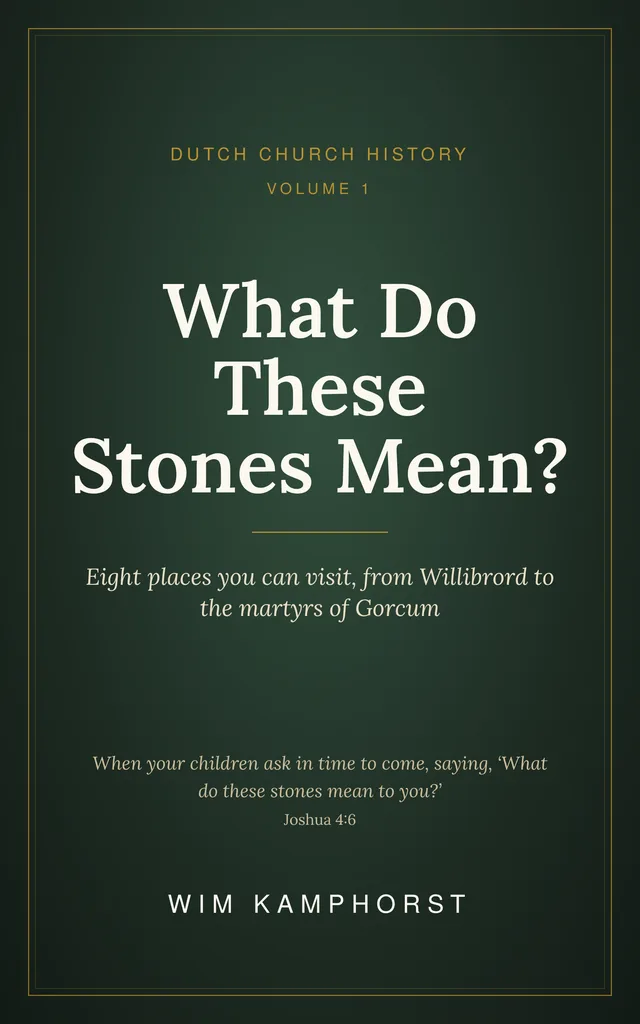
What Do These Stones Mean? volume 1
Dutch church history in places you can visit
Eight places you can visit, from Willibrord to the martyrs of Gorcum.
Introduction: stones that tell a story
When the people of Israel had crossed the Jordan, twelve men each had to take a stone from the river. Those stones were piled up at the place where they slept that night. Joshua explained why: when your children ask in time to come, saying, ‘What do these stones mean to you?’ (Joshua 4:6). Then the parents were to tell what God had done there.
The Netherlands is full of stones like these. A square in Utrecht with lines in the paving. A spring in Dokkum. A monument in a Frisian meadow. A church in Brielle that pilgrims visit every year. You can cycle right past them. But if you stop and ask what they mean, you hear a story about people who believed, who doubted, who were persecuted and sometimes persecuted others themselves.
A history you can visit
This is the first volume of a series on the church history of the Netherlands. I do not tell that history as a row of dates, but through places you can still visit today. Each chapter begins at one of those places, as it looks now. Then we go back to the moment when something happened there that changed the church in our country. And we look at the people who were there.
The model is God’s Generals by Roberts Liardon. He shows that the history of the church is made by people of flesh and blood, with courage and with faults. That is how I want to do it too.
This volume runs from about 690 to 1572. From a monk from England who started a church in Utrecht, to nineteen priests and friars who were hanged for their faith in Brielle. In between lie monasteries, books that were read all over the world, and the first people who were burned at the stake because of the Reformation.
Facts first
Many stories go around about these places. Some are centuries old and beautiful, but not always true. A saint’s life from the eighth century is something different from an archival record. A legend about a spring that welled up is something different from an excavation.
For each chapter I have found out what is certain, what we know only from tradition or from someone’s own words, and what is uncertain. I say so in the text. After each chapter there is a short overview and then the sources, so that you can search further yourself.
Belonging to everyone
The church history of the Netherlands does not belong to one church. Catholics, Protestants, Mennonites and later evangelicals and Pentecostals all have a share in it. They have sometimes caused each other great pain. I try to tell honestly what happened, even when it hurts, and I do not take sides. The martyrs of Gorcum and Wendelmoet Claesdochter stand side by side in this book. They both died for what they believed.
A few people about whom I have already written a whole chapter in other books appear here only briefly. This book is about the places and the moments.
How you can read this book
You can read it from front to back, because the chapters are in order of time. But you can also take it with you. After each chapter, under Go and see for yourself, you will find where the place is and what you can see there. I do not include opening hours, because they change. For those, check the website of the place itself.
Perhaps you live close to one of these places and have never gone inside. Take your children along. And when they ask what those stones mean, you will know what you can tell them.
Chapter 1 Utrecht: a church in the old fort
Anyone who walks across the Domplein in Utrecht usually looks up. At the Domtoren, the cathedral tower, and at the choir of the Domkerk, the old cathedral church. Look down for once. A line of rust-brown Corten steel runs through the paving. It follows exactly the place where the wall of a Roman fort once stood. A map of the borders of the Roman Empire is engraved in the steel. Utrecht lay on its edge.
Further on you see other signs in the stones. An area of paving bricks marks the floor plan of the nave of the Dom, the long middle section that collapsed in a storm in 1674. Next to it, the outlines of two vanished buildings are marked: the Heilig Kruiskapel (Holy Cross Chapel) and the Sint-Salvatorkerk (Church of St. Salvator, the Savior). That last little church was built by an English monk, more than thirteen centuries ago. Beneath your feet, in the space called DOMunder, you can walk along the foundations with a flashlight.
That monk was called Willibrord. He came across the sea to the Low Countries in 690, and from here, within the walls of that Roman fort, he tried to win the Frisians for Christ. Utrecht calls him its first bishop. The Catholic Church in the Netherlands calls him its patron saint. We know less about his life than you might think, and part of what is told is legend. But enough has survived, even in his own handwriting and in the story that Alcuin wrote about him at the end of the eighth century, to see the man.
To see what really happened, you first have to go to the north of England.
A moon in her mouth
Willibrord was born in 657 or 658 in Northumbria, in the northeast of present-day England. Christianity was still young there. A little more than half a century earlier, the first English king had been baptized.
Alcuin, the scholar who wrote his biography, begins with the night the boy was conceived. His father was called Wilgils, a respected man who, according to Alcuin, married with one purpose: to have a child who would be a blessing to many peoples. That night his mother dreamed of a new moon in the sky, which grew into a full moon. The moon fell quickly into her mouth. When she swallowed it, her breast was full of light.
She woke up in fright and went to a holy priest. He asked her a question, and then gave his explanation. The moon that began small and grew large was the son she had conceived that night. He would drive away the darkness of error with the light of truth, and wherever he went, there would be heavenly light. Alcuin writes it down as a prophecy that later came true.
When the boy was small, his father brought him to the monastery of Ripon. How old he was exactly, we do not know. The Canon van Nederland (the official canon of Dutch history) says six or seven years old and adds that his mother had already died. In those days that was not strange. A child entrusted to a monastery in this way grew up among monks and usually became a monk himself. Willibrord ended up in Ripon, with Wilfrid of York.
Alcuin portrays him as a boy who saw only virtue there and heard only holy words. He compares him with the young Samuel: the boy grew up and found favor with God and with men. He received the tonsure, the shaved crown of a monk, and took his vows. His body was small and slight, Alcuin writes, but his mind had the wisdom of an old man.
Twelve years in Ireland
Around his twentieth year, Ripon became too small for him. He wanted to live more strictly and far away. He heard about the Irish schools, where learning flourished, and about two men who for the love of Christ had left house, land and family behind: Egbert and Wichtberct. They lived there in seclusion, Alcuin says, shut off from the world and close to God.
Willibrord received permission from his abbot and his fellow monks. Around 678 he crossed over to Ireland, to the monastery of Rath Melsigi, where Egbert was in charge. Alcuin compares him to a bee that sucks honey from flowers and stores it in the comb. He stayed there twelve years, until he was fully grown, until what Alcuin calls the full age of Christ.
Something is known about Wichtberct that later meant a great deal to Willibrord. He had gone to Frisia before. For two years he preached there without success, and then he returned to Ireland. The land where Willibrord would soon go had already seen one failed attempt.
Egbert sends twelve men
In Ireland there was an idea that sounds strange to us. Monks voluntarily left their country and their family, as a sacrifice to God. They called it peregrinatio pro Christo: living in a foreign land for the sake of Christ. It reminds us of Abraham, to whom God said: Get out of your country, From your family And from your father’s house, To a land that I will show you (Genesis 12:1).
Egbert wanted to go to the Germanic peoples on the continent himself. He did not manage it. According to the biography of Adalbert, which comes up in the next chapter, a sign from God forbade him that journey. So he sent others. First Wichtberct, who came back. Then Willibrord.
The English historian Bede, who completed his church history of the English people in 731, tells that Willibrord was the most remarkable of them. They left in 690, twelve of them, Bede writes: Willibrord and eleven companions. Willibrord was thirty-three. Alcuin writes that they were men of the same zeal, some of whom later became martyrs and others bishops. The Canon van Nederland has them come ashore at the mouth of the Rhine, where Katwijk now lies. Other writers also mention the Grevelingen, an estuary further south. No one knows for certain exactly where that boat ran up onto the beach. What is certain is where they went next.
They rested, ate something, and traveled on to the castle of Utrecht on the bank of the river. It was not yet a bishop’s city. Willibrord would establish his seat there years later.
Egbert himself never reached the peoples of the continent. Yet the work in Utrecht began with him. Paul wrote about his own work in Corinth: I planted, Apollos watered, but God gave the increase (1 Corinthians 3:6).
Pepin and the fort on the Rhine
In Utrecht ruled Radbod, the king of the Frisians, and he was still a pagan. Willibrord saw that staying made no sense. He traveled on to Pepin of Herstal, the mayor of the palace of the Franks. Pepin was not a king, but he held the power. In 689 he had defeated Radbod. Bede writes that Pepin had shortly before subdued the nearby part of Frisia and driven out the king.
Alcuin portrays Pepin as a powerful man, successful in battle and of good character. He received the monks with great respect, Bede writes, and did not want to lose such a learned man. He gave Willibrord land within his realm, where he could fight idolatry and teach the new believers. He also sent the monks to Frisia to preach there, and gave them his protection.
Here is something about Willibrord that you should not polish away. His mission traveled along with Frankish power. Where Pepin won, Willibrord could preach. Where Radbod returned, he had to flee. For the Frisians, Christianity was therefore also the faith of the enemy. That explains much of what happened later.
When Willibrord arrived in Utrecht, there was already a small church there. Around 630 the Frankish king Dagobert had it built, within the walls of the abandoned Roman fort. Under Frisian rule it had been destroyed or had fallen into decay. It was a small beginning that had already failed once.
On the feast day of Cecilia
In 692 Willibrord traveled to Rome for the first time. He asked the pope for permission and a blessing for his work, and hoped to be given relics: remains of apostles and martyrs, which were given a place in new churches.
In the meantime the brothers in Frisia chose one of their number, Suidbert, as bishop. He was consecrated in England by Wilfrid, the man with whom Willibrord had grown up.
Then Pepin took the initiative. With everyone’s agreement, as Bede writes, he sent Willibrord to Rome again, where Sergius was still pope. Pepin wanted Willibrord to receive the pope’s blessing, and with it more authority to preach. Willibrord refused. He was not worthy of that dignity, he said. Alcuin has him list the requirements that Paul sets for a bishop in his letter to Timothy, and say that he fell far short of them. The king pressed him. The brothers who were with him all agreed with the king. Willibrord saw God’s will in it and gave in, because he preferred to follow the counsel of many rather than stubbornly insist on his own way.
He left with a company and with gifts for the pope. Four days before he reached Rome, Alcuin relates, the pope dreamed that an angel told him to receive this man with the highest honor. God had chosen him to bring the light of the gospel to many souls, the angel said, and nothing he asked was to be refused him. The pope therefore greeted him with great joy. He saw in him a burning faith and deep wisdom.
In November 695 Pope Sergius I consecrated him archbishop of the Frisians. An archbishop stands above other bishops. It was a big plan for a people who hardly knew any Christians yet.
The consecration took place in the church of Saint Cecilia, a martyr of the early church, on her feast day, November 22. Alcuin names St. Peter’s, but he is mistaken. Bede puts it in the year 696. Willibrord himself wrote down the year 695, and most historians follow him. The pope gave him a new name: Clement. He clothed him in a bishop’s robe and laid the pallium on his shoulders, the band of white wool that belongs to the office of archbishop. Everything Willibrord asked for, relics of saints and objects for worship, the pope gave without hesitation. So he blessed him and sent him back to preach the gospel. Willibrord rarely used his new name.
I find that a moving detail. In 728, when he is already seventy, Willibrord writes a short note about his life in the margin of his own church calendar. He places it next to the feast days of Cecilia and of Clement, at the day of his consecration. The calendar itself was written at Echternach in the first years of the eighth century, and it still exists, in a library in Paris. It is one of the few places where we hear Willibrord himself.
Wiltaburg
After his return, Pepin gave him a permanent place. Bede calls it a place in his fort, called Wiltaburg in the ancient language of that people, and Trajectum in the Gallic tongue. The Roman fort on the Rhine became the home of the archbishop.
Here, on what is now the Domplein, Willibrord went to work. He built a church dedicated to the Savior, the Sint-Salvatorkerk. He rebuilt Dagobert’s ruined little church and dedicated it to Saint Martin. Next to the churches he founded a monastery, which later also got a monastery school.
Historians do not agree about the order. Some have Willibrord build both churches immediately after 695. An article from 1995 in the journal Madoc dates the rebuilding of St. Martin’s only after 719. Everyone agrees about the place. The later Dom grew out of that St. Martin’s. The Sint-Salvatorkerk remained standing until 1587, when it was torn down after the Reformation. The lines in the square show where it stood.
From here he went out into the region. He preached in cities, villages and fortified places, Alcuin writes, and everywhere he built churches and gathered communities of monks and nuns. Many new believers gave him the land of their ancestors. On it he built churches and appointed priests and deacons. In 731 Bede wrote that Willibrord had by then already been a bishop for thirty-six years. He calls him venerable for his great age. The old man was still alive when the English monk wrote about him.
Not a god, but a devil
What did Willibrord do outside Utrecht in those years? For that we depend largely on Alcuin. His biography is written as a saint’s life: to edify and to honor, not to give an accurate report. He wrote it more than half a century after Willibrord’s death, at the request of Beornrad, abbot of Echternach. What he tells, I pass on as he tells it.
Willibrord first went to the court of Radbod and preached to the king. Radbod received him kindly, Alcuin writes, but his heart stayed closed. Then Willibrord traveled to the Danes. Their king Ongendus was wilder than a wild beast and harder than stone, but he received Willibrord with honor. Willibrord found the people completely entangled in idolatry and took thirty boys back with him. He baptized them along the way, so that their souls would be safe if they died at sea or were attacked on the road.
On that return journey a storm drove his ship to an island between Frisia and Denmark. It was called Fositesland, after the god Fosite, whose shrines stood there. The people there held the island in deep awe. Their cattle were not touched, and you drew water from the spring only in complete silence. Willibrord waited there for days until the storm had passed. He paid no attention to its sacredness. He baptized three people in the spring, in the name of the Trinity, and had some of the cattle slaughtered for his company.
The pagans watched. They expected the strangers to go mad or to fall down dead. Nothing happened. They reported it to their king.
Radbod was furious about the insult to his god. For three days, three times a day, he had lots cast to decide who must die. The lot never fell on Willibrord, Alcuin writes, nor on his men, except for one of them. He was killed and died as a martyr.
Willibrord was brought before the king and berated. He answered calmly. The object of your worship, O King, he said, is not a god but a devil. He called on the king to be baptized in the fountain of life and to renounce the error of his ancestors. Radbod answered that his threats left the preacher cold and that his words were as relentless as his deeds. He let him go back to Pepin with honor. He was not converted.
That is how Alcuin tells it. Whether it went that way, we cannot check. Even where that island of Fosite lay is uncertain. Some think of Helgoland, others of an island closer to the Dutch coast, and Butler’s lives of the saints names Ameland. The stories do show how people thought about him a generation later: a man who, without weapons, touched what was holy to the Frisians and survived.
Another story takes place in the village of Walichrum, on Walcheren, an island in the southwest of the Netherlands. There stood an idol that people honored with vows and offerings. Willibrord smashed it, before the eyes of the man who guarded it. The priest of the idol struck him on the head with his sword. It did Willibrord no harm. His companions wanted to attack the man, but Willibrord let him go. That same day, Alcuin writes, the man became possessed, and after three days he was dead. Butler’s version has him only lose his mind.
Water from the sand, wine from a jug
Alcuin also tells smaller stories. They show a different Willibrord from the man before the king: a traveler who grows tired, gets thirsty, and deals with people who work against him.
Traveling along a coast where there was almost no fresh water, his men suffered from thirst. Willibrord had one of them dig a trench in his tent. He knelt and prayed that God would give water from the sandy ground, as He once gave water from the rock to Israel in the wilderness. The trench filled with fresh water. The travelers drank their fill and took some with them.
On another day he saw twelve beggars along the road. He had one of his companions give them a drink from his own jug. All twelve drank, and the jug remained as full of wine as it was. In Echternach, on a walk through the monastery, he found in the storeroom only a little wine in one cask. He put his staff into it and prayed. The night after, the wine rose to the brim and ran over. The steward ran after him to tell him. Willibrord thanked God and told the man to keep silent until after his death.
At a friend’s house the wine for the meal ran out. Willibrord had four small jugs brought from the travel supplies and blessed them in the name of Him who turned water into wine at the wedding in Cana. Some forty people drank until they had enough. They said that the Lord Jesus had truly fulfilled His promise from the gospel.
Not everyone was kind. A rich man struck the horses of the company when Willibrord wanted to let them rest in his meadow, and mocked the travelers. Willibrord spoke calmly. Brother, he said, do us no harm. He invited the man to drink with them as a friend. The man refused. Then Willibrord said: if you will not drink with me, then do not drink at all. The man was seized by a burning thirst that no wine could quench. The next year he sought out Willibrord, confessed what he had done and asked to be set free. Willibrord forgave him and let him drink from his own cup. The man went home healed.
Another story is about a field. Willibrord took a narrow path through the grain of a rich landowner on his way to his cell in Susteren. The field watchman cursed at him. His companions wanted to punish the man, but Willibrord held them back and turned around. According to Alcuin, the watchman fell dead on the same spot the next day, before everyone’s eyes.
And there was a convent of nuns in Trier, struck by a severe illness. Many sisters died, the rest were sick or afraid. They sent for Willibrord. He came at once, offered the mass for the sick, blessed water and had it sprinkled around the buildings and given to the nuns to drink. They recovered, and no one died anymore.
One foot in the water
In 714 Pepin died. Shortly before that, Alcuin writes, Willibrord baptized a child of Pepin’s son Charles Martel, the later king Pepin the Short. At the baptism he spoke a prophecy in the presence of his disciples. The child would be raised high and become famous, he said, and greater than all the Frankish kings who had come before him. Alcuin adds that it came true.
But after Pepin’s death Frankish power fell into confusion, and Radbod seized his chance. He reconquered the territory he had lost. According to the old accounts, priests were driven out and churches destroyed. The work of nearly twenty-five years came to a standstill. Willibrord had to leave Utrecht and withdrew to Echternach, in present-day Luxembourg. He had founded that monastery in 698 on land given to him by Irmina, a Frankish noblewoman. A medieval tradition makes her a daughter of King Dagobert, but historians consider that incorrect. Her deed of gift from Trier still exists: a vineyard in Trier, given to “father Willibrord, bishop,” for his monastery at Echternach. Later Pepin and others gave more. Echternach became the place where he often withdrew.
While Willibrord was there, another Englishman stood on the quay in Utrecht in 716. His name was Winfried. He spoke with Radbod, looked over the land, and saw that conditions were bad. After a summer without result he went home.
With Willibrord, it is this moment above all that stays with me. He was in his fifties. Everything he had built up in Utrecht was gone. Nowhere does it say what he felt, and I am not going to fill it in either. What we do know is what he did next.
A famous story goes around about Radbod. He is said to have been on the point of being baptized, with one foot already in the baptismal font. Then he asked Bishop Wulfram what had become of his ancestors, who had never been baptized. The bishop answered that they were certainly not in heaven. Radbod pulled his foot back and refused baptism.
This story comes from a legendary source from the ninth century. Willibrord plays no part in it, and historians count it among the anecdotes. But it captures something that was real. For a Frisian, choosing Christ also meant choosing against your ancestors and for the Franks. What would you have done, if you had to choose between the God of the foreigner and the graves of your father and mother?
Three years with Boniface
In 718 Charles Martel, the new strongman among the Franks, began the fight against Radbod. In 719 the Frisian king died. Willibrord could return to Utrecht. He was then around sixty, and he started again: restoring churches, appointing priests, teaching people.
In Ecclesiastes it says: In the morning sow your seed, And in the evening do not withhold your hand (Ecclesiastes 11:6). Willibrord had sown in the morning of his life. In the evening of it, he did not withhold his hand.
He received help from another English monk: Boniface. Boniface had returned after his failed summer of 716, with letters from his bishop in England and the pope’s commission to preach among the Germanic peoples. For about three years the two worked together in the Frisian region, from 719 to 721 or 722. According to Willibald, who later wrote the life of Boniface, they toppled the temples of idols and built churches. Willibrord finally asked Boniface to become his assistant bishop. Boniface did not dare to take on such a high office, he said. He pointed to his age, to his unworthiness and to his promise to the pope, and asked whether he could return to the work for which he had been sent. Willibrord let him go.
After that their ways parted. Boniface continued his work in the German lands. In 754, when he was around eighty, he was murdered near Dokkum. The next chapter is about that.
Boniface plays a part in this story in another way as well. In 753 he wrote a letter to Pope Stephen II about Utrecht. King Dagobert had given the first little church in Utrecht to the bishop of Cologne, he writes, on condition that he would bring the Frisians to the faith. Cologne had not done so. Then he relates that Willibrord, consecrated by Pope Sergius, converted the Frisians and built churches there, that he built the church of the Savior and restored the ruined church of Saint Martin, and that Willibrord had a bishop’s seat in Utrecht. That seat, he wrote, had afterward been entrusted to himself. He asked the pope to confirm Utrecht under Rome and to send him the instructions of Sergius to Willibrord. The letter is an important source, but the article in Madoc calls his presentation of Utrecht’s early history a falsification. Boniface had an interest in telling it that way. The pope’s reply has not been preserved.
Was it already a diocese?
Utrecht counts 695 as the beginning of the diocese. It is more complicated than that.
Willibrord was consecrated as archbishop of a people, the Frisians. Utrecht was his base and his church. After Boniface, an abbot, Gregory, led the monastery and the mission post. For a time there was no question of a diocese. In 777 a bishop for Utrecht, Alberic, was again consecrated in Cologne, under the authority of the archbishop of Cologne. Only in the ninth century, under Bishop Frederick, did the diocese really take shape.
I do not find that a reason to honor Willibrord any less. What he began in Utrecht lasted, even when it nearly disappeared a few times. A diocese is, in the end, a community of people. That community began in that fort.
A grave in Echternach
In 734 Willibrord withdrew to Echternach. He had handed over his seat to a coworker whom he had consecrated himself, and spent his last years preparing for eternity. He died there in 739, on November 6 or 7, at eighty-one years of age. He was buried in the church of his abbey, which he had dedicated to the Holy Trinity. His feast day has remained November 7.
Alcuin portrays him as the monks remembered him. He was of medium height, with a dignified bearing and a fine face, cheerful by nature, wise in counsel and pleasant in speech, and serious when he had to be. He sang psalms, kept vigil, fasted and prayed, and kept working tirelessly for Christ. He was generous to those in need.
At the burial, Alcuin relates, the marble sarcophagus turned out to be six inches too short for his body. The brothers grew anxious. Then the sarcophagus turned out to be exactly as much longer than the body as it had been too short. A sweet fragrance filled the church, and the monks believed that angels were present at the ceremony. A disciple who was keeping watch in prayer a little way off saw Willibrord’s soul surrounded by light, carried to heaven by angels, while they sang his praise. Many brothers also saw a wondrous light above his bed.
Almost immediately after his death he was venerated as a saint. Alcuin tells of miracles at his grave. The sick anointed themselves with oil from the lamp above his relics and were healed. Penitents who wore iron rings around their arms as a sign of repentance saw them break. The rings are still hanging there, Alcuin writes. A woman who had been paralyzed for seven years and could hardly breathe was set down beside the coffin by her family. She prayed in tears, was healed at once and walked home on her own legs. A young man who trembled and could not hold his head upright was brought to the body and healed before everyone’s eyes.
Alcuin writes less cheerfully about a deacon who stole a golden cross that Willibrord carried with him on his travels. He would not be brought to repentance by the brothers, fell ill and died badly. Before his death he confessed to some brothers where he had hidden the stolen goods. And there is a story of Abbot Aldberct, who on the death day of Wilgils, Willibrord’s father, held a meal with the brothers when there were only two jugs of wine left, one of which was already empty by noon. Aldberct urged the brothers: let us drink what we have, with joy and hope. He reminded them how Willibrord once had forty men drink from four jugs. When everyone had drunk, the jug was as full as before. Alcuin ends with praise for Wilgils, the father of such a son.
In Echternach, every year on the Tuesday after Pentecost, a dancing procession still moves through the streets, a penitential procession in his honor. In Utrecht a Willibrord procession has been held every September since 2002.
After the Reformation the Dom became a Protestant church in 1580, and it has remained one. The Gothic cathedral that rose from 1254 on the site of Willibrord’s St. Martin’s lost its nave in a heavy storm on August 1, 1674. It was never rebuilt. The rubble lay there for a long time. Only in the nineteenth century was it cleared away and were the graves moved. In 1825 the church handed the ground over to the city, and so the square between the tower and the choir came into being. Whoever goes down into DOMunder experiences that storm of 1674 in a show with light and sound, and then sees underground the remains of what stood there before the Gothic cathedral: the Roman fort, the settlement from Willibrord’s time and the older churches. Protestants and Catholics both have their own memory of this place. Willibrord belongs to both.
Bronze across from the Janskerk
Walk a few minutes north from the Domplein, to the Janskerkhof. There, on a high pedestal, stands a bronze man on horseback. He wears a monk’s habit. In his hand he holds a little church. It is Willibrord, made by the Belgian sculptor Albert Termote. The statue belongs to the commemoration of the year of Willibrord’s death, twelve centuries later, in 1939. It was unveiled in 1947.
The statue stands across from the Janskerk (St. John’s Church) and looks toward the Domplein. Cyclists have to go around it.
The little church in his hand is small. As small as Dagobert’s little church may have been, within the walls of a fort the Romans had left centuries earlier. A man from across the sea came to live there, lost it again, and came back at sixty.
When you are standing on the Domplein again, look for that line of Corten steel. It marks the edge of a world empire that had long since disappeared when Willibrord came. Within that old wall he built his little church, with the land of the Frisians before him.
Go there yourself
The Domplein lies at the heart of the old city center of Utrecht, between the Domtoren and the Domkerk. The line of Corten steel that marks the wall of the Roman fort, and the paving bricks that show the floor plans of the vanished nave, the Heilig Kruiskapel and the Sint-Salvatorkerk, can be seen at all times. Take the time to follow them on the ground.
Under the square lies DOMunder. You go down with a flashlight and see foundations of the Roman fort, traces of Willibrord’s time, remains of earlier churches and of the collapsed nave. Tickets are sold at, among other places, the Utrecht Winkel at Domplein 9, where the tours of the Domtoren also begin. For opening hours, check the DOMunder website.
The Domkerk itself, the choir that survived the storm of 1674, is a Protestant church that also welcomes visitors. For opening hours, check the website of the Domkerk. The equestrian statue of Willibrord stands on the Janskerkhof, across from the Janskerk, a short walk from the Domplein.
What is certain and what is told
Certain (several independent sources): the Roman fort on the site of the Domplein; Dagobert’s little church around 630; Willibrord’s birth in Northumbria (657 or 658), his youth in Ripon and his years in Ireland with Egbert; the crossing in 690 with eleven companions and the reception by Pepin; the journeys to Rome in 692 and 695; the consecration by Pope Sergius I on the feast day of Cecilia, with the name Clement; Utrecht (Trajectum, Wiltaburg) as his base, with St. Salvator and St. Martin; the founding of Echternach in 698 and the deed of gift of Irmina from Trier, in which Willibrord is called “father” and bishop; Radbod’s reconquest after Pepin’s death in 714 and his death in 719; Winfried’s failed visit to Utrecht in 716 (Willibald); the cooperation with Boniface from around 719 to 721 or 722 and his refusal of the bishop’s office (Willibald); Willibrord’s death in Echternach in 739; the collapse of the nave of the Dom in 1674; the demolition of the Sint-Salvatorkerk in 1587; Termote’s statue, unveiled in 1947. The note of 728 in Willibrord’s calendar has been preserved; its place next to the feast days of Cecilia and Clement is confirmed, but I have not been able to read the words themselves.
Only from later tradition or the saint’s life (Alcuin, around 796): the dream of his mother and the priest’s explanation; the placement in the monastery as a child; the pope’s dream four days before Willibrord’s arrival in Rome; the events on the island of Fosite, with the casting of lots and the killed companion, and Willibrord’s words to Radbod; the idol in Walichrum, the sword blow and the death of the guard; the journey to the Danish king Ongendus and the thirty boys; the water in the sand, the jug with twelve beggars, the wine in the cask at Echternach, the four jugs, the thirst of the rich man, the field watchman, the sick sisters in Trier; the baptism of Pepin the Short with his prophecy; the sarcophagus that was first too short, the fragrance and the light; the miracles at his grave, the broken rings, the stolen cross and the jugs of Abbot Aldberct.
Unconfirmed: the exact landing place in 690 (Katwijk, Grevelingen or elsewhere); the location of the island of Fosite (Helgoland, Ameland or elsewhere); the story of Radbod with one foot in the baptismal font, which comes from a legendary source from the ninth century; the exact order in which Willibrord built or rebuilt the two churches in Utrecht.
Interpretation and where the sources differ: Bede dates the consecration to 696, Willibrord’s own note and most historians to 695. Alcuin gives St. Peter’s as the place of the consecration; that is a mistake, it was Santa Cecilia. Whether Utrecht was already a diocese in 695 in the later sense of the word is a question among historians: Boniface’s letter of 753 is an interested source here, and the diocese only took firm shape in the eighth and ninth centuries. The death of his mother and the age of six or seven come from the Canon van Nederland; in the text of Alcuin that I read, it says only that his father brought him to Ripon. A note to the English translation of Alcuin mentions, following a letter of Boniface, an age of about fifteen before his vows, while he went to Ireland only around his twentieth year. In Alcuin the guard of the idol in Walichrum dies after three days; Butler has him only lose his mind. Whether the boys from Denmark were bought (Butler) or taken along (Alcuin) remains open. The day of his death is November 6 or 7; the years of death given in older works run from 739 to 745, and most sources follow 739.
Sources for this chapter
- Canon van Nederland, venster Willibrord
- Beda, Kerkgeschiedenis van het Engelse volk, book V, chapter 10 (CCEL)
- Beda, Kerkgeschiedenis van het Engelse volk, book V, chapter 11 (CCEL)
- Allgemeine Deutsche Biographie en Neue Deutsche Biographie, Willibrord
- Madoc, jaargang 1995, over Willibrord en Bonifatius in Utrecht (DBNL)
- Van Afra tot de Zevenslapers, lemma Willibrord (DBNL)
- Catholic Encyclopedia, Willibrord (Ökumenisches Heiligenlexikon)
- Schaff-Herzog Encyclopedia, Willibrord (CCEL)
- Butler, St. Willibrord, Confessor, First Bishop of Utrecht (EWTN)
- Cult of Saints, Oxford: de kalender van Willibrord, november
- DBNL, over het schilderij van Radboud en de legende van de doopvont
- Kerkenkijken, Domkerk Utrecht: geschiedenis en gebouw
- OKRA landschapsarchitecten, project Domplein
- DUIC, Verbouwing Domplein van start
- Tinker, archeologische beleving onder het Domplein (DOMunder)
- DOMunder
- DUIC, Op het voetstuk: Sint Willibrordus op het Janskerkhof
- Equestrian Statue, Willibrord in Utrecht
- COMECE, Saint Willibrord by Albert Termote
- Alcuin, The Life of Willibrord, vert. C.H. Talbot (Fordham Medieval Sourcebook)
- Alcuin, The Life of St. Willibrord, chapters 2 to 8 (IntraText)
- Schenkingsoorkonde van Irmina aan Echternach, Wampach nr. 10 (Formulae)
- Willibald, The Life of Saint Boniface (vert. C.H. Talbot), Fordham Medieval Sourcebook
- Letters of Boniface, letter to Pope Stephen III about Utrecht (Fordham)
- Wikipedia, Willibrord (starting point)
Chapter 2 Dokkum: the spring where the water kept flowing
On the Bronlaan in Dokkum, just outside the old center, a cast-iron pump stands beside a spring with brick edges. Behind the spring lies a semicircular brick chapel, open in the middle, with rows of benches that rise as in a theater. There are more than sixteen hundred seats. Around the chapel runs a park with winding paths and a beech hedge. Along the paths stand small prayer shelters with ceramic scenes of the way of the cross of Jesus. On a pedestal stands a stone man about two and a half meters (eight feet) tall. He holds a book above his head.
That man is Boniface. The book above his head is a legend. The water in the spring is another story: it is found in one of the oldest texts we have about him.
On June 5, 754, Boniface was murdered in Frisia, together with a group of priests, deacons and monks. He was an archbishop at the time, an Englishman who had worked on the continent for almost forty years. Dokkum has kept his name ever since, in a church on the terp, in an abbey that disappeared, in a spring that was found again and in a chapel from 1934. But what do we really know about that morning? And what was added to the story later?
It begins in England, with a boy named Winfrid.
A boy who wanted to be a monk
Winfrid was born in England around 675. Tradition names Crediton in the southwest as his birthplace, but that is a later story. What we know of his youth comes from the book of Willibald, which comes up later in this chapter. Willibald tells it like this.
Already as a child of four or five, the boy wanted to serve God. When traveling preachers came to his father’s house, he asked them how he could overcome his weaknesses. When he finally told his father that he wanted to become a monk, his father reacted harshly. He forbade him to leave and held up before him all that he could inherit. Then the father became seriously ill. His attitude changed. He sent his son to the monastery of Examchester, under Abbot Wulfhard. The boy asked for admission himself, and the monks agreed.
Later he went to the monastery of Nursling, to Abbot Winbert. There he learned grammar, rhetoric, poetry and the interpretation of the Bible, and he became a teacher himself. Willibald writes that he stayed obedient to his superiors, because no one should rule over others who has not learned to submit. Students came from monasteries for men and for women. Nuns who could not attend his lessons studied his texts on their own. He taught with lively parables, was strict and gentle at once, and treated rich and poor, free and slave with the same fairness.
He became a priest only around his thirtieth year. He had not sought it himself, but his superiors and fellow monks put him forward. As a priest he gave generously to the poor, got up for the night prayers to pray, and was hard on himself. He drank neither wine nor beer.
An Englishman with a new name
A missionary is someone who goes to tell the gospel to people who do not know it yet. Winfrid felt that this calling was for him. In 716 he crossed over to the continent. He sailed from London to Dorestad and traveled on to Utrecht, where he spoke with King Radbod and looked over the land. There was war between Charles Martel and Radbod. The churches lay in ruins and the pagan shrines had been restored. He stayed one summer, without result, and returned to Nursling.
In those days the Frisians lived along the whole coast, from present-day Zeeland to far into Germany. They had their own gods and their own holy places. They lived on terps, mounds of earth and dung that they had raised themselves to stay dry when the sea came in.
When Abbot Winbert died, the brothers asked Winfrid to become abbot. He refused and helped them choose Stephen. In 718 Bishop Daniel of Winchester gave him a letter for kings, dukes, bishops and abbots, asking them to receive the traveler hospitably, as Abraham was hospitable. Winfrid traveled over the sea and over the Alps to Rome. On May 15, 719, Pope Gregory II charged him to preach among the pagan peoples, to teach the Old and New Testaments with love and moderation, and to receive the baptized according to the Roman rite. By way of Thuringia he came to Frisia, where Radbod was meanwhile dead.
There he worked for about three years together with Willibrord, the English missionary who had been in Utrecht for years. According to Willibald, they toppled pagan shrines and built churches. Willibrord asked him to become his assistant bishop. Winfrid did not dare to accept that high office. He pointed to his age and his unworthiness, and to his promise to the pope, and asked whether he could return to the work for which he had been sent. Willibrord let him go.
In Hesse he converted the two brothers Detti and Deorulf, who were in charge at Amanaburch, and built a chapel there. He sent a messenger, Bynnan, to Rome with news and questions, and the pope called him back. Winfrid traveled to Rome, prayed at the church of Peter and wrote down his profession of faith, which the pope accepted. At the end of November 722, around the feast of Andrew, Gregory II consecrated him a bishop. The pope gave him the name Boniface, the book of church rules, and a letter placing him under the protection of Charles Martel. Boniface swore an oath that he would do nothing against the unity of the whole church.
In 723 Charles Martel wrote to the lords and officials of his realm that Boniface was under his protection wherever he went, and that whoever harmed him or his followers would have to fight it out with Charles. He sealed the letter with his ring. In 723 or 724 Bishop Daniel of Winchester wrote him advice for talking with pagans. Do not begin with arguments about the descent of their gods, he wrote. Ask instead, calmly and without giving offense, whether the world had a beginning, who governed it, and what good it did their gods that they received sacrifices.
The oak at Geismar
What Willibald tells next belongs to the best-known stories about Boniface. In Hesse lived people who had been baptized but still followed pagan rites. At Geismar stood a mighty oak, called the oak of Jupiter. Boniface decided to cut it down, in the presence of a crowd of pagans.
He set the axe in for the first time. Then a strong gust of wind rose, Willibald writes, and the tree fell. It broke into four pieces of equal length. The bystanders stopped cursing and began to believe. From the wood Boniface built an oratory, dedicated to Peter.
He went on to Thuringia and founded churches and the monastery of Ohrdruf. Monks came from England to help. In 732 Pope Gregory III made him an archbishop. In 745 he was given Mainz as his see, the city from which he governed the church over a large area. With his pupil Sturm he founded the monastery of Fulda. In Bavaria he drove out heretics and divided the land into four dioceses, and with Carloman and Pepin he carried out reforms at church councils. Much has been written about those years. In this chapter what matters is the end.
“Of one blood and one bone”
In his letters you hear Boniface himself. They tell less about miracles than about books, worries and friendship.
In 738 he wrote to the English, as a countryman and as an envoy of the pope. He asked them to pray that God would convert the pagan Saxons and receive them into the mother church. Even the Saxons said, he wrote, that they were of the same blood and the same bones as the English.
At the same time he kept asking for books. To Duddo, his former pupil, he wrote that he helped him with holy writings and works of the church fathers. From Abbess Eadburga he asked that the letters of Peter be copied for him in gold letters, to use in preaching. From Archbishop Egbert of York and from Abbot Huetberht of Wearmouth he asked for Bede’s works. To Huetberht he sent a blanket of goat’s hair.
To Bishop Daniel he wrote something more personal. He asked for the Book of the Prophets that had belonged to his old teacher Winbert, because his eyes were too weak to read small letters. That Daniel himself had gone blind, he compared with Didymus, the blind teacher of the early church: you have the eyes of Didymus, he wrote.
In 751 he wrote to Pope Zacharias about the monastery of Fulda and that he wanted to be buried there. Around 752 he asked the priest Fulrad to plead with King Pepin for his disciples, many of whom were foreigners. Without him they would scatter, he wrote, like sheep without a shepherd. He wanted Bishop Lul to succeed him. In 752 he reported to Pope Stephen that he was busy restoring more than thirty churches that pagans had burned.
An old man goes back
In 754 Boniface went to Frisia once more. He was about eighty. Why a man of that age, with an archdiocese and a network of monasteries behind him, went back to the land where he had begun as a young monk, no source says in so many words. Willibald, who wrote his first biography, describes him above all as someone who wanted to preach and baptize until the end.
Before he left, Willibald relates, he told Lul that his end was near. He asked him to finish building the churches in Thuringia, to call the people back from error and to complete the church in Fulda, where his body was to go. He also gave a practical instruction. Lul was to pack a linen cloth in which his old body could be wrapped, and put it in the chest that held his books. Lul wept. Boniface calmly went on with his business.
So a man of eighty, if we follow Willibald, did what he had begun as a young monk. Psalm 92 says of those who are planted in the house of God: They shall still bear fruit in old age (Psalm 92:14).
He sailed down the Rhine with a small company, crossed the Almere, the large inland water from which the Zuiderzee later grew, and traveled through the Frisian districts with their many waterways. He preached, tore down pagan shrines and baptized many.
Who was this Willibald? An Anglo-Saxon priest, like Boniface. He never knew him personally. He wrote his book at the request of Lul, Boniface’s successor in Mainz, and of Bishop Megingoz of Würzburg. Megingoz died in 768, so the book was written within about fifteen years of the murder. The historian Marco Mostert calls Willibald a writer who presents the martyr as an exemplary saint. You need to know that when you read him. His text is a saint’s life, a story meant to show how a saint lived and died. It is also the best source we have.
A group of his people traveled with Boniface, and Willibald names them. Eoban was there, whom he calls a bishop and connects with Utrecht. Then three priests: Wintrung, Walthere and Ethelhere. Three deacons: Hamrind, Scirbald and Bosa. And four monks: Wachar, Gundaecer, Illehere and Hathowulf. Willibald does not say how many people there were in all. Later writers speak of fifty-two companions, but that number comes from a later time.
Wintrung, Walthere, Hamrind, Scirbald, Wachar. Of most of them we know only the name. Willibald wrote those names down anyway. When the disciples whom Jesus had sent out came back, He told them to rejoice because your names are written in heaven (Luke 10:20).
A camp on the Boorne
Boniface had set a day on which newly baptized Frisians would come back. He wanted to lay hands on them, a gesture by which a bishop confirms a new believer in the faith. The people had gone home and would return on that day. He waited in a camp on the bank of the Bordne, the Boorne, a stretch of water that in those days separated Oostergo and Westergo, two Frisian districts. That is how Willibald tells it.
Here I must say something honestly. Willibald does not mention Dokkum. The historian Cas Hofstee has read his text carefully on this point. The oldest source speaks of a camp on the Boorne, on the border of two Frisian districts, and nothing more. That Dokkum is the place, we know from later sources and from what has been found in Dokkum itself. I will come back to that.
It was June 5. The Frisians he was expecting did not come. At first light an armed band came toward the camp, with spears and shields.
“Stop fighting”
What happened then we know only from Willibald. Boniface’s companions reached for their weapons. Boniface came out of his tent. He had relics with him, remains of saints that Christians of that time kept as precious, and he always carried them with him. He told his people to stop fighting. Sons, cease fighting, he said, and they were to lay down their arms. For we are told in Scripture, he said, not to render evil for good but to overcome evil by good, a thought that comes from the apostle Paul. They were to accept suffering and trust in God.
Then he spoke to the priests, deacons and monks. They should not be afraid, he said according to Willibald, of those who can kill the body but not the soul. In this he used the words of Jesus: And do not fear those who kill the body but cannot kill the soul (Matthew 10:28). He urged them to rejoice and to be ready for martyrdom.
Then they were all killed.
I have often read those sentences. Willibald was not there. He wrote down what others told him, and he wrote as someone who wanted to show a saint. Whether Boniface said exactly this, no one can check. What is certain is that the oldest memory of this man is one of someone who forbade his people to strike back. What would you have done, with a band of armed men in front of your tent and your own people with swords in their hands?
Chests full of books
What Willibald tells next is less solemn. The attackers plundered the camp. They took the chests, because they thought there was gold and silver in them. On the ships they found wine, and they drank. They quarreled over the loot. They split into two groups and killed each other.
When the survivors opened the chests, they found books. No gold, no silver, only manuscripts and sacred texts. They were the book chests of a man who had asked for books all his life. They threw them away, in the fields and in the marshes. Later, Willibald writes, the books were found again and brought to a monastery, where they are still used.
Three days after the murder came revenge. Christians from the surrounding area marched with an armed force against the pagan settlements nearby. They killed many people and took prisoners. According to Willibald, the pagans then accepted the faith they had rejected during Boniface’s lifetime.
He tells it as a victory. For a reader today it is a difficult passage. The man who forbade his people to fight was avenged with violence. Willibald does not go into that. I leave it as he wrote it.
Boniface had pointed his people to the words of Paul: Do not be overcome by evil, but overcome evil with good (Romans 12:21). He could hold back his own people. What others did after his death, he could no longer hold back.
A bell that rang by itself
The bodies went by ship to Utrecht, across the Almere, the large inland water from which the Zuiderzee later grew. There they were buried. Soon afterward monks came from Mainz, sent by Lul and led by a monk named Hadda. They wanted to take the body of Boniface with them.
In Utrecht a count said that King Pepin had decreed that the body was to stay there. Then a bell began to ring, without anyone touching it. That is how Willibald tells it. The people saw it as a sign and let the body go. Thirty days after his death it arrived in Mainz, where Lul arrived at the same moment and had the body laid in a new sarcophagus.
Willibald writes that miracles happened at his grave: the dying revived, the blind saw and the possessed came to their senses.
In England the news was soon known. Milred, bishop of Worcester, wrote to Lul shortly afterward. He called his news that his spiritual father had died a sad one, but it comforted him to believe that Boniface was now a martyr and could plead for them in heaven. He asked Lul to send an account of his venerable life and his glorious end, and he hoped that what the Bible says about believers who held all things in common would hold true for them.
In the end Boniface got his grave in Fulda, the monastery he had had founded himself. He still lies there, in a shrine under the main altar of the cathedral. The relics of Eoban also came to Fulda after 756, together with those of another companion, Adalar. Before the year 1100 those two were moved to Erfurt. In the cathedral there stands a reliquary for both from about 1350.
Of Eoban we know little else. He was probably an Englishman who had come to the continent with Boniface. Willibald calls him a bishop and connects him with Utrecht. Later lists present him as bishop of Utrecht, but the sources do not agree on that.
A horse that sank in
And then the spring.
Willibald tells the story as something he had heard from Lul, who had it from King Pepin, who in turn had it from eyewitnesses. At the place where Boniface had died, the king wanted a great mound to be raised. The water came in there at high tide, and a church and a monastery were to be built on top. When Abba, an official of Pepin, rode over that mound, the horse of one of his servants sank into the soft ground. When the animal came out, a spring welled up. The water was clear and sweet, Willibald writes, and it became a stream.
It is a miracle story at third hand. Willibald tells it with care and says who he has it from. Later the story became simpler. In Dokkum it is told as the legend of the horse of Boniface himself. In the oldest text it is the horse of a servant, years after the murder.
Fresh water at a place on the coast, where salt water kept coming in, was no small thing for the people of Frisia. You do not need to accept a miracle to understand why this spring was remembered.
The book above the head
The statue on the Bronlaan shows Boniface with a book above his head, to catch the blow of the sword. Many people in the Netherlands know that story from school. Willibald does not tell it.
The story first appears in a biography of Boniface from Utrecht. Historians differ about exactly when it was written. According to Mostert, the story comes from a lost saint’s life from Utrecht and turns up about two hundred years after the murder. In the monastery of Fulda they knew it around 975: a liturgical book from that time contains a picture of the murder, with the martyr holding a large book.
In Fulda there is a manuscript called the Ragyndrudis Codex. It is a book from the eighth century, with cuts in its edge, as if someone had hacked at it with a sword or an axe. In the eleventh century the monk Otloh of Sankt Emmeram connected this book with the story of Boniface. It was supposed to be the book with which he had defended himself.
There are two problems with this. The legend speaks of a gospel book, and the codex is not one. It contains texts against the teaching of Arius, an early heresy about who Jesus is, and other texts about the faith. The historian Petra Kehl therefore does not accept the link with the legend. Another historian, Lutz von Padberg, suggested that the book may have been damaged when the murderers fought over the loot. That would fit with what Willibald writes about the scattered books. But that too remains a supposition.
The original is kept under lock and key in Fulda. A facsimile, an exact copy, lies in the cathedral museum.
A church on the terp
How did Dokkum become the place? A later biography from Utrecht already knows of a church on the site of the murder, and a spring of fresh water. According to tradition Liudger had that church built. Liudger was a Frisian priest who from 777 worked as a missionary in Oostergo, with Dokkum as its center. In 784 the Frisians rebelled. They drove out the missionaries and set the churches on fire.
Under the Markt, the market square of Dokkum, lies a terp. Archaeologists have found remains there of memorial churches for Boniface: first of wood, then of tufa stone, then of brick, with graves around them. The terp is a protected national archaeological monument. What the people who built there believed, you can read from that succession of churches. They built again and again, on the same spot.
Mostert points to something that makes the matter less simple. At the beginning of the ninth century the area around Dokkum fell back into the old religion. Only in the eleventh and twelfth centuries was it entirely Christian. A veneration that continued without interruption could hardly have survived that, in his view. Kehl notes that there are no liturgical sources, no prayers or feast days, that show a veneration in Dokkum in the early centuries.
In the thirteenth century Boniface is certainly present in Dokkum. A chronicle from Dokkum mentions him, although it wrongly puts his death in the year 725. And between 1214 and 1216 the monk Caesarius of Heisterbach wrote about a vision of a cross in Dokkum on the day of the martyrdom.
An abbey and a church that remained
Around 1200 there was an abbey in Dokkum dedicated to Boniface. It was a double monastery of the Premonstratensians, also called Norbertines: a religious order of canons, with a section for men and a section for women. Next to the large abbey church came a parish church for the town, dedicated to Saint Martin. Work on the present Martinuskerk began early in the fifteenth century.
Until 1580, pilgrimages went to Dokkum every year. A pilgrimage is a journey to a holy place to pray there. Then the Reformation came to Friesland. Monastic life ended and the abbey was torn down. The Martinuskerk became the main church of the Protestants in Dokkum and was enlarged between 1588 and 1593. In 1751 it received a pulpit by Sjouke Nooteboom, which is still there.
For Catholics, 1580 was a loss. For Protestants it was a return to the Bible, without relics and pilgrimages. Both groups claimed their share of Boniface. I find it striking that the church on the terp has stood all those centuries and has remained in use, only by other people. Even after 1580, individual pilgrims kept coming to Dokkum for more than a hundred years.
Then it was quiet for a long time. In 1853 an old spring was found again in Dokkum, known as the Brouwersbron (the Brewers’ Spring). It was seen as the spring from Willibald’s story. Whether it is the same spring, no one can prove.
It was the time when Catholics in the Netherlands were again allowed to profess their faith openly and build churches. Around 1870 Dokkum got a new Catholic church, designed by the well-known architect P.J.H. Cuypers. That church on the Koningstraat is dedicated to Martin, Boniface and his companions. Relics attributed to Boniface are displayed there.
In 1875 there was a first revival of the pilgrimage, mainly from Friesland itself. It lasted about ten years. In 1884 a cast-iron pump was placed at the spring. In 1919 there was a bicycle pilgrimage, and in 1921 the spring was cleaned and given brick edges.
A park, a chapel and a Carmelite
In 1925 the Sint-Bonifatiusstichting (St. Boniface Foundation) was founded, with the aim of making Dokkum a real place of pilgrimage again. The foundation bought the land around the spring, the Martelaarsveld (Martyrs’ Field). The architect Wolter te Riele designed a park for processions and a large chapel. In 1926 the first national pilgrimage took place. Of Te Riele’s large chapel, only the foundations were laid.
A former pupil of Te Riele, H.W. Valk from ’s-Hertogenbosch, made another design free of charge. In February 1934 construction began, and half a year later the chapel was finished. It was given a Romanesque form, semicircular, with an open center and along the edge a covered walkway of about three hundred meters (a thousand feet).
One of the people who helped shape the place of pilgrimage was the Frisian Carmelite Titus Brandsma, about whom I write at length elsewhere. He helped think through the way of the cross in the park. He died in Dachau in 1942. In 1949 the stations of the cross were installed, with ceramic scenes by Jacques Maris. There is also a statue of Titus in the park.
In the 1960s the statue of Boniface with the book was added, made by G. Bolhuis from French limestone. In the early 1990s the park and the chapel were restored. The complex is a national monument.
Water from a pump
The pilgrimages of the years after that are in the archive of the Meertens Institute. In 1928 the third national pilgrimage to Dokkum took place, to which the Katholieke Illustratie devoted a page of photographs. In 1930 the same magazine carried a photo of girls in Frisian costume drawing water from the spring. In 1933 a bicycle pilgrimage of the North Holland cycling association rested on the Afsluitdijk. On July 9, 1939, the twenty-first bicycle pilgrimage was held. Around 1945 and around 1950, postcards show groups at a resting altar in the procession park.
According to the tourist information of Friesland, between twenty-five and forty thousand pilgrims come to the chapel every year. The Bonifatius Kloosterpad also begins at the chapel, a walking route past old monastery sites in Friesland.
I do not know whether that spring is the same as the spring of Abba and his servant. Nor do I know whether Boniface died at this place or somewhere else along the Boorne. What I do know is that on a terp in Dokkum, century after century, a church was built again for an old man who forbade his people to strike back. And that in the eighth century there was a writer who thought you ought to know that the murderers found only books in his chests.
On the Bronlaan the pump stands by the spring, with the brick edges around it. Behind the spring stands the chapel, open in the middle. Above it there is only the sky.
Go there yourself
The Bonifatiuskapel is at Bronlaan 12 in Dokkum, on the Martelaarsveld just outside the old town center. There you see the spring with the pump, the semicircular open chapel, the procession park with the fourteen stations of the cross, the statue of Boniface and the statue of Titus Brandsma. You can follow an audio tour along the way of the cross. For opening hours of the chapel, check the website of the Bonifatiuskapel Dokkum; the park and the chapel are not accessible in the same way all year round.
In the town center, on the Markt, stands the Grote or Sint-Martinuskerk (the Great or St. Martin’s Church), on the terp where the remains of the old memorial churches and the abbey lie in the ground. In summer there are organ concerts. A few minutes’ walk away, on the Koningstraat, stands Cuypers’ Catholic Bonifatiuskerk, where relics of Boniface are displayed.
Museum Dokkum has a permanent exhibition on the life of Boniface. For opening hours, check the website of Museum Dokkum. If you want to walk, you can start the Bonifatius Kloosterpad at the chapel.
What is certain and what is told
Certain (several independent sources): Boniface (Winfrid), an Englishman, worked on the continent from 716, became archbishop and was given Mainz as his see; he was murdered in Frisia in June 754 with a group of companions, among them Eoban; Willibald wrote his biography within about fifteen years, at the request of Lul and Megingoz, and did not know him personally; his grave is in Fulda; his letters have been preserved, among them those to the English about the Saxons (738), to Daniel, to Duddo, Eadburga, Egbert, Huetberht, Fulrad and the popes Zacharias and Stephen, and Milred’s letter to Lul after his death; the oath of 722 and the letter of protection from Charles Martel (723); under the Markt in Dokkum lie remains of wooden, tufa and brick memorial churches for Boniface and of a twelfth-century abbey; the abbey existed until 1580; the Martinuskerk became Protestant and was enlarged between 1588 and 1593; the pump (1884), the Bonifatiusstichting (1925), the chapel by H.W. Valk (1934) and the way of the cross (1949); the pilgrimages of 1928, 1933 and 1939; the Ragyndrudis Codex is an eighth-century manuscript with cuts in its edge, and not a gospel book.
Only from later tradition or the saint’s life: Boniface’s youth and calling as Willibald tells it (his father’s resistance, the illness, Examchester); the oak at Geismar that fell in four pieces; Boniface’s words during the attack and his ban on fighting; the instruction to Lul about the linen cloth; the plundering, the wine and the scattered books; the revenge raid three days later; the bell that rang by itself in Utrecht; the miracles at his grave; the welling up of the spring under the horse of a servant of Abba (in Willibald, at third hand); Liudger’s church on the site of the murder; the vision of the cross in Caesarius of Heisterbach.
Unconfirmed: that Boniface died precisely in Dokkum (Willibald mentions only the Boorne); the number of fifty-two companions; that Eoban was bishop of Utrecht; the book he held above his head (it comes only from a later biography from Utrecht, whose date is disputed); that the Ragyndrudis Codex is that book; that the present spring is the same as the spring in Willibald; the legend that it was the horse of Boniface himself.
Interpretation and where the sources differ: the year of the statue of Boniface is given differently (1962 and 1965), as is that of the restoration (1992 and 1993). Whether the miracles in Willibald happened as he tells them is a question of faith; the text shows what the people around Lul told about Boniface. Willibald himself gives the year of death as 755 and mentions a term of office of thirty-six years, six months and six days; that calculation does not fit with the consecration in 722, and Fulda holds to 754, as do most historians. The English translation I read has unclear passages in a few places. About his years in Frisia: in 716 Winfrid stayed only one summer in Utrecht, after that he worked from 719 to 721 or 722 with Willibrord. Mostert mentions six years between the murder and Willibald’s book; the limit of about fifteen years comes from the death of Megingoz in 768. The testimonies of pilgrims themselves, such as girls with water from the spring in 1930, appear only as captions to photographs and cannot be checked further.
Sources for this chapter
- Willibald, The Life of Saint Boniface (vert. C.H. Talbot), Fordham Medieval Sourcebook
- Marco Mostert, bijdrage in Madoc, jaargang 1995 (DBNL)
- Marco Mostert, “Het bloed der martelaren”, Leidschrift 20 (2005)
- Michel Aaij, “St. Boniface in Germany and the Netherlands”, The Heroic Age 6 (2003)
- Medievalists.net, “Boniface’s Booklife: How the Ragyndrudis Codex Came to be a Vita Bonifatii”
- NASSCAL, Fulda, Hochschul- und Landesbibliothek, Bonifatianus 2
- Comité Bonifatius-Dorestad 1300, over Willibald en de plaats van de moord
- Rijksmonumentenregister, complex Bonifaciuskapel Dokkum
- Rijksmonumentenregister, archeologisch monument Dokkum Markt
- Archimon, Bonifatiuskapel Dokkum
- Meertens Instituut, Bedevaartbank: Dokkum
- Kloosterlijst VU, abdij van Bonifatius in Dokkum
- Friesland Wonderland, Dokkum
- Eropuit in Friesland, kerken in Dokkum
- Eropuit in Friesland, Bonifatius in Dokkum
- Friesland.nl, Bonifatiuskapel
- Bonifatiuskapel Dokkum
- Wikipedia, Saint Boniface (starting point)
- Wikipedia, Eoban (starting point)
- Wikipedia, Ludger (starting point)
- Willibald, The Life of Saint Boniface (vert. George W. Robinson, 1916)
- The Letters of Boniface, Fordham Medieval Sourcebook
- Letter from Milret to Lul after the death of Boniface (Roman Letters)
Chapter 3 Egmond: the well by the empty grave
On the Sint Adelbertusweg in Egmond-Binnen, a village close to the dunes of the North Sea coast, lies a piece of land with trees and benches. When you step onto it, you see low walls of old stone. You can sit on them. They trace the outline of a church that stood here for centuries. At the spot where the choir once was, there is a well with a hand pump and a zinc bucket. There is a small chapel with a mosaic of a saint, and there is a statue of the same man.
People come here to be quiet. You can drink the water from the well. According to tradition it is good for those who see poorly.
About two kilometers (just over a mile) further east, on the edge of the village, stands an abbey of brown brick with high red roofs. Benedictine monks live there. Under the altar of their church, in a transparent shrine, lies a skull, pieced together from small fragments. According to research in Leiden it belongs to a man who lived around the year 700.
Between the well and the skull lie more than twelve hundred years of history. It is the story of the oldest monastery of Holland. It begins with a grave in the dunes.
A deacon from Willibrord’s company
Around the year 700, missionaries came from the British Isles to the coast of the Low Countries. The best known of them was Willibrord, who would later become the first bishop of Utrecht. He had helpers with him. One of them was called Adelbert.
What we know about Adelbert comes almost entirely from one text: the Vita Sancti Adalberti, his biography from the tenth century. It tells that he was an Anglo-Saxon nobleman who, out of a longing for God, left his family and his homeland and went to Ireland. His virtues stood out there, and people followed him. According to that text he was a levita, a deacon. A deacon is a servant in the church, who helps the priest and cares for the poor. A much later manuscript, from around 1514, calls him the son of Edilbald, king of Deira in the north of England. The abbey today presents that as tradition, and that is how you should read it too.
In Ireland lived Egbert as well, who wanted to convert the Germanic peoples but was not allowed to go himself because of a sign from God. He sent Wigbert first, who came back after a failed attempt. Then he sent Willibrord, with Adelbert and ten others. They crossed over, Pepin received them hospitably and sent them to Frisia. Of them, the Vita says, some died as martyrs and others as bishops.
About Adelbert’s character the writer is brief and warm. He was gentle and humble, and his deeds matched his words. He kept on in his spiritual struggle to the end. Jesus said: Blessed are the meek, For they shall inherit the earth (Matthew 5:5).
The core of an apple
Adelbert often withdrew to the coast, away from the crowds. In Egmond he made friends with a man named Eggo, who gave him shelter. According to the Stichting Adelbertusakker (the Adelbertusakker Foundation), the name Egmond refers to him. Adelbert baptized Eggo’s little son.
Then he told Eggo that he wanted to visit his homeland and his parents. Eggo was alarmed. He was afraid he would not see his friend again and asked when he would come back. Adelbert took the core of an apple and threw it into the fire. If these seeds sprout and bear fruit, he said, then I will return in good health, with God’s help.
Eggo’s house later burned down. On the place of the ashes stood a twig, full of blossom and fruit. The promise was fulfilled. Adelbert returned to Frisia and was received with great joy.
That is how the Vita tells it: a promise, a fire and a twig.
Miracles at a wooden chapel
Adelbert died on June 25. Around 740, tradition says, although the Vita itself gives no year of death. The people of Egmond buried him and built a wooden chapel over his grave. The Northmen destroyed that church repeatedly. According to the history told by the Stichting Adelbertusakker, they set the chapel on fire in the ninth or tenth century.
The writer of the Vita says that so many miracles happened at the grave that he cannot count them all. He picks out a few, so as not to weary the reader.
A woman named Eswar had long honored Adelbert. Pirates ravaged her region, took her possessions and left her alone and without food. Every day food washed up on the beach.
Pirates came to the harbor of the place, but a low cloud took away their sight. Their plan failed. The place was therefore named Hecmunda, a place free from enemy raids. Even pagans came to bring offerings there.
A priest, Amalat, was commanded by an angel to restore Adelbert’s ruined church at once. Three laymen had the same dream. The builders noticed that one beam was too short. The next morning it was as long as the others, or even longer.
A farmer stole a cheese that lay by the relics as a gift. When he went to take it, he bit his own fingers. His lord sent him to the relics. He was healed and, through a donation, became a serf of the church.
And after a long storm there lay a mountain of sand by the chapel. King Rorik, a pagan ruler, ordered his men to remove it. The next morning the mountain already lay more than a stone’s throw further away, through Adelbert’s merits.
These are stories from a saint’s life, written to teach something: this saint protects those who trust in him, and whoever steals from him comes to a bad end. Whether any of it happened, no one can find out anymore. They do show that the grave was a place of hope for the people on the coast. According to the introduction of the Dutch edition, the descriptions of the beach, the drifting sand and the land of Hallem would come from an eyewitness.
The same dream three times
Then comes the story that changed the place for good. This is how his biography tells it: in the tenth century, more than two centuries after his death, Adelbert appeared three times in a dream to a woman named Wilfsit. She was a nun, a woman who had given her life to God. Adelbert asked her to lay his bones, which lay deep in the ground, higher up and in sight, so that they could be venerated. He repeated the message three times, so that she could not doubt.
Wilfsit went to the count, Dirk I, the owner of the land, and he had the grave opened. Under the sarcophagus lay, as the Vita tells it, a spring of clear water. It healed many, down to the time of the writer. The cloth in which the body had been wrapped was not damaged, without any trace of decay. In chapter 21 of the Vita, a blind priest, Volmar, regains his sight at that spring.
In Hallem, as the later Egmond-Binnen was called until about 1025, Dirk had a wooden chapel built. On an appointed day the relics were carried there. Many sick people were healed, the Vita tells, the blind regained their sight and people with a faltering gait could walk again. The writer adds that Adelbert, though already in heaven, still thought of the suffering on earth and wanted his relics to be venerated.
One of the builders, Sifried, was paralyzed. When he came to repentance and did penance, he was at once healthy again and fully restored.
The Vita has one more story about Count Dirk. He was driving a wagon across a deep lake whose ice seemed thick. The ice began to crack under the weight. His companions fled and left him alone. Dirk called on Adelbert. The water came only up to his belt, and wagon and load were spared.
What are you to make of such a dream? I think it is honest to say that I do not know. I do know that in the Bible God often speaks through dreams, and I also know that saints’ lives like to use dreams. What is certain is that there is a spring. It is still flowing.
June 15, 922
Here we come to firmer ground. On June 15, 922, the West Frankish king Charles III made a gift to a count named Dirk. That charter exists. According to most readings the church of Egmond was part of the gift. Some historians doubt whether that church is really named in it.
The Egmond tradition always celebrated the transfer of Adelbert’s bones on June 15. For that reason many writers link the raising of the bones to this year. Other historians think it happened somewhat later, under another Dirk, who ruled between 928 and 939. The year 922 is therefore a strong tradition, not a certainty.
What is certain is that Dirk I founded a convent for nuns in Hallem, where they prayed for the count’s family. So at the edge of the dunes began the oldest monastery of Holland. The land was not yet called that. The sources speak of Frisia, and the counts themselves would only later be called counts of Holland.
Monks from Ghent
The son of Dirk I was also called Dirk. Around 950 Dirk II married Hildegard, a woman from Flanders. He decided to replace his father’s wooden monastery with a stone church. The nuns made way for monks from Ghent, Benedictines. According to the Vita, the nuns had had a hard time under the Frisian raids.
Building was not a matter of course. The ground around Hallem is sand, and there was no stone or lime. Dirk’s son had a stone church built anyway in honor of Adelbert, and had an artful shrine made for the relics. Then he appointed a community of monks.
Benedictines live by the rule of Benedict, an Italian monk of the sixth century. That rule orders the day around prayer, work and reading. Monks promise to stay where they are, to let their lives be shaped and to obey. An abbey is a monastery led by an abbot.
When exactly the monks came differs by source. Some name 950, others 975. For the year 975 there is a remarkable witness.
What the pilgrims left behind
The Vita tells about people who sought help in Egmond, and it names them.
Egbert, the son of Count Dirk, was a subdeacon. The day after Palm Sunday he came down with a violent fever, and he stayed ill until Adelbert’s feast on June 25. He trusted in the saint, went to high mass and was completely healed. Later he became archbishop of Trier. A daughter of the count, Erlinda, had long been blind in one eye and received her sight back.
A priest, Volmar, an Anglo-Saxon, had been blind for twenty years. He visited shrines, Rome among them, and finally came to Egmond. He washed his eyes three times with the water from the spring under the sarcophagus, and he could see again.
A viscount, Ruosekin, had promised his son to the monastery and later broke his promise. The boy became seriously ill. He recovered only when he was offered on the saint’s altar. A baby refused his mother’s milk for twenty days. His parents offered him on the altar. After that he drank eagerly. The writer sees God’s care in it.
Twice the chapel burned down, through careless watchmen. The cloth that had wrapped the holy body remained unharmed both times. The writer sees in this the power of the saint and God’s judgment on those who were careless.
And there was a story about two brothers who had killed their uncle in a quarrel over an inheritance. Full of remorse, they bound themselves with iron and went from shrine to shrine. At Nivelles, the intercession of Gertrude freed one of them. The other was commanded in a vision to go to Egmond, where his iron ring broke into pieces by itself before an image of Christ. The monks rejoiced. According to the introduction, this chapter probably comes from the monk from Mettlach who completed the Vita.
Two people on their knees
In the Koninklijke Bibliotheek (the Royal Library) in The Hague lies a book with the four gospels in Latin. It was written in the ninth century in Reims, in northern France. It is called the Egmond Gospels.
Dirk II and Hildegard gave it to the abbey. To record that gift, they had two new pictures added at the back in 975. In the first they lay the book on an altar together. In the background stands the abbey church of Egmond. According to the KB, that is the oldest picture of a building in the Netherlands. The Latin inscription says that this book was given by Dirk and his beloved wife Hildegard to the blessed father Adalbert.
In the second picture they kneel before Adelbert and ask him to plead for them with Christ. The inscription asks him to watch kindly over the welfare of these people. The KB calls these two drawings the oldest surviving pictures of people from the Netherlands.
Whoever looks at them sees a count and a countess making themselves small. They had power, land and a castle, and they had themselves drawn on their knees. You may see in this the politics that was certainly part of it too: a count with a saint on his side stands strong. But the prayer on that page is also simply a prayer.
Peter wrote: God resists the proud, But gives grace to the humble (1 Peter 5:5). What Dirk and Hildegard carried in their hearts, we do not know. We do know how they had themselves pictured: kneeling, asking for intercession.
Their son Egbert became archbishop of Trier. He had the stories about Adelbert written down. A monk from Mettlach, Ruopert, went to Egmond and wrote the Vita between about 977 and 993, the same text with which this chapter began. In the twentieth century a German historian called it a forgery. Later researchers, such as Meilink and Vis, made it plausible that it largely does date from the tenth century. That makes it the oldest narrative source about the first counts of Holland. In the closing, the writers ask for understanding for their simple style and end with a hymn of praise to Christ.
A bookcase at the edge of the dunes
Dirk II died on May 6, 988. He was buried in the abbey, like his father and later counts.
In the eleventh century Abbot Steven led the abbey for almost fifty years. The library grew. According to the abbey, Egbert of Trier donated about eighty books. The abbey also served as the count’s chancery: his documents were written here.
History was written in Egmond too. The Egmond Annals are a list of years with short reports on what happened. They run from the year 640 to the end of the twelfth century. The medieval manuscript is now in the British Library in London. When exactly the annals began is still an open question among scholars. Between 1322 and 1332 the Egmond monk Willem Procurator worked them into his own chronicle.
So a monastery in the dunes became a memory. Much of what we know about the first counts of Holland comes from what was written down here.
In the twelfth century Countess Petronilla, who ruled for her young son Dirk VI, had a larger church built. A stone tympanum from the front, the semicircular field above the door, now hangs in the Rijksmuseum in Amsterdam. Building also took place on the field. According to the Stichting Adelbertusakker, a little church was built again over the well in 1113, and its key was kept in the monastery. Later a church of tufa stone stood there.
A castle next to the monastery
In 1129 the knight Berwout of Egmond built a castle close to the abbey. The count had appointed him as advocate: he was to protect the abbey and collect the rents. So began the House of Egmond, and a struggle that would last centuries. Lords and abbots quarreled over money, land and power. According to the abbey, their quarrels reached all the way to Rome.
In the fifteenth century abbots called for stricter discipline and poverty, as Benedict had intended. In the sixteenth century Abbot Meinard Man had the buildings thoroughly restored. In 1561 the abbey became the table property of the new bishop of Haarlem. The abbey’s income from then on went to the bishop, who also became abbot of Egmond.
A chronicle attributed to Anthonius Hovaeus gives a view from the inside. Hovaeus was a monk in Egmond and later became abbot of Echternach, the abbey where Willibrord is buried. He died in 1568. The manuscript of it that has been preserved dates from the seventeenth century. It calls Adelbert an apostle of Holland, tells that he baptized a king and had a disciple who started a school in Schoorl, and puts his death in 740. It also tells of an abbot Steffanus, who forgave a thief who had stolen three barrels of butter. He had him given three mudden of wheat, for butter without bread is poor food.
It was an abbey with a long breath. It would exist for another twelve years.
May 1, 1567
In the Netherlands resistance was growing. Protestants were persecuted, and discontent with the Spanish government under King Philip II increased. In 1566 the Iconoclastic Fury swept through the country. A year later the Duke of Alva came with an army to restore order.
On May 1, 1567, Protestant rebels came to Egmond. According to the abbey, they had been driven out of Amsterdam. The Stichting Adelbertusakker calls them Geuzen (Beggars), from the group around Hendrik van Brederode. They robbed the abbey of its valuables and took a monk hostage.
In 1568 Lamoraal van Egmont, from the family of the castle next to the abbey, was beheaded in Brussels on Alva’s orders. His death belongs to the unrest that led to the Eighty Years’ War.
In 1572 Holland took the side of William of Orange. Dirk Sonoy became governor of the Noorderkwartier, the region north of the IJ. According to the Stichting Adelbertusakker, that year he occupied and plundered the abbey with his Geuzen.
Smoke over Hallem on June 7, 1573
On June 7, 1573, the end came. Sonoy had the bells taken from the tower, a brewing kettle and six thousand pounds of lead from the roofs. Then the buildings were set on fire. The castle and the little churches in the surrounding area also went up in flames that day, the church on the field included.
Why? The Spanish army was advancing on Alkmaar. According to Christi Klinkert of the Stedelijk Museum Alkmaar, Sonoy wanted to prevent the soldiers from settling in the solid buildings. With rubble from the abbey the ramparts of Alkmaar were built up. Stones and beams went to the new line of defense, designed by the city surveyor Adriaen Antoniszoon, among others for the Kennemerpoort and the Nieuwlanderpoort. On August 21 and 22, 1573, Alkmaar was surrounded. The city held out.
Six and a half centuries of prayer ended in one day. For the Protestants in Alkmaar it was an act of survival in wartime. For the Catholics in Kennemerland it was the loss of their shrine, and for the monks of their home. Both sides suffered in those years, and both sides made others suffer. I do not have to choose here. I only do not want to forget what it cost people.
Something was also saved. The gospel book of Dirk and Hildegard turned up in 1583 in Cologne, without the wooden binding with gold and precious stones, which was never found again. In 1688 the book lay in the Geertekerk in Utrecht. In 1805 the Utrecht archivist Musschenbroek discovered it anew. A scholar who described it in 1812 saw a binding of brown leather with the year 1574, a year after the destruction. In 1830 King William I bought it for 800 guilders, and so it came to the Koninklijke Bibliotheek.
What happened to Adelbert’s bones is less clear. It is said that after the Reformation they were kept in Haarlem. I have not found a good source for that.
Ruins for painters
The walls stood for a long time. Between 1655 and 1660 Jacob van Ruisdael painted the ruins, and other painters also came to Egmond to capture them. In the nineteenth century the lord of Egmond had the last remains cleared away.
Of the old abbey almost nothing is left above ground. Only a piece of wall. The rest is in the ground, and that ground is protected as a provincial monument. In 2019 a geophysicist, commissioned by the province of Noord-Holland, walked across the site with ground-penetrating radar, searching for the walls of the oldest abbey of Holland.
People kept coming to the well on the field. In 1857 Professor J.A. de Rijk drew the well on the spot. In the eighteenth century the water, according to tradition, was used to heal sick cows. The faith of the region could not simply be burned away.
In the nineteenth century there were plans to rebuild the abbey. They met with a lot of resistance. According to the abbey, the old grounds, with the field, were quietly bought up.
Back after 362 years
In 1933 the rebuilding began. The initiative came from the Benedictines of the Sint-Paulusabdij in Oosterhout, in Brabant. That year the architect A.J. Kropholler made a design, next to the place where the old abbey had stood. In 1934 and 1935 the first wing and the gate went up.
In 1935 the first brothers and priests from Oosterhout came to live in Egmond. After 362 years there were again monks living by the rule of Benedict.
It did not stay quiet. From 1942 to 1945 the German army requisitioned the monastery. According to the abbey, one brother and two priests stayed behind. After the war building continued. Between 1947 and 1950 the abbey and the cloister were completed. In 1954 came the church, designed by B.J. Koldewey, a pupil from Kropholler’s school. In the 1950s more than forty monks lived there.
The motto of the community is Deo vacare: to be free for God.
It brings to mind Mary at the feet of Jesus, while Martha was busy. Jesus said: But one thing is needed, and Mary has chosen that good part, which will not be taken away from her (Luke 10:42). It is the motto of men who arrange their day around prayer.
There is a verse in the book of Joshua that gives this book its title. The Israelites set up stones at the Jordan, so that their children would later ask: What do these stones mean to you? (Joshua 4:6). In Egmond there were no stones left. There was a well, a field and a memory. In 1935 monks from Brabant came to live on that spot, and they built again.
A skull of fragments
In 1983 a narrow strip of parchment from the second half of the tenth century was found in the parish church of Egmond-Binnen. In Latin it says: “Here rest the limbs of Saint Adalbert, confessor of Christ.” The strip had probably been laid with the relics in 975, when they were placed in a new shrine after a fire.
Researchers studied the bones and determined the age of the skull. It turned out to belong to a man who lived around 700. Whether it is really Adelbert, no laboratory can say. The date does fit the story.
On June 26, 1984, a procession carried the relics from the field to the abbey. So Adelbert’s bones made the same journey for the second time, from the grave in the dunes to the monastery in Hallem. Since then the reconstructed skull has rested in a transparent shrine under the high altar, together with the strip of parchment.
Every year on the Sunday around June 25, Adelbert’s feast day, a mass is celebrated on the field.
The devotion never entirely went away. In 1924 the Katholieke Illustratie carried a plan for a new chapel on the field. In 1927 the same magazine showed people drawing water from the well, under a headline about the trust of the people of Kennemerland in Adelbert’s intercession. In 1934 a page of photographs followed on the reviving veneration. A Dutch researcher of Old English who wrote about it in 2015 saw three wooden statues at the entrance, found the well still in use and let his dog drink from it. The water is also used at the abbey: Brouwerij Egmond brews, under license from the abbey, the organic beer Sancti Adalberti with water from the well, the only Dutch Benedictine abbey beer.
What would you see if you stood there? A bit of superstition, or a place where people sought God for twelve hundred years? Perhaps both. The well asks no questions.
On the Sint Adelbertusweg the well stands between the low walls. Whoever pushes the handle down gets water from the ground where once a grave lay. Behind the field the dunes begin.
Go there yourself
The Sint-Adelbertabdij lies on the Abdijlaan in Egmond-Binnen, on the edge of the village, in the municipality of Bergen in Noord-Holland. The abbey itself is not open to visitors, but the abbey church is: you can attend the prayers of the monks or sit in silence. Under the altar lies the shrine with Adelbert’s relics. There is an abbey museum about the medieval abbey, with finds from the ground and an old reliquary, and a mausoleum with the grave of a count of Holland. In the abbey shop on the Vennewatersweg, candles from the abbey’s own candle workshop are sold, among other things. For opening hours, check the website of the Abdij van Egmond.
Kropholler’s complex, with the gate, the monastery farm and the vegetable garden, has been a national monument since 2001. The site of the old abbey lies next to it and is protected. Digging and treasure hunting are forbidden there.
The Adelbertusakker lies about two kilometers further west, on the Sint Adelbertusweg next to number 31, against the dunes. There you see the well with its hand pump, the wall remains of the medieval church, and the small chapel with a mosaic and statues, among them one of Adelbert. The field is maintained by the Stichting Adelbertusakker and is the start and end point of the Monnikenpad (Monks’ Path), a walk around Egmond-Binnen.
The gospel book of Dirk and Hildegard is the property of the Koninklijke Bibliotheek in The Hague. You can view the two pictures online in the KB’s digital collection.
What is certain and what is told
Certain (several independent sources): the charter of King Charles III of June 15, 922 for Count Dirk; the founding of a convent in Hallem by Dirk I and the change to Benedictine monks from Ghent under Dirk II; the Egmond Gospels with the pictures of Dirk II and Hildegard from 975; the writing of the Vita Sancti Adalberti in the years between about 977 and 993 at the request of Egbert of Trier; the Egmond Annals (640 to the end of the twelfth century); the building of the castle in 1129; the plundering of May 1, 1567; the destruction by Sonoy on June 7, 1573; the rescue and later fortunes of the gospel book (1583 Cologne, 1688 Utrecht, 1830 purchase by William I); the rebuilding from 1933 and the arrival of monks from Oosterhout in 1935; the requisition from 1942 to 1945; the church of 1954; the parchment strip of 1983 and the transfer of the relics on June 26, 1984; the photographs and reports in the Katholieke Illustratie from 1924, 1927 and 1934; what can be seen today on the field and at the abbey.
Only from tradition or the saint’s life: that Adelbert was a companion of Willibrord and a deacon; his royal descent (only from a manuscript of around 1514); his year of death around 740 (the Vita gives only the day, June 25); the story of the apple core with Eggo; the miracles of Eswar, the cloud over the harbor, Amalat’s beam, the thief with the cheese and King Rorik’s mountain of sand; Wilfsit’s triple dream; the springing up of the well at the opening of the grave; the healings of Sifried, Egbert, Erlinda, Volmar, Ruosekin’s son and the baby; the rescue of Count Dirk on the ice; the iron ring that broke; the healing power of the water.
Unconfirmed: whether the raising of the bones really took place in 922 or later under another Count Dirk; the exact year the monks came (950 or 975); where the relics were kept between 1573 and the twentieth century (Haarlem is mentioned, but a good source is lacking); the correct starting years of the Egmond Annals; whether the whole abbey was really destroyed in one day, June 7, 1573 (one reading of the abbey’s history questions this and speaks of a deliberate decision in the spring of 1573).
Interpretation and where the sources differ: that the skull is from a man from around 700 fits the story, but does not prove that it is Adelbert. Whether the destruction of 1573 was a necessary act in wartime or a loss that could have been prevented is weighed differently by Catholics and Protestants. The Dutch edition of the Vita speaks of food that washed ashore, not of bread, and of a man who bit his own fingers. It calls the place in Hallem a wooden chapel; the convent of Dirk I appears later in the same text. The Stichting Adelbertusakker places the translation in 922, the edition of the Vita links it to Dirk I, other historians to a later Count Dirk. The name Hecmunda and the origin of the name Egmond (Eggo) come from the Vita and the field foundation; they are not proven. A newspaper article from 1991 gives the year 1170 for the castle and a son of Berwout; the abbey itself holds to 1129. A report on a lecture also mentions permission from William of Orange for the demolition; that appears only there. The inscription with the picture of Dirk and Hildegard I read in English translation, not in Latin. The chronicle of Hovaeus is a seventeenth-century manuscript and not an original.
Sources for this chapter
- Abdij van Egmond, Geschiedenis (Abdijmuseum)
- Abdij van Egmond, Sint Adelbert, patroon
- Abdij van Egmond, The Origins of Egmond Abbey
- Abdij van Egmond, Egmond Abbey, a Provincial Monument
- Abdij van Egmond, History
- G.N.M. Vis, De Vita Sancti Adalberti Confessoris (Nederlandse historische bronnen 7, 1987), introduction via DBNL
- G.N.M. Vis, De Vita Sancti Adalberti Confessoris, text and translation via DBNL
- Koninklijke Bibliotheek, The Egmond Gospels
- Rijksmonumentenregister, complex St. Adelbertusabdij
- Stichting Adelbertusakker, Historie
- Stichting Adelbertusakker, home
- Meertens Instituut, Bedevaartplaatsen in Nederland, Egmond-Binnen
- Michel Bakker, Van Mirakelput tot Jeruzalemvaarders (bisdom Haarlem-Amsterdam, 2018)
- Thijs Porck, Adelbertusakker (2015)
- Rodi, Rust en bezinning op Adelbertusakker
- NH Nieuws, Met een grondradar op zoek naar resten van de oudste abdij van Holland (24 oktober 2019)
- Christi M. Klinkert, Het beleg van Alkmaar in 1573 (3 Oktoberlezing)
- Det Kongelige Bibliotek, GKS 624 2°: Annales Egmundenses
- Marjoke de Roos, review of Heiligenlevens, annalen en kronieken (BMGN)
- EgmondOnline, Egmond Abbey and the candle factory
- Noord-Hollands Archief, Op reis door Noord-Holland (fragment, 2025)
- Regionaal Archief Alkmaar, Kroniek van Egmond (transcriptie, handschrift met de kroniek van Hovaeus)
- Rodi, Lezing over de Abdij van Egmond
- Abdij van Egmond, The Tomb
- EgmondOnline, Egmond Abbey (kasteel en geschiedenis)
Chapter 4 Deventer: the house Geert Grote gave away
It is August 1384 and the plague rages in Deventer. Geert Grote lies sick, and around his bed stand the men and boys who have become his students. What should they do, they ask, and who will teach them now?
Thomas a Kempis, who wrote the story down half a century later, gives his answer this way. Have trust in God, dearest friends. He pointed to Florens Radewijns. They were to love and honor him as a father. Geert left little behind himself: books, a few old clothes and some worn-out dishes, as a sign of contempt for the world. On August 20, 1384, he died. He was forty-three.
On the Lamme van Dieseplein in Deventer there now stand two bronze figures. The sculptor, Karoly Szekeres of Deventer itself, calls them brother and sister. They have no names. They stand for the men and women who, more than six centuries ago, wanted to serve God here, in an ordinary house, in an ordinary town, with their hands at work.
On the same square stands the Museum Geert Groote Huis, built on the foundations of the first chapel of the Brothers of the Common Life. In a back room the life of Geert Grote is told in six display cases. In the cellar there is room for changing exhibitions.
A few streets further on, around the corner from the Broederenkerk (Brothers’ Church), the house where it all began once stood. It has disappeared. At the spot a text of Geert’s has been placed. A walking guide to the places of the Modern Devotion quotes this sentence of his: we must always do the things that lie within our reach.
It sounds simple. For a man who once had everything within his reach, it was not.
A boy from the Brink
Geert Grote was born in October 1340, in a house on the Brink, the big square in the middle of Deventer. The museum gives October 16 as the day. His father, Werner Grote, was a cloth merchant and a man of standing: alderman and mayor of the town.
Deventer was in those days a trading town on the IJssel, with great churches. The Lebuïnuskerk was a collegiate church, a church with a college of canons: clergymen who together kept the choir prayers and received an income for it. The Mariakerk next to it was the parish church of the citizens.
Around 1350, when Geert was about ten, the plague swept through Europe. His father and his mother both died of it. An uncle took charge of the boy. Geert inherited enough to pay for his studies later.
He went to the Latin school of the Lebuïnuskerk. Around the age of fifteen he left for Paris, to the most famous university of his time. After three years, in 1358, he was magister artium, master of the liberal arts. He studied further: law, theology, medicine. According to the historian Jan Romein he also delved into astrology and into what was then called the black art, books on magic.
In the years after that, Geert led the life of a scholar with connections. He taught and debated in Deventer, Aachen, Utrecht and Cologne. In 1366 he pleaded a case for Deventer before the pope in Avignon. He received two canonries: one at the Church of Our Lady in Aachen and one at St. Martin’s in Utrecht.
A canonry brought a prebend, a fixed income from church property. Whoever held such a position did not always have to do much for it. Romein estimates the income from his two prebends together at about two hundred pounds a year. From his Paris years on, Geert collected books. He had everything a clever boy from a rich family could wish for.
I want to show this clearly. Geert Grote did have something to lose: he was a church official with a handsome income, not a poor seeker.
A question in Cologne, a fire on the Brink
The road to change began, if you follow Thomas a Kempis, in Cologne. There lived a hermit to whom it had been revealed beforehand that Geert would be converted.
One day Geert stood in the city watching a show. Jan Romein writes that it was a play. A man who knew of the prophecy came up to him. Thomas gives his words like this: Why do you stand so intently watching empty things? You must become another man. Geert found that childish at first, Thomas writes. He walked on. The words stayed.
Around 1372 Geert became seriously ill in Deventer. He asked for the last sacraments, the blessing and communion that the church gives to someone who is dying. What happened then we know from the biographies that his students and their successors wrote. According to that story the priest refused him the sacraments. First Geert had to give up his books on black art.
Geert had them burned publicly on the Brink. Thomas speaks of the books that dealt with such vanities. Afterward he recovered. He gave up what he had learned about the stars and magic, and also law and medicine, because he no longer wanted to serve two masters. That is how Titus Brandsma summarizes it in an article from 1938.
One of the first biographers, Rudolf Dier of Muiden, tells something more. Geert wrote his sins on a piece of paper and instructed his students to burn it after his death. Some thought that a pity. Perhaps there was a revelation on it.
Later, opponents would reproach him for having dabbled in astrology and necromancy. Thomas has him answer that he had learned the theory of that art, but had, in his words, no dealings with the follies of magical practice.
A prior in Utrecht
An old friend played a large part in this. Hendrik Eger of Kalkar knew Geert from his student days. He was prior of the monastery of Monnikhuizen near Arnhem, a monastery of Carthusians: monks who live largely in silence, each in his own cell. In 1374 Hendrik sought him out in Utrecht.
Thomas has the prior say a sentence that stuck. Death hangs over every man, he said, and yet the day and hour of it are unknown. After those conversations Geert had made his choice. He gave up his prebend in Utrecht, and later the one in Aachen as well.
His clothes went with it. He took off his rich clothing and put on a simple robe. In town people talked: all that studying had driven him mad. Thomas relates what he answered. He had chosen to be an abject in the house of my God, he said, rather than to dwell in the tabernacles of sinners. It is an echo of Psalm 84, where the poet would rather stand at the threshold of God’s house than in the tents of wickedness. Geert made a word of his own life out of it.
Dirk Gruter, a teacher from Deventer, offered him a better cloak. Geert refused. He asked whether the man wanted to take his poverty from him. So it stands in Rudolf Dier. In his worn clothes, he said, he could conquer himself. Thomas describes a gray cloak with patches, and what those patches did: they kept the cold and the wind out. And at table with friends he said: I am not worthy to sit at meat with you, for I am a sinner beyond all men and have offended God.
Have you ever had to let go of something you had built on? For Geert it was his income, his position and a large part of his books.
A deed in September 1374
In September 1374 Geert had a deed drawn up. The document arranged that his house on the Bagijnenstraat, which he had from his parents, was from then on meant for poor women. According to the deed they were “arme luden die er Gode dynen willen,” poor people who wanted to serve God there. For himself he kept a few rooms, for the rest of his life.
The women who came to live there took no monastic vows and did not become nuns. They prayed together, cared for the sick and earned their bread by spinning, weaving and other handwork. Some worked outside the house. Thomas names a few women whom Geert helped: Elsbe de Gherne, Aleidis Dreyer, Fenelle and Beatrice. Geert himself kept his own side of the house separate from the women’s. According to Titus Brandsma, contact with them went through a hatch with a pulley. Thomas has him say that he would stop up his ears so as not to hear their voices, if he could.
Here a woman could serve God without a convent, in a house on the street, in the middle of town.
In 1379 a new deed followed, with a rule for the house. It became a sisters’ house, the Meester-Geertshuis (Master Geert’s House). Around 1394 the residents called themselves Sisters of the Common Life. Common here meant shared: they shared what they had.
It brings to mind the first congregation in Jerusalem, where neither did anyone say that any of the things he possessed was his own, but they had all things in common (Acts 4:32). In Deventer it began with a man who handed over his parental home to poor women.
Three years in a cell
Geert himself withdrew to Monnikhuizen, to Hendrik of Kalkar. On the years the sources differ: Romein has him knock only in 1377, the museum gives 1375 to 1378. He stayed there about three years, as a guest, without taking vows. He was given a cell. Thomas has him say there what Peter said on the mountain: Lord, it is good for us to be here (Matthew 17:4).
They were years of study and strict discipline. He fasted, ate no meat, kept night vigils and, according to Romein, wore a hair shirt, a penitential garment of rough cloth on the skin. A sister later told Thomas that she had touched that garment with her own hands after Geert’s death. He read the Bible and the church fathers, and Augustine was especially dear to him. In these years he wrote down a rule of life for himself, the Conclusa et proposita, resolutions and intentions. He himself did not call them vows.
According to Jacobus de Voecht, Geert came to Monnikhuizen as a penitent and left as a mystic. After about three years of study and prayer the brothers sent him out to preach.
What stands out is that he did not stay. He could have chosen a quiet life in a cell. He went back to the cities.
“I hunt for books like a miser”
Geert did not let go of books. Those on magic he had burned, but he kept collecting what brought him closer to God. Around 1377 he traveled with his friend Johan Cele to Paris to buy books. On the way back he visited the mystic Jan van Ruusbroec at Groenendaal, near Brussels. About the dates of that journey the sources differ. In Thomas a shoemaker also travels along, who was also called Geert.
Thomas tells what happened when they arrived. The old prior Ruusbroec greeted Geert by name. They had never seen each other. Geert later wrote that he was welded to this man by love and reverence. In a letter to Ruusbroec he said of himself that he hunted for books like a miser. He no longer hunted for riches. For books he still did.
Thomas quotes another sentence of his: I am ever covetous, yea, more than covetous, of books, and if he lacked them, he was useless. He wrote notes in the margin so that he could answer his critics. A hostile prelate once spoke out against what Geert had written. Geert took out his letters and said: Consider, Sirs, as these speak, so speak I.
That love of books would mark the movement after him. Geert translated the book of hours, the prayer book with psalms and prayers for fixed hours of the day, from Latin into Dutch. An ordinary woman in Deventer could now pray in her own language what until then mostly the clergy had prayed. Of that translation at least a thousand manuscripts have been preserved.
Thomas also tells how Geert did it himself with his company. He read the hours with Johannes van Zutphen and asked him: Of what thinkest thou? Understandest thou what thou readest? Johannes answered with the words of the Ethiopian court official to Philip: How can I, unless someone guides me? (Acts 8:31). Every evening the men confessed their faults to each other and pointed them out to one another. When he prayed, he lay stretched out before the sacrament and struck himself hard on the chest.
Thomas tells two more things about him that he himself heard from others. Once Deventer was attacked. Geert prayed, and a cloud rose up between the armies, after which the enemy fled. Another time he comforted a student who was sad: for thy brother is well, he said. Soon after, the brother stood at the door.
Two sermons in one day
In 1379 Geert was ordained a deacon. A deacon in the Catholic Church is a clergyman who may preach and assist at mass, but is not a priest. Romein speaks of an ordination as subdeacon, a lower rank. Geert did not want to become a priest. The bishop of Utrecht, Floris van Wevelinkhoven, gave him permission to preach in the whole diocese.
His first sermon in Dutch he gave, according to Thomas, in Amsterdam. He warned his hearers of the last judgment. And even now the ax is laid to the root of the trees (Matthew 3:10). Some were converted, others made plans against him.
He traveled through the IJssel towns, to Amersfoort, Amsterdam, Haarlem, Leiden, Delft, Gouda and Utrecht. He spoke in the language of the people, sometimes for two hours or longer. According to Thomas he often gave two sermons in one day, and sometimes a sermon lasted three hours. According to the museum the churches became too small. A young man from Deventer, Johannes Brinckerinck, often traveled with him. He asked no money for his sermons. What he had, he gave away to poor clerks, widows and maidens, and whoever slandered him, he forgave. Geert himself wrote that he accepted gifts from no one, as long as there were people who needed them more than he did.
They were sermons of repentance. He called on people to change their lives and to break with unchastity and greed. He turned against simony, the buying and selling of church offices. He came from that world himself. He knew how it worked. In December 1382 he stayed almost a month in Kampen, against Brother Bartholomew. According to Rudolf Dier the town forbade him to preach there. He then predicted that Christ would still conquer the walls of Kampen.
A woman by the hearth
Geert was fiercest about two groups in the church. The first he called focarists, after the Latin word for hearth: priests who lived with a woman although they had promised to remain unmarried. The second group were members of religious orders who kept personal property although they had promised poverty.
In 1383 Geert addressed the clergy of Utrecht with a sermon against the focarists. What they did, he called a grave sin. According to the Schaff-Herzog Encyclopedia the bishop himself had asked him to speak against concubinage.
That did not go down well with everyone. Here stood a man who was not a priest, telling priests what they were doing wrong. By the church’s own rules he was right. But being right does not make you loved. Accusations came that he held heretical ideas. Geert defended himself in a public statement, the Publica Protestatio, in which he said that he remained faithful to the teaching of the church. He submitted to the Holy See. He resolved to accept no more church income, and to fast on Wednesdays and Fridays.
He also wrote to an abbot in Altenkamp, who thought the decay in the monasteries was due to the times. That could not be, Geert wrote: the Carthusians, the Cistercians and the Norbertines had no people with private property, and with them things went well.
October 1383
His opponents found a simple way. They asked the bishop to let only priests preach, and Geert was a deacon. In 1383, in October according to Romein, the bishop withdrew the special preaching licenses. For other preachers who were not priests, the measure was later lifted again. For Geert it was not.
What did he do? He obeyed and no longer preached in public. He did appeal to Pope Urban VI, through the papal envoy William of Salvarvilla. His friends wrote to the bishop that Geert’s preaching had drawn many people away from usury and concubinage, and that he should not be condemned without warning and without anyone saying why. Salvarvilla asked the pope for a new preaching license, adding that Geert had given up all his church income. A nineteenth-century dictionary mentions that he prevented an uprising among his followers. He even considered becoming a priest after all. Whether the pope responded in time, we do not know. Romein writes that there is no certainty about that.
That choice touches me. Geert had many followers and was convinced of his cause. He thought the ban unjust and filed an appeal, and yet he submitted. He did not break with the church. The walking route past the places of the Modern Devotion in Deventer puts it this way: what mattered to him was to keep tradition and the present in balance.
A vicar at the Lebuïnuskerk
Meanwhile something was growing in Deventer that Geert had not planned in this way. One of his friends and students was Florens Radewijns, born in Leerdam and educated in Prague. One day Florens walked into the Mariakerk to hear Geert preach. Thomas writes that Florens was converted there. He gave up his canonry in Utrecht to become a vicar at the Lebuïnuskerk in Deventer, a much lower position. He hoped, he said, not to be a canon all his life, but to serve God in some lower station.
Geert himself had advised him to become a priest. Thomas has Geert say: once only did I cause a man to be ordained to the priesthood, and I believe that he is worthy.
So Florens did what Geert had done before: he exchanged a good position for a lower one. Jesus said to His disciples: Yet it shall not be so among you; but whoever desires to become great among you, let him be your servant (Matthew 20:26). Florens wore gray, patched clothes and had a tailor cut his cloak as plainly as possible. He took his turn in the kitchen and found that the prayers of the brothers gave him more than his own prayer alone.
Around Florens a community of young men formed, clergy and laymen. Together Geert and Florens provided a house where they copied books, and with that they earned their bread. In a time without printing, that was a trade. Florens prepared the parchment and supported the scribes. Later they would be called the brothers of the pen. It became the core of the Brothers of the Common Life. According to Johannes Horn, Geert thought that whoever lived together should earn his bread with the work of his hands.
Every year, on the feast day of Gregory, Florens invited poor schoolboys. He cared for the poor, the sick and lepers. His advice to his brothers has been preserved: Abide in your lowly simplicity, and Christ shall abide with you.
Geert gave the idea direction. Florens gave it a house and a form. The walking route in Deventer says it carefully: the movement was not consciously founded, it grew out of the ideas of Geert. That movement is called the Modern Devotion, a new, personal way of believing, aimed at an inner life with God and at self-denial.
A visit to a sick friend
In 1384 the plague raged in Deventer. Geert went to visit a sick friend. Engelbrecht names him Lambert Stuerman. Geert was infected. He died of the same disease that had taken his father and mother when he was a boy, and he caught it because he visited a sick friend. Jesus names exactly such visits: I was sick and you visited Me (Matthew 25:36).
Thomas tells that in his last days Geert spoke to his students. Lo! I am called of the Lord, he said, and the time of my dissolution is at hand. Augustine and Bernard, he said, were knocking at the door already. To students who had been struck by the plague he had said that they could face death with confidence. They died after their confession. He himself died on the eve of the feast of Bernard, August 20, 1384. Thomas writes that he was buried in the church of Mary, and gives his age as forty-four.
About what he said on his deathbed, there are two versions. Thomas a Kempis tells that his friends complained that they were losing their father. Geert is said to have told them to trust in God and to regard Florens as their father. Johannes Busch, another chronicler from the movement, has him say something different: that they should found a monastery with a rule approved by the church. Romein puts both side by side.
Perhaps both wishes are in it, for both happened. Florens led the brothers on. And in 1387, three years after Geert’s death, the first buildings of a monastery of regular canons, men who did take vows, rose at Windesheim near Zwolle. From it grew the Chapter of Windesheim, a union of monasteries.
Thomas also tells that Geert later saw the soul of Ruusbroec ascend to heaven, and that he had the bells rung in Deventer. A story from tradition. It says something about how his students thought of him.
In Paris the cantor William of Salvarvilla, Geert’s friend from his student days, wrote a memorial. He called him “the Great” and wrote that in knowledge Geert yielded to no one in the world. That is how a merchant’s son from Deventer got his nickname.
What remained in the manuscripts
Besides copying, the brothers and sisters made rapiaria: personal notebooks with sentences from the Bible and from other books that had touched them, to reread and ponder. Out of this circle also came The Imitation of Christ, written by Thomas a Kempis, the same man who wrote Geert’s biography. It is often called the most widely read Christian book after the Bible. What the Modern Devotion wanted is in it.
The brothers also got schools. According to The Low Countries, Erasmus and Martin Luther later sat in such schools. To draw a straight line from Geert Grote to the Reformation is too easy. What is certain is that his way of believing spread over the Low Countries and Germany, with houses in Amersfoort, Delft, Gouda and Utrecht, among other places.
In Deventer itself many of those manuscripts have been preserved. The Athenaeumbibliotheek holds about one hundred thirty medieval manuscripts. They come mainly from Deventer religious communities and from the monastery of Diepenveen, the first women’s monastery of the movement. By 2022 they had all been digitized.
The Meester-Geertshuis existed until 1592, when the town, by then Protestant, abolished the monasteries. The building stayed standing into the twentieth century. Above ground nothing is left of it. A memorial plaque hangs there.
If you go looking for Geert Grote in Deventer, you find no grave to stand beside and no house to enter. You find an inscription on the wall of a Catholic church, a text on the spot of a vanished house and a museum on the foundations of a chapel. It suits him. He gave his house away.
On the Lamme van Dieseplein the bronze brother and sister stand. They have no names. They are simply busy with their work.
Go there yourself
The Museum Geert Groote Huis stands on the Lamme van Dieseplein in the inner city of Deventer, on the foundations of the first chapel of the Brothers of the Common Life. There you see the life story of Geert Grote in six cases and a changing exhibition in the cellar. On the square stand the bronze statues of the brother and the sister. The museum also has a library on the Modern Devotion, a museum café and a shop. For opening hours, check the website of the Museum Geert Groote Huis.
Then walk to the Broederenkerk on the Broederenstraat, a Gothic monastery church that is now Catholic. On this church an inscription in memory of Geert has been placed. Around the corner, at the spot where his house stood, there is a text of his.
On the Grote Kerkhof stands the Lebuïnuskerk, where Florens Radewijns was vicar. The Romanesque crypt is the oldest part of the building. Right next to it, on the Nieuwe Markt, stands the remnant of the Mariakerk, the parish church where, according to the museum, Geert was baptized. In the Bergkwartier stands the Bergkerk, the old St. Nicholas church, which is now used for exhibitions and concerts. For opening hours, check the website of the Lebuïnuskerk, and for the Bergkerk the agenda of Deventer Verhaal.
You can view the medieval manuscripts of the Athenaeumbibliotheek online via the library’s website. The library is housed at the Klooster in Deventer, together with Collectie Overijssel; there are plans for a new building, so check the website of the Athenaeumbibliotheek beforehand.
What is certain and what is told
Certain (several independent sources): birth in Deventer in October 1340, son of Werner Grote; death of both parents from the plague around 1350; study in Paris and two canonries (Aachen and Utrecht); serious illness around 1372; renunciation of his prebends and the gift of his house to poor women in September 1374 (the day is September 20 according to Romein, September 21 according to Engelbrecht); stay as a guest with the Carthusians of Monnikhuizen (the years differ: from 1377 according to Romein, 1375 to 1378 according to the museum, 1374 to 1378 according to Koekkoek); ordination as deacon and preaching license in 1379; the sisters’ house (Meester-Geertshuis) from 1379; sermons of repentance in the towns of the diocese, against focarists and members of orders with private property; sermon to the Utrecht clergy in 1383; the preaching ban of 1383, Geert’s obedience and his appeal to the pope; the community around Florens Radewijns; the translation of the book of hours; his death from the plague on August 20, 1384 after a visit to the sick; Windesheim in 1387.
From the biographies of his students (Thomas a Kempis, around 1434, and Rudolf Dier of Muiden): the hermit and the man in Cologne; the words of Prior Hendrik in Utrecht; what Geert said when the town called him mad; the cell in Monnikhuizen; the gray cloak with patches and the cloak offered by Dirk Gruter; the visit to Ruusbroec and the greeting by name; the first sermon in Amsterdam; the conversation with Johannes van Zutphen; the cloud over Deventer; the comfort given to the student; his last words; Florens’ conversion in the Mariakerk and Geert’s remark about his ordination; Geert’s sins on paper (Dier). These are stories of people who knew him or heard them from eyewitnesses. They have not been checked by independent sources. I read Thomas through the English translation of J.P. Arthur (1905, The Founders of the New Devotion) and through summaries and introductions; where Arthur’s wording was not at hand for a sentence, I have retold it without quotation marks. The burning of his books on the Brink and the refusal of the sacraments come from the same circle; The Low Countries writes that the historical value is uncertain. The story that Geert saw Ruusbroec’s soul ascend to heaven is tradition.
Only from one source: the birthday of October 16 and the baptism in the Mariakerk (only the museum); the memorial of the cantor William of Salvarvilla with the nickname “the Great” (Thomas a Kempis); Geert’s stay of almost a month in Kampen in December 1382 (Romein) and the preaching ban there (Dier); the hatch with a pulley (Titus Brandsma); the address in 1383 at the bishop’s request (Schaff-Herzog); the letter to the abbot of Altenkamp (Post); the remarks about his worn cloak, in Dier.
Unconfirmed: that the priest who refused the sacraments was from the Sint-Nicolaaskerk (Bergkerk) (one researcher, Wilken Engelbrecht; the museum speaks of “the pastor”); the name of the sick friend, Lambert Stuerman (one source); the journey to Ruusbroec (1377 according to the museum, 1378 according to Van der Aa); the month of October for the preaching ban (one source); whether the pope still lifted the ban; the discovery of his remains in the house of Florens in 1697 (only a nineteenth-century dictionary; Thomas mentions only the burial place in the Mariakerk); when the Meester-Geertshuis disappeared (a database of monasteries names the bombing of 1945, a review of a Deventer study book speaks of demolition in the 1960s). Thomas gives Geert’s age as forty-four; from his birth year 1340 it follows that he was forty-three. A fixed annual Geert Grote commemoration I have not been able to confirm; the six hundredth anniversary of his death was marked in 1984 with a study book.
Interpretation: the Modern Devotion was not founded by Geert as an organization. His students, above all Florens Radewijns, gave form to what he began.
Sources for this chapter
- Jan Romein, Erflaters van onze beschaving, chapter Geert Groote (DBNL)
- Van der Aa, Biographisch woordenboek, lemma Groote (DBNL)
- Wilken Engelbrecht, “War Geert Grote in Prag?” (1992)
- The Low Countries, “Geert Groote”
- Museum Geert Groote Huis, timeline
- Museum Geert Groote Huis, Wie was Geert Groote?
- Museum Geert Groote Huis, Wat is er te zien
- Museum Geert Groote Huis, Beelden op het Lamme van Dieseplein
- Thomas a Kempis, Leven van Geert Grote, translated by Frank de Roo (excerpt)
- Jacques Koekkoek, introduction to De navolging van Christus (excerpt)
- Literatuurgeschiedenis.org, Moderne Devotie
- Monasteries Geoplaza (VU), Meester Geertshuis Deventer
- Wandeling Moderne Devotie in Deventer (theologie.nl)
- BMGN, review of Vernieuwde innigheid (2008)
- Archimon, kerken in Deventer
- Archimon, Lebuïnuskerk Deventer
- Meertens Instituut, Bedevaartbank, beelden Geert Groote Deventer
- Museum.nl, Bergkerk Deventer
- Lebuïnuskerk Deventer
- Universiteit Leiden, nieuwsbericht Athenaeumbibliotheek (2022)
- Medieval Manuscripts in Dutch Collections, Stadsarchief en Athenaeumbibliotheek
- Gemeente Deventer, nota Collectie Overijssel (2024)
- Clemens M. Hogenstijn, Deventer als bakermat van de Moderne Devotie (Thijmgenootschap)
- Museum Geert Groote Huis, homepage
- Thomas a Kempis, Life of Gerard Groote, in The Founders of the New Devotion (J.P. Arthur, 1905), CCEL
- Schaff-Herzog Encyclopedia, Groote (CCEL)
- Post, The Modern Devotion (DBNL)
- Titus Brandsma, excerpt on Geert Groote (Titus Brandsma Instituut)
- Bible.com, Handelingen 8:31 (NKJV)
- Bible.com, Mattheüs 3:10 (NKJV)
- Bible.com, Mattheüs 17:4 (NKJV)
Chapter 5 Zwolle: the monk who wrote a book about following
On Whit Sunday, June 4, 2006, an open car drives through Zwolle. In the back stands a painted shrine. The car is headed for a hill outside the city, where a monastery stood centuries ago. There the relics are set down in front of a memorial stone, on a white child’s bier. Students from the Theological University in Kampen read passages from The Imitation of Christ in several languages. They also read the page from the monastery’s chronicle about the death of the man in the chest. A theologian speaks about what his work means. Many people of Zwolle walk along, writes Bert Pierik, and even more townspeople stand along the road to watch. A delegation from Kempen is there too, the little town in the Rhineland where the man came from.
Later that day the shrine stands in the Onze Lieve Vrouwebasiliek (the Basilica of Our Lady), beneath the tower that the people of Zwolle call the Peperbus, the Pepper Pot. It is seventy-five meters high and belongs to a church that received the title of basilica from Pope John Paul II in 1999, when the building was six hundred years old. In the Catholic Church, a basilica is an honorary title for a church of special significance.
In that shrine lie the bones of a monk who died more than five hundred years ago, on the hill outside the city. He was never a bishop or a prince. He was a copyist, a master of novices and the writer of one small book that went around the world.
His name was Thomas Hemerken. The world knows him as Thomas a Kempis.
To understand why his bones are here, you have to go back to a boy from the Rhineland who followed his brother.
A boy from Kempen
Thomas was born in 1379 or 1380 in Kempen, a small town in the diocese of Cologne. That is where his nickname comes from: a Kempis, from Kempen. His parents were called Johannes and Gertrud. According to a nineteenth-century biography, they were not rich and lived from the work of their hands.
Thomas had an older brother, also named Johannes. He had already traveled west, to Deventer. There he had come into contact with the circle around Geert Grote, the Deventer preacher who has his own chapter in this book. From that circle a movement had grown that was later called the Moderne Devotie, the Modern Devotion: a renewal of faith that centered on a simple, inner life with God, on reading the Bible and on ordinary work. Its followers lived together in houses of brothers and houses of sisters. They were called the Brothers and Sisters of the Common Life.
Johannes became a canon, a clergyman who lived with others in a monastery under the Rule of Augustine. Around 1392 Thomas, twelve or thirteen years old, also came to this region. In Deventer he went to school. According to an introduction to one of his books, his brother handed him over with a letter of recommendation to Florens Radewijns, Geert Grote’s successor as leader of the brothers in Deventer. Thomas stayed about seven years.
An old biography says that in those years he copied books to earn some money, and that he gave the money to the brothers. In a time without printing, copying was the only way to multiply a book. The same biography also tells of a dream in which Mary is said to have rebuked the boy because he neglected his prayers. It is a legend, the kind that lives of saints like to tell.
In his own chronicle the schoolboy appears briefly too. He writes that he fell ill in those days and that Everard of Eza took care of him. What kind of illness it was, he leaves unsaid. He only names the man who helped him.
What is certain: in Deventer Thomas came to know the brothers’ way of life. He would never let go of it again.
A mountain where Geert held back the wind
Meanwhile something new had begun near Zwolle. Thomas tells it himself, in the chronicle of the monastery that he kept until shortly before his death. The first chapter is about Geert Grote, who walked with a small group of followers to a mountain, the Nemelerberg. On the way he promised them that he would walk ahead of them and keep the wind off them with his cloak. When the men suggested a valley, he refused. Too low, too narrow. He showed them an open, sunny spot on the south side.
So it stands in his chronicle. It began in 1386 with a little house of logs and clay, under a thatched roof, on a piece of land that the landowners had given up.
The first leader was Johannes of Ummen, a man who had been blind from his youth. Thomas describes him as strict and sharp of mind. When a brother resisted, Johannes said that the door was open, and whoever wanted to leave should go. Another brother, Reyner, came back late from his watch by the reeds and said he had wanted to keep something from being stolen. Johannes answered that he would rather have seen the animals carry everything off, if only Reyner had come in with the others. Geert Grote had sent people to him, Thomas writes, telling them to go to blind Johannes of Ummen and do what he told them.
It was a poor life. Gerard, the cook, worried about the next day’s food. Then Everard of Eza arrived unexpectedly with flour and meat, and the brothers caught bream in the Vecht. One of the two cows died, but the other gave enough milk for everyone. Once a brother got a scolding from an old woman. He said kindly, Good woman, tell me freely what I am doing wrong, and rebuke me hard. She felt ashamed and grew calm. When someone asked Johannes why poor people wanted to build a monastery, he answered that poverty is the cause of all good, and the means by which that good grows.
In 1395 the chapel was consecrated, on the eve of the feast of John the Baptist. In 1398, on the Annunciation, the first four brothers in Westerhof received the monastic habit: Egbert of Lingen, Wolfard, Johannes of Ummen, a clerk from Kampen, and Dirk of Kleef. Thomas sees the four evangelists in the number four. That summer the plague raged, and in some cities twenty or thirty people were buried every day.
That group from the Zwolle brothers’ house had decided to become canons. They joined the chapter of Windesheim, a union of monasteries that had grown from Windesheim near Zwolle. The bishop of Utrecht, Frederick, allowed them to return to the mountain. In September 1398 they moved to the hill outside the city and dedicated their monastery to Saint Agnes. From then on the hill was called the Agnietenberg, Mount Saint Agnes.
Geert Grote had once told Wolfard, one of the four, that he would know two conversions. In 1401 Wolfard went to help the plague-stricken brothers in Northorn. He left the mountain and died there within a few days.
The prior of the new monastery, the leader of the house, was Johannes Hemerken. Thomas’s brother.
I came to Zwolle for the indulgence
The new prior carried the mud himself. Thomas writes that his brother had the church walls built, had an orchard planted and worked with his own hands, carrying mortar and digging. The brothers copied books to sell. Godfrey of Kempen, a skilled scribe, made a missal and three antiphonaries. When Hendrik of Deventer ended up under the mortar, he said that nothing was wrong, and that no one should worry.
In 1399 Thomas enters his own chronicle. He writes in the first person. He, Thomas of Kempen, a scholar at Deventer, born in the diocese of Cologne, came to Zwolle to obtain an indulgence. An indulgence was a remission of punishment for sin that the church granted to pilgrims. Then he went on to the mountain. He was received, he writes, with mercy. He was nineteen or twenty.
As a canon he did not come in right away. Only in 1406, after a trial period of more than five years, did he receive the habit, the monastic robe. The chronicle names Thomas Hemerken of Kempen that day among those clothed, as the brother of the first prior. A year later he took his vows. In 1413 he was ordained a priest, the year after the monastery church had been consecrated. That was on April 8, 1412, by an auxiliary bishop.
More than five years of waiting. Would you hold out that long, for something you are sure God is calling you to? Thomas did, and he stayed there for the rest of his life. Until his death he lived on the Agnietenberg for about seventy-two years.
It was a house full of people whom he wrote down. In 1410 a young brother, Nicolaas Kreyenschot, asked the subprior to punish him hard for his faults. He died eight months and ten days after his vows, about twenty-three years old. Conrad the tailor died hoping that his work on the brothers’ clothes had also washed his own sins clean. Riquin, a layman who served in the monastery, asked to die on a feast day, in the midst of the brothers. His three wishes were granted. In 1436 Brother Alardus said on his deathbed that the best dish set before him in the refectory was the Holy Reading. In 1441 Christiaan, who nursed the sick, died of the plague himself. The chronicle says he was very attentive to the sick, and that the plague in the monastery stopped afterward.
The work of the pen
What did a canon on the Agnietenberg do all day? He prayed the hours, the fixed services of prayer at fixed times. And he worked. Thomas’s work was mainly writing and copying.
He copied a large missal, and works of Bernard of Clairvaux, the twelfth-century monk he read often. He copied out the whole Bible, in four large volumes, and these have been preserved. According to later encyclopedias he did so more than once, and one of those Bible manuscripts now lies in Darmstadt in Germany. The chronicle of his own monastery puts it this way later: he wrote the complete Bible that they used in the monastery.
When I read that, I can picture it. A person sits at a desk for years and writes out, letter by letter, the book he loves most. Whoever handles the Bible like that knows it from the inside. You can tell in everything Thomas later wrote himself.
For he wrote on his own too. Sermons for novices, the young men preparing for monastic life. Prayers and meditations on the life of Christ. A biography of Lidwina of Schiedam. Lives of the men who had shaped him: Geert Grote, Florens Radewijns and others from the first generation of the movement. And until a few months before his death he kept the chronicle of his own monastery.
People who knew him described him. He was small of stature, but well formed. His face was dark and yet lively in color. He had, so the biographical sketch of 1887 tells, such sharp eyesight that he needed no glasses until his last hour. He was known for his gentleness and kindness. According to the Catholic Encyclopedia, he had time for those who were grieving, and in conversation he was mostly silent, unless it was about God or the soul. Then he spoke eloquently.
A saying of his has been preserved, which he often said and wrote: Everywhere I have sought rest, and nowhere have I found it, except in a little corner with a little book.
Another detail is told in the same sketch. When he sat among his fellow brothers and heard the voice of God within himself, he politely asked leave to go. He made it look as if someone was waiting for him in his cell. That way he could speak undisturbed with his Creator. The story cannot be checked. It fits the man who writes in his book: Close the door behind you and call Jesus, your beloved, to you. That is my own rendering of the twentieth chapter of the first book.
Four little books for young brothers
In those years, somewhere between about 1418 and 1427, Thomas wrote four short writings about the inner life with God. The last part is about the sacrament of the Eucharist, the Lord’s Supper. Later they were brought together under the title of the first part: De imitatione Christi, The Imitation of Christ.
The book begins with a word of Jesus from the Gospel of John. In the NKJV it reads: I am the light of the world. He who follows Me shall not walk in darkness, but have the light of life (John 8:12). Thomas quotes only the second part and builds the whole book on it. He who follows Me. Imitation means here: letting your life be shaped after the life of Jesus.
It is a sober book. Short chapters, short sentences. It is full of words from the Bible and thoughts of church fathers like Augustine, and of Bernard. It speaks to the reader like an older brother sitting next to you. An introduction from 2013 calls the style simple and practical, aimed at inner change.
Whoever opens it finds sentences you do not lose again. In the first chapter he says he would rather feel remorse than know its definition. In the third chapter you read that on the day of judgment you will not be asked what you have read, but what you have done. The second chapter says that you should love being unknown and counted as nothing. Thomas did that himself.
For he did not put his name on it. The book went around without an author, like many spiritual texts in that time. Copyists in other monasteries wrote it out, and so it traveled from house to house.
That he left out his name fits the book, which is not about the writer but about Him who is followed. John the Baptist said of Jesus: He must increase, but I must decrease (John 3:30).
A stable in Hasselt
The quiet life on the Agnietenberg was not always left in peace. In the diocese of Utrecht a struggle arose over who could be bishop. Pope Martin V laid an interdict, a church penalty under which no regular church services may be held in a region. The chronicle of Thomas says what that meant for the brothers: they stopped singing because of the interdict.
They chose to leave rather than hold the services without song. In 1429, before sunset on the feast day of the apostle Barnabas, they left the Agnietenberg. They spent the first night in Hasselt. The sisters there gave up their own bedding, and the brothers slept on hay and straw in a stable. The next morning they hired a small ship to Friesland. They sailed with sail and with oars, against the wind. Twenty-four people from the monastery reached Lunenkerk. There they stayed three years.
Thomas himself went in those years to Arnhem, to Bethany, the house where his brother Johannes was. Johannes, the brother who had brought him to Florens as a boy with a letter of recommendation, was ill. Thomas cared for him. In his chronicle he writes about the night of November 4, 1432. His brother Johannes died at midnight, in the sixty-seventh year of his life. He had first been rector in Arnhem, then for nine years prior of the Agnietenberg and later active in Bommel and Haarlem. Thomas writes in the first person that he was with him, and that he closed his eyes. The Visitators had sent him to keep Johannes company.
Proverbs says: A friend loves at all times, and a brother is born for adversity (Proverbs 17:17). Thomas stayed with Johannes to the end.
Meanwhile, in 1432, the interdict was over. A papal envoy met the exiles in Viana, and they came back to Utrecht, glad, writes Thomas. Step by step they went home: some around the Assumption of Mary, others around Saint Michael’s Day, and a few stayed in Friesland. So the community could return to the hill.
Thomas became subprior, the second man of the monastery, and received the care of the novices. For a time he was also procurator, the man in charge of the money and business of the house. An old biography says he was relieved of it because he gave alms too easily, and that the task distracted him too much from the contemplative life and from writing. A Catholic encyclopedia from 1913 writes that he asked for it himself. However that may be, he returned to what suited him best: praying, reading, writing and guiding the young brothers. In 1448 he became subprior again.
Who actually wrote it?
In 1441 Thomas did something that means a great deal for the history of his book. He completed a manuscript of his own with the four books of the Imitation and nine smaller writings, and put his name under it. That manuscript now lies in the Royal Library in Brussels. The library owns a second manuscript in his hand, from 1456, with his meditations and his signature. At the six hundredth anniversary of the Imitation, in 2024, both were put on display in Brussels.
That signature later became important. Once the book was famous, others wanted to attach their names to it.
In the seventeenth century a fierce dispute broke out. Followers of Jean Gerson, the chancellor of the University of Paris, claimed he had written the book. Italian Benedictines put forward a certain Giovanni Gersen, an abbot in Vercelli. Whether that man ever existed has never been shown. For a moment the English mystic Walter Hilton was named too.
In 1929 a Dutch variant was added. The linguist Jac. van Ginneken argued that the Imitation was a Latin adaptation of a Middle Dutch text by Geert Grote. That claim did not hold up.
What spoke for Thomas? Contemporaries from his own monastic union named him as the writer. Manuscripts from his time carry his name, and there is that manuscript of 1441 in his own hand. The style strongly resembles that of his other works, and the book breathes the spirit of the Windesheim monasteries. Today the authorship of Thomas is hardly doubted anymore, writes the Windesheim minister Henk de Jong.
A book that went around the world
What happened to the Imitation after his death, Thomas could not have imagined. When printing arrived, the book was printed, and again, and again. The Dutch broadcaster NOS wrote in 2021 that after the Bible it was the most widely distributed book of the late Middle Ages. Henk de Jong calls it for centuries the most read book after the Bible and lists twenty-two languages into which it was translated, including Dutch and Frisian. An English-language encyclopedia speaks of more than two thousand editions.
In the Netherlands Vincent van Gogh read it too. Henk de Jong wrote a book about it, with a saying of the painter as its title: Dat boek is subliem, That book is sublime.
How can a little book written for a handful of young monks on a hill near Zwolle travel so far? Perhaps because it is so little about the monastery and so much about the heart. You do not have to be a monk to recognize what it describes: the restlessness, the pride, the longing for rest in God.
The day of Saint James
Thomas a Kempis died on July 25, 1471, on the Agnietenberg. He was about ninety-one. In some modern overviews there is confusion about his date of death, but the older reference works and the Zwolle sources name July 25. His monastery wrote about him that he had been a priest for more than fifty-seven years and had been a pupil of Florens. At the end of his life he had dropsy. The chronicle says he had copied the whole Bible that they used, and that he wrote all kinds of little books to build up the young.
He was buried in the eastern cloister walk of the monastery church, against the wall, next to Brother Pieter Herbort. We know that from the chronicle and from the report of the later excavation. According to that report he lay about three meters deep, in a chest coated with clay. The brothers probably lowered the heavy chest with ropes, writes Bert Pierik, the manager of the cemetery that now lies on that spot. He suspects it was done a bit carelessly.
A story goes around that during an excavation scratches were found on the inside of his coffin lid, as if he had been buried alive. For that reason Rome supposedly never declared him a saint. There is no reliable source for that story. I mention it only because you may come across it.
Thomas was never declared a saint. No story is needed for that either. He was a canon who stayed in the same house his whole life.
Paul asked the believers in Thessalonica to aspire to lead a quiet life, to mind your own business, and to work with your own hands (1 Thessalonians 4:11). That is how Thomas lived: more than seventy years on the same hill, pen in hand.
The year the enemy came
The monastery outlived its best-known resident by more than a hundred years. In the second half of the sixteenth century the church map of the Netherlands changed drastically. In 1561 the monastery was added to the new diocese of Deventer. After that it lost its existence, and in 1581 it was torn down. The stones were reused for the defense of the city. Bert Pierik speaks of about three million monastery bricks that went over the Vecht to Zwolle. What is still found in the ground today, he calls “the crumbs”.
The grave of Thomas stayed under the ground. Until 1672. That year France, England, Münster and Cologne invaded the Republic. According to the report that Pierik published in 2006, the elector of Cologne, Archbishop Maximilian Henry of Bavaria, ordered the remains of Thomas to be dug up. After three weeks of searching, the Zwolle pastor Arnold Waeyer found the bones. Thomas did not lie on his back, but tilted onto his right side. The remains were placed in a wooden shrine.
It is a strange thought. A country at war, a city under pressure, and meanwhile people stand for weeks in the ground of a vanished monastery, searching for the bones of a writer.
Back under the Pepper Pot
Zwolle did not forget its famous resident. In 1897 the shrine was given a place in a wall tomb in the new, neo-Gothic Saint Michael’s Church. The design came from the Mengelberg studio in Utrecht. Gifts came in from many countries, among others from Queen Emma and Pope Leo XIII. The Catholic leader Herman Schaepman gave a speech on that occasion.
In 1919 a memorial stone was unveiled on the Agnietenberg. According to Pierik it was designed by Pierre Cuypers, the architect of the Rijksmuseum.
In the 1960s the Saint Michael’s Church in the city center closed. It was demolished for a shopping center, and the wall tomb went down with it. A few parts were saved, including a sculpted head of Thomas. The shrine moved to a new Saint Michael’s Church outside the center.
So it came to that Whit Sunday in 2006. After the gathering at the memorial stone, the car drove back to the city. From the Walloon Church a procession passed places of the Modern Devotion. The dean of Salland walked along, with pastors and the guests from Kempen. The procession ended at the Onze Lieve Vrouwekerk under the Peperbus. There a vespers service was held, an evening prayer, and the shrine was given a place in a niche of the church.
Thomas now lies in a church that was built in the years when he worked on his books on the hill outside the city.
So you walk into the basilica again. You see the shrine. You see no monastery, no cloister walk, no writing room. They are all gone, absorbed into the walls of the city.
In 2021, on his five hundred and fiftieth death anniversary, the carillon of the Peperbus played songs about the monk’s life for half an hour. In the Sassenstraat a life-size portrait of him appeared on a wall. And on the site of the monastery, Bert Pierik began a small museum with the remains that were still coming out of the ground. He also collected editions of the Imitation. One of them, inlaid with gold, had belonged, he says, to Emperor Franz Joseph of Austria. His dearest piece is an old painting of Thomas on the Agnietenberg, which hung for years in a living room in Tilburg. The owners had seen an exhibition about the monk in Zwolle. When Pierik told them that he lived on the mountain in the painting, the deal was made.
Thomas himself had written about none of those things. He wrote about one thing: following Jesus, day after day, in ordinary work. The book still opens with the same words. He who follows Me.
Above the shrine hang the bells of the Peperbus.
Go there yourself
The Onze Lieve Vrouwebasiliek stands in the city center of Zwolle and can be recognized from afar by the Peperbus. In the church stands the painted shrine with the relics of Thomas a Kempis. An introduction from 2013 places it near the entrance. The church belongs to the Roman Catholic Thomas a Kempis parish. For opening hours of the church, see the website of that parish. The tower is owned by the municipality of Zwolle and can be climbed under certain conditions.
The site of the Sint-Agnietenberg monastery lies outside the city center, near the Bergkloosterweg in Zwolle. On the grounds now lies the Bergklooster Cemetery. At the side entrance of the cemetery stands the memorial stone for Thomas a Kempis. The grounds of the old monastery are an archaeological monument.
At Bergkloosterweg 92 there is a small Museum Thomas a Kempis, with remains of the monastery, foreign editions of the Imitation and a painting of Thomas on the Agnietenberg. It can be visited by appointment. For the possibilities, see the website of the Bergklooster Cemetery.
In the city center you can combine the visit with the portrait of Thomas on a wall in the Sassenstraat. Whoever wants to see more of the movement he came from can continue to Deventer, the city of Geert Grote.
What is certain and what is told
Certain (several independent sources): birth around 1380 in Kempen; school in Deventer with the brothers of Florens Radewijns; entry into the Agnietenberg in 1399, with his brother Johannes as prior; receiving the habit in 1406 and priestly ordination in 1413; his work as a copyist, among other things of the whole Bible; his offices as subprior and master of novices; the exile from 1429 to 1432 and the death of his brother in 1432; the signed manuscript of 1441 in Brussels; his death in 1471 on the Agnietenberg; the demolition of the monastery in 1581; the excavation in 1672; the wall tomb of 1897 in the Saint Michael’s Church and the demolition of that church in the 1960s; the transfer of the shrine to the Onze Lieve Vrouwekerk in 2006.
From Thomas’s own chronicle of the Agnietenberg (English translation by J.P. Arthur, via Project Gutenberg; I opened parts of the text, not all of it, and gave the sentences in my own words in Dutch): the scene with Geert Grote and his cloak on the Nemelerberg; the little house of logs in 1386; Johannes of Ummen and his sayings; the small miracles of poverty; the first four monks in 1398; Thomas’s first-person sentence about his arrival in Zwolle; the deaths of Nicolaas, Conrad, Riquin, Alardus and Christiaan; the exile in 1429, the stable in Hasselt, the crossing and Lunenkerk; the death of Johannes and Thomas’s words that he closed his eyes; the description of Thomas himself at the end (the later writer of the chronicle), his age and burial place next to Pieter Herbort.
From biographies after his death: his appearance, the glasses he did not need, his gentleness, the saying about the corner with the little book and the story about asking leave to speak with God (Biographical sketch 1887, via DBNL); the letter of recommendation from his brother; the copying of books for the brothers in Deventer and giving away the money.
From one source only: the details of his burial and of the search in 1672 (report by Bert Pierik); the number of three million monastery bricks; Pierre Cuypers as designer of the memorial stone; the numbers about editions, such as more than two thousand; the scene in 2006 comes from Pierik.
Unconfirmed or contradictory:
- The beginning of the community. Thomas’s chronicle has the little house begin in 1386 and names a chapel in 1395; other sources name 1398 as the year of the canons’ monastery and of the hill. I have told both, without reconciling them.
- Where Thomas was from 1429 to 1432. The chronicle names him in the list of exiles in Friesland, the Catholic Encyclopedia says he was more than a year with his sick brother in Bethany near Arnhem. Both are possible: the chronicle also says that the Visitators sent him to his brother.
- Where Johannes died. The chronicle names Bethany, “the house of obedience”. Older overviews speak of Arnhem. I have kept Bethany near Arnhem.
- Nemelerberg and Agnietenberg. In the chronicle the mountain is called Nemel; according to Post the monastery began on the Nemelerberg. I have treated them as the same hill; I did not check that separately.
- The age of Thomas. Ninety-one according to my own calculation from 1379/1380 to 1471; ninety-two according to the chronicle and the sketch of 1887.
- Number of years on the mountain. Seventy-two (De Jong, based on 1399 to 1471) or seventy-one (sketch of 1887).
- The dream in which Mary rebuked him (legend from a life of a saint); the scratches on the inside of his coffin; the legend that Thomas was buried alive because he lay on his side (Pierik calls that a legend).
- The exact day of death. Most sources name July 25, 1471, a single modern overview May 1.
- The exact years in which the four books of the Imitation arose. Around 1418 to 1427 according to most sources, 1424 according to Brussels.
- The vision in which Thomas saw a soul go to heaven and concluded that the superior of Windesheim would die (sketch of 1887).
Interpretation: the authorship of the Imitation was disputed for centuries, with names like Jean Gerson, Giovanni Gersen and even Geert Grote. Today Thomas a Kempis is almost universally regarded in research as the writer. The sentences from the Imitation (remorse, the judgment, being unknown, closing the door) are retold from the English translation in Project Gutenberg, not literally from the Latin.
Sources for this chapter
- NOS, “Na 550 jaar krijgt schrijver en mysticus Thomas a Kempis een museum in Zwolle”, 24 juli 2021
- Bert Pierik, “Translatio Reliquiarum Thomae Kempensis”, Terebinth 2006, nr. 3
- Monasteries Geoplaza (VU Amsterdam), Sint-Agnietenberg Zwolle
- Catholic Encyclopedia (1913), “Thomas a Kempis”
- Levensschets van Thomas a Kempis, 1887, deel 1 (via DBNL)
- Levensschets van Thomas a Kempis, 1887, vervolg (via DBNL)
- Jacques Koekkoek, introduction to Thomas a Kempis, Het leven van Jezus Christus (Kok, 2013), excerpt
- Henk de Jong, Dat boek is subliem, excerpt
- Belspo/KBR, 600 jaar Imitatio Christi (2024)
- Katholiek Documentatiecentrum, inventaris archief Vereniging Thomas a Kempis
- Begraafplaats Bergklooster, Museum Thomas a Kempis
- DagjeWeg, Museum Thomas a Kempis
- GCatholic, Basiliek van Onze Lieve Vrouw ten Hemelopneming, Zwolle
- Street Art Cities, portret Thomas a Kempis, Sassenstraat Zwolle
- New World Encyclopedia, “Thomas a Kempis”
- Thomas a Kempis, The Imitation of Christ (Project Gutenberg)
- Lonely Planet, Onze Lieve Vrouwe Basiliek
- Wikipedia, “Thomas a Kempis” (starting point)
- Thomas a Kempis, The Chronicle of the Canons Regular of Mount St. Agnes (Project Gutenberg)
- Post, The Modern Devotion, chapter on Windesheim and Zwolle (DBNL)
Chapter 6 The Hague: the widow who said it was bread and flour
It is Wednesday, November 20, 1527, and on a scaffold in The Hague stands a widow from Monnickendam. She helps the executioner with the gunpowder he has to place on her body. A monk holds a crucifix in front of her. She pushes it away.
Then she looks at the bench she is to stand on. She asks whether it is firmly in place. She does not want to fall.
So it stands in the accounts of her fellow believers. A woman who is about to die asks whether the bench is sturdy enough. I know few scenes that are calmer.
Her name was Wendelmoet Claesdochter. In the old books she is also called Weynken, Weyntgen or Wendelmoet Klaasdochter. At the Gevangenpoort (the Prison Gate) you will find her name on no sign at all. This chapter is an attempt to put her back in the place where she spent her last days.
On the Buitenhof in The Hague stands an old gate. Since 1923 no one has walked through it: the houses next to it were torn down then to make room for a street. It is the Gevangenpoort, once the border between the Binnenhof and the Buitenhof. From 1420 to 1828 people sat here waiting for their sentence. Since 1882 it has been a museum. Next to it is the Galerij Prins Willem V, and a staircase connects the two buildings.
The square in front of the gate once had a name of its own: the Groene Zoodje, the Green Sod, after the piece of turf on the scaffold. People were executed here. Here, in 1672, an angry mob also murdered the brothers De Witt. Almost everyone knows that story.
There is another story, which far fewer people know. It is about a widow who in November 1527 stood in this city before the stadholder and the Council of Holland, and said out loud what she believed about the bread of the Mass. Two days later she was dead.
A widow without a life story
Anyone who wants to know something about Wendelmoet’s life before 1527 comes back almost empty-handed. She came from Monnickendam, a small town on the water north of Amsterdam. She was a widow. Her father was called Claes, for Claesdochter means daughter of Claes. A database of Radboud University also lists the variants Weynke Arisdr. and Willemptgen Arisdochter. Then her father would have been called Aris.
About her birth we know nothing for certain. Some reference works write “around 1490”, others put a question mark behind it. About her husband, any children or her work the sources are silent as well. In an English-language encyclopedia you read that she led Bible gatherings in Monnickendam. I have not been able to find a source for that which is older than that article.
Honestly, I find that hard. Of people who later became famous we have letters, sermons and portraits. Of Wendelmoet we have almost only her last week. But that week is well described.
Monnickendam had held town rights since 1355 in her time. Around 1500 large ships could sail from the town straight to the IJ near Amsterdam, and goods were weighed in the Waag, the weigh house. The orphanage, from 1454, stood on a small island where plague victims were separated from the others. Wealthy citizens were buried in the church.
In Monnickendam itself the Grote or Sint-Nicolaaskerk (the Great or Saint Nicholas Church) still stands. In her time it had already been under construction for more than a century: the town was growing fast and wanted a new church, on the edge of town, so that a town fire would not touch it. The building would take about two hundred and fifty years. It is a church with three aisles and an oak choir screen almost ten meters wide. Whether Wendelmoet ever went there, we do not know.
An emperor and an edict
To understand how a widow from Waterland ended up in a prison in The Hague, we have to go back a few years.
In 1517 Martin Luther had published his theses against the sale of indulgences in Germany. An indulgence was a paper from the church that remitted punishment for sins, often for payment. Luther’s writings spread quickly, in the Netherlands too. Emperor Charles V, who ruled these provinces, wanted to put an end to that. In 1521 he issued the Edict of Worms: books now had to be approved by a censor first. According to Museum de Gevangenpoort, he set up the Inquisition in 1522, a court meant to track down and punish heresy.
The emperor had heretics prosecuted by means of edicts, public orders that were posted on walls and church doors. Anyone who read or spread forbidden books, or spoke about faith in a way the church did not approve, was in danger. After 1522 he took truly harsh action with the blessing of Pope Adrian VI and appointed inquisitors, among them Ruard Tapper. Old city and provincial privileges concerning their own jurisdiction got in their way, because magistrates and clergy often defended them. One of the councillor-inquisitors, Frans van der Hulst from Brabant, was suspended after a year for his bloody zeal.
In the Netherlands it often came down to one question: what happens to the bread in the Mass? The Roman Catholic Church taught that at Mass bread and wine truly become the body and blood of Christ. That is called transubstantiation. Whoever denied it was called a sacramentarian. For them the bread was a sign, a remembrance of Christ. In the eyes of the church of that day, that was one of the gravest heresies there was.
The priest who became a baker
Two years before Wendelmoet, another prisoner sat in the Gevangenpoort. His name was Jan de Bakker, or Jan Jansz. of Woerden, and in Latin Pistorius. He was born in 1499 as the son of the sexton of Woerden. According to the museum, he got his nickname from his work as a baker in Woerden.
As a boy he went to the school of Hinne Rode in Utrecht, a school of the Brothers of the Common Life. You know those brothers from Deventer and Zwolle. Rode was a follower of Luther and supported the sacramentarians, who saw in the bread of the Mass only a sign. In 1520 Jan’s father called him back to Woerden. He was afraid his son believed things that did not agree with the teaching of the church. Jan went to Leuven, where Erasmus was among his teachers, and finished his studies there in 1522.
He was ordained a priest in Utrecht, helped his father as sexton and deacon, and preached against the sale of indulgences in Jacobswoude. In May 1523 he and another priest were arrested by the castellan of Woerden and released after a short time. He married, and that was forbidden to a priest. Who his wife was and when they married, the sources do not tell.
In the night of May 9, 1525, he was arrested, on the order of governor Margaret of Austria. The next day they took him to The Hague. According to the museum, he first sat in the Ridderkamer, the Knights’ Room, a cell for prisoners of rank. After his confession he was put in a bare cell with ten vagrants and countless lice. The inquisitors questioned him. One of the hearings took place in the hall we now call the Ridderzaal, the Knights’ Hall, before a group of jurists. They accused him of rejecting the rituals and ceremonies of the church. He refused to recant.
On a platform in front of the Ridderzaal he was stripped of his priesthood. On September 15, 1525, they tied him to a stake on the Groene Zoodje, between peat and branches, and burned him. Margaret of Austria had come to The Hague for it. According to Wikipedia, his last words were the question from the first letter to the Corinthians: O Death, where is your sting? O Hades, where is your victory? (1 Corinthians 15:55). His widow later recanted views that resembled his and spent the rest of her life in an abbey.
The museum calls him the first fatal victim of the heresy hunt in Holland, and his execution the first public trial against a heretic in this province. His story now hangs in the exhibition. Wendelmoet’s does not.
The castle of Woerden
Wendelmoet too began her imprisonment in Woerden. On what day and why she was arrested there, the accounts do not say. She was held in the castle that the bishop of Liège had built in 1407 and that served as a prison until the nineteenth century.
On November 15, 1527, she was transferred as a prisoner of Woerden to The Hague. With that the accounts about her open. On November 17 the count of Hoogstraten arrived in The Hague. He was stadholder of Holland, the emperor’s highest representative in this province. The next day Wendelmoet had to appear before him, together with the full Council of Holland.
Her story was written down by people who shared her faith. Among the Anabaptists it is found in Het Offer des Heeren (The Sacrifice of the Lord). The first known printing of that appeared in 1562, and Wendelmoet is in it from the 1570 edition. Later it came into the Martyrs Mirror of Thieleman van Braght (1660, with engravings in 1685). The Protestant minister Adriaan van Haemstede also included her in his Historie der martelaren (History of the Martyrs).
Power from above
On November 18 she stood before the Council. She had to recant, withdraw her words. Otherwise she would be burned. They asked whether she would reconsider her position, and they threatened a painful death.
Her answer is in all versions, each time in slightly different words. In the retelling of Haemstede it runs: if power has been given to you from above, I am ready to suffer. Whoever knows the Gospels hears an echo here of what Jesus said to Pilate. She pointed to a power above that of her judges. She appealed to her trust in God.
Someone on the Council remarked that she did not fear death because she had never tasted it. She answered that she would never taste death, and quoted the words of Jesus. In the Gospel of John Jesus promises that whoever keeps His word shall never see death (John 8:51). I could not check the NKJV wording of that verse, so I give it in my own words.
What would you say, if you stood before the most powerful man in your province and knew that your next answer would decide your life?
Bread and flour
Then came the question that everything turned on: what did she think of the sacrament?
Anyone who knows the Bible knows where that question comes from. On the evening before His suffering, He took bread, gave thanks and broke it, and gave it to them, saying, “This is My body which is given for you; do this in remembrance of Me” (Luke 22:19). The church of Wendelmoet’s day read in those words a miracle that happens again at every Mass. She and her fellow believers heard mostly the command to remember. That one read it this way and the other that way cost her her life.
Church historian R.H. Bremmer quotes her answer in sixteenth-century spelling: Ik houde u sacrament voor broot ende meel, “I hold your sacrament to be bread and flour.” According to the retelling of Haemstede she added that it would be their devil if they worshiped it as their God.
These are hard words. For a Catholic believer of that day the host was the holiest thing there was. You knelt when one was carried past in a procession. Wendelmoet called it bread and flour. You can understand that the Council saw in this an attack on everything holy. You can also understand what she meant: she did not want to look for God in something baked by human hands.
About the saints she said she knew no other mediator or advocate than Jesus Christ, who sits at the right hand of the Father and prays for us. When she was advised to confess to a priest, she answered that she had already confessed to the Lord. He had taken her sins away. Asked whether she would not recant, she said she had already died. It sounds like Paul in his letter to the Galatians. The Spirit lived in her, she said, the Lord was in her and she in Him. Was she then the only one called to say this? No, she said: the Lord calls everyone who is weary and burdened. She did ask everyone she had ever hurt for forgiveness.
She spoke harshly about what her judges held holy, and yet she asked for forgiveness, later also on the scaffold. Paul wrote: If it is possible, as much as depends on you, live peaceably with all men (Romans 12:18). What depended on her, she did.
Bremmer places her in what he calls the sacramentarian phase of the Reformation in the Netherlands. Luther himself did believe that Christ was present in the bread in a special way, and Wendelmoet’s words do not fit with that. An English-language encyclopedia calls her Lutheran. The Anabaptists later included her in their martyr book. So different movements claimed her as one of their own. She herself, as far as we know, used none of those names.
A woman who advised her to be silent
For the next two days she remained in prison. In which cell, the sources do not say. The Gevangenpoort was then the state prison, and Jan de Bakker had sat there. But that Wendelmoet was there too is nowhere stated in so many words.
She received many visitors. Monks, priests, women and friends came by to change her mind. A simple woman felt pity for her and advised her to keep quiet about what she believed. Then she would not have to die. Wendelmoet answered: Dear sister, I am commanded to speak. Keeping silent she could not do. Whether they burned her or put her in a sack, she said according to the German account, it made no difference to her. The will of the Lord had to be done. Over the learned men who were so blind she would weep and pray for them.
That advice came out of pity. Wendelmoet’s answer resembles that of Peter and John, when the council in Jerusalem forbade them to speak any more about Jesus: For we cannot but speak the things which we have seen and heard (Acts 4:20).
On Sunday she was admonished again at the Court. She said she would not turn away from her Lord, in living or in dying.
According to the Martyrs Mirror, two Dominicans also came, monks of the order of preachers. One of them held a crucifix before her and called it her Lord and God. That was not her God, she said. The cross through which she was redeemed was another one. This was a wooden god, and they should throw him in the fire to warm themselves by it. When they wanted to give her the sacrament, she asked what kind of God that was, who was sold for a penny. On the morning of her death one of them came again, according to the German account, with communion. She called that a God who perishes. A priest who had read the Mass that day, she said, had crucified God again. He said she was in error. She could do nothing about that, she answered: her God had given it so. And the holy oil, which a priest used on the dying, was in her view good for salad, or for greasing your shoes.
In the middle of the week
In the middle of the week, says the Martyrs Mirror, she was brought before the Court to hear her sentence. I checked the calculation: November 20, 1527, fell on a Wednesday. So that fits.
First the church spoke. The dean of Naaldwijk, who acted as inquisitor, read out the sentence, according to the German account first in Latin and then in the vernacular. He declared her a heretic, because she did not believe rightly about the sacrament, and handed her over to the secular judge. He added that he did not consent to her death, for under church law a clergyman could not pronounce a death sentence. Then he withdrew.
Then the chancellor spoke. She was to be burned, and her possessions were confiscated, for the benefit of the common treasury. According to the Martyrs Mirror she asked the judges for forgiveness for any wrong she might have done them. On this course of events all versions agree.
It costs something to read such a session. An emperor, a stadholder, a council, a dean and a chancellor. And across from them a widow without a title, of whom we do not even know the date of birth.
A bench that must stand firm
On the way to the scaffold a monk walked with her. He held the crucifix before her and asked her to call on Our Lady, Mary. According to the Martyrs Mirror she answered that Mary was well off with God, and that they had Christ, who sat at the right hand of the Father. In the German account she points him again and again to Christ along the way. When he pointed her to the Lord on the cross, she said that her Lord was in her. He asked whether she then wanted the damnation of all others. Judgment belongs to God, she answered, and not to everyone. She was not afraid of the judgment, for she knew how she stood with her Lord. When he asked whether she was not afraid of God’s judgment, she said that God had not come to condemn sinners.
Her answer to the monk lies close to a verse from the Gospel of John: For God did not send His Son into the world to condemn the world, but that the world through Him might be saved (John 3:17). She said it while she herself was condemned.
On the scaffold she asked the onlookers for forgiveness. She helped the executioners to put gunpowder in her bosom. Once more she pushed the crucifix away: her Lord and God was up here. According to the account she went to the stake gladly, the German account says: as to a wedding. When the monk urged her to recant without delay, she said that the will of the Lord had to be done. The monk answered that God’s will was her sanctification. She asked once more whether the bench was firmly in place, so she would not fall. She loosened her neckerchief and herself put the cord around her neck. When she was asked whether she wanted to die as a Christian, she said yes. She said she renounced all heresy. The German account adds that she said she regretted her earlier error, but that this was the right way, and that she stayed with God.
The retelling of Haemstede says she went up with a cheerful heart and an unchanged face. When the executioner strangled her, she lowered her eyes, as if falling asleep. Only when she no longer moved was the fire lit.
It was Wednesday, November 20, 1527. Where in The Hague the scaffold stood, the accounts do not say. Jan de Bakker had been burned two years earlier on the Groene Zoodje, at the Gevangenpoort. It is likely that it happened there too, but I have not found a source that says so.
The first woman
Wendelmoet Claesdochter is regarded as the first woman in the Netherlands to be executed for her faith under Charles V. That is how the English Wikipedia summarizes it, on the authority of the Digitaal Vrouwenlexicon van Nederland (Digital Women’s Lexicon of the Netherlands). The writer Theun de Vries even called her in 1982 the first Protestant martyr of the Netherlands. In the same chapter he had Jan de Bakker die in Woerden instead of in The Hague. About these early years mistakes go around easily.
After her many followed. The martyr books in which her story appears run to hundreds of pages.
Her words survived. They were passed on and written down, and from 1570 they had a place in the martyr book of the Anabaptists. Het Offer des Heeren was the oldest martyr book in Dutch and a true people’s book. There are eleven known editions between 1562 and 1599, and it was meant as comfort and strength for people who might be arrested themselves. Whoever opened such a book in a kitchen or a barn read, then, what a widow from Monnickendam had said while the bench stood under her feet. In that edition every martyr also got a song. A Dutch database of women writers credits her with a martyr song of her own. A report about her imprisonment and death has, according to the introduction of an edition of that martyr book, also been preserved in a German translation that probably dates from the same time.
A street name in Waterland
In Monnickendam a street is named after her: the Wendelmoet Claesdochterlaan. A plaque or memorial stone I did not find there. The Grote or Sint-Nicolaaskerk still stands. After the Reformation it became a Reformed church. There too her name is not mentioned, as far as I could find out.
In The Hague it is quiet around her name. The museum in the Gevangenpoort tells the story of Jan de Bakker. That of the widow who died in the same city two years later, I did not find there.
Perhaps that fits who she was. She had no title and no books to her name. She had a few sentences, spoken in a week in November, nearly five hundred years ago.
If you ever stand on the Buitenhof, take a moment to look at the square in front of the old gate. Here lay the Groene Zoodje. Somewhere in this city in November 1527 a bench stood on a scaffold, and a woman from Monnickendam asked whether it was firmly in place.
Go there yourself
The Gevangenpoort stands at Buitenhof 33 in The Hague. It is a prison museum, where the story of Jan de Bakker is also told. The square in front of the gate was once the Groene Zoodje, the place of the executions. Next to the gate is the Galerij Prins Willem V. For opening hours, see the website of Museum de Gevangenpoort.
In Monnickendam you will find the Grote or Sint-Nicolaaskerk at Zarken 2. In the summer months the church is open to visitors and you can climb the tower. For opening hours, see the church’s website. Volunteer town guides of the Vereniging Oud Monnickendam give tours of the town. The Wendelmoet Claesdochterlaan is there too.
Whoever wants to follow the whole route of her last weeks can also go to Woerden. The castle where she was held still stands. It is now a venue for parties and events and can only be visited as a guest.
What is certain and what is told
Certain (several independent sources): Wendelmoet Claesdochter was a widow from Monnickendam; she was strangled and burned in The Hague on November 20, 1527, because she had been condemned as a heretic; she is named as the first woman in the Netherlands to be executed for her faith under Charles V; Jan de Bakker was burned on September 15, 1525, in The Hague at the Gevangenpoort; she appears from the 1570 edition in Het Offer des Heeren, later in the Martyrs Mirror and in Haemstede.
Only from tradition (the martyr books and the German account): her imprisonment in the castle of Woerden and the transfer on November 15; the hearing on November 18 before the stadholder and the Council of Holland; her answers about the sacrament (broot ende meel), the saints, confession and death; the words that she had already died and that the Spirit lived in her; the visit of the woman who advised her to be silent; the role of the dean of Naaldwijk and the chancellor; the visit of the Dominicans with the crucifix, the communion on the morning of her death and the remark about the priest who read the Mass; her last words and actions on the scaffold. These accounts were written by fellow believers. I opened the Martyrs Mirror (English translation of 1886) and Haemstede through summaries, and a German anthology (Sei getreu bis in den Tod, section 2.10 on Weynken van Monickendam, 1527) through a summary; the sentences are retold in my own words. In the edition of Het Offer des Heeren (introduction, page 12) it says that the report about her had been printed before and now exists only in a “probably contemporary German translation”.
Unconfirmed: her year of birth (around 1490); that she led Bible gatherings; that she was held in the Gevangenpoort; that the scaffold stood on the Groene Zoodje; that she herself made a martyr song. The statements about the holy oil and the wooden god are in the Martyrs Mirror and in the German account, but not in the retelling of Haemstede; the Sunday at the Court is only in Haemstede. The “seventeen days” (the stadholder is said to have arrived seventeen days after her coming) in a modern retelling of Haemstede conflicts with the date of her death; the Martyrs Mirror says he arrived on the seventeenth. The name of her father differs by source (Claes, Aris, in the German account Nicolaus).
Interpretation: whether she was Lutheran, sacramentarian or a forerunner of the Anabaptists depends on who tells it. She herself, as far as is known, used none of those names. That November 20, 1527, was a Wednesday is my own calculation (Julian calendar). What is said about Jan de Bakker comes from Wikipedia: the father as sexton, the school of Hinne Rode, 1520 and Leuven until 1522, the arrest in May 1523, the night of May 9, 1525, the last words (1 Corinthians 15:55) and the widow in an abbey; Wikipedia also names his father’s occupation as the source of the nickname (brickmaking). What the museum says (Hinne Rode, Leuven and Erasmus, Jacobswoude, the baker’s trade, the cell with ten vagrants and the presence of Margaret of Austria at his execution) comes from Museum de Gevangenpoort. What is said about the building of the Sint-Nicolaaskerk in Monnickendam (begun in the late fourteenth century, about two hundred and fifty years of building) comes from the description on the Laag Holland site.
Sources for this chapter
- Martelaarsspiegel (Van Braght), English translation 1886: Weynken, a widow, daughter of Claes, of Monickendam
- Adriaan van Haemstede, Historie der martelaren, deel 2 (digitale editie De Gihonbron, 2004)
- R.H. Bremmer, Ontstaan van de Nederlandse Hervormde Kerk (1977, digitale editie 2004)
- DBNL, Lexicon literaire werken: Het Offer des Heeren
- Wikipedia (Engels), Wendelmoet Claesdochter (met verwijzing naar E. Kloek, Digitaal Vrouwenlexicon van Nederland, 2014)
- SheWrote (Radboud Universiteit), Wendelmoed Claesdochter
- Theun de Vries, Ketters (1982), chapter Ketterjacht in de Nederlanden (DBNL)
- Museum de Gevangenpoort, Jan de Bakker
- Museum de Gevangenpoort, verhalen over vervolging en vrijheid
- Cambridge University Library, Refusing to kneel (over de Martelaarsspiegel van 1685)
- Wikipedia (Engels), Gevangenpoort
- Wikipedia (Engels), Jan de Bakker
- Verhaal van Woerden, Boekdrukkunst maakt en breekt Jan de Bakker en Evert Bogert
- Literatuurgeschiedenis.org, Het gedrukte boek in de 16e eeuw
- Castles.nl, Kasteel Woerden
- Laag Holland, Grote of Sint-Nicolaaskerk Monnickendam
- Rodi Waterland, Stadsgidsen trots op rijke geschiedenis van Monnickendam
- Postcode 1141 JA, Wendelmoet Claesdochterlaan, Monnickendam
- Het Offer des Heeren, edition after the printing of 1570, introduction (Voorrede en Inleiding, theologienet.nl)
- Sei getreu bis in den Tod, Märtyrerspiegel (German anthology), section 2.10
Chapter 7 Witmarsum: the priest who left his name behind
Just outside Witmarsum lies a small piece of land with water around it. You reach it over a little brick bridge, through an iron gate. Between the trees stands a gray stone obelisk on a raised base, with a cast-iron fence around it. On the four sides of the base are inscriptions. The address is It Fliet 5. The obelisk was placed in 1879 and has been a national monument (a rijksmonument) since 2000.
In front of the obelisk sits an older stone in a low wall, probably from 1828. According to the monument register, the house of Menno Simons once stood on this moated spot. Later a small church stood here, which was torn down around 1878. Tradition says that Menno preached here in secret.
It is a quiet place, and yet groups come here from far away. Mennonites from Germany, Canada, the United States, Mexico and Belize stand here for the same reason: here the story of their church began. A newsletter of the Menno Simons Foundation told in 2024 about two men, from Winnipeg and from Idaho, who met a German group at this monument. They understood each other in Plautdietsch, a Low German language that many Mennonites still speak.
How does a village in the Frisian clay become a place of pilgrimage for people from the other side of the ocean? The answer begins with a priest who doubted the bread in his hands.
A boy from the clay
Menno was born in Witmarsum, probably in 1496. His father was called Simon, and so he became Menno Simonszoon: Menno, the son of Simon. It was a simple family. A German biographical dictionary calls his father a farmhand.
Where he learned to read and Latin, we do not know for certain. Perhaps in the monastery near Pingjum or in Bolsward. What is certain is that he became a priest in the Roman Catholic Church, the only church Friesland knew at the time. In 1524 he was a chaplain, an assistant priest, in Pingjum, his father’s village, a few kilometers from Witmarsum.
He himself later wrote that he was twenty-four when he began there. Two other young priests of his age served in the same post, and with them he spent his days. They played, they drank, they knew all kinds of vain pastimes, he writes, and they did not talk about the Bible. Menno had never touched the Book. He was afraid it would mislead him. If he did say something about it, he was laughed at, because he did not understand what he was talking about.
That is how the man began after whom a worldwide church was later named. He wrote it down himself, without making anything prettier.
Bread that stayed bread
Menno wrote his look back almost twenty years later, in 1554, as part of an answer to an opponent, the minister Gellius Faber. The piece later got a title of its own: Uitgang uit het pausdom (Departure from the Papacy). You hear in it a man laying out his whole soul to anyone who wants to read. No one else looked into his mind, so everything that follows about his doubt and his struggle we have from him.
It began at the Mass. According to Catholic teaching, bread and wine at the Mass truly become the body and blood of Christ. Menno stood at the altar with the bread in his hands, and in his first year in Pingjum a thought came to him that he did not want: this is not the flesh and blood of the Lord. He took it for a suggestion of the devil, who wanted to turn him away from his faith. He confessed it. He sighed and prayed. But the thought stayed.
Then he did something he had never done before. He picked up the New Testament and began to read. It was not long, he says himself, before he saw that he and many others had been deceived. His conscience about the bread came to rest, without any human helping him with it. He also read in Luther, who impressed on him that no human can bind another to death forever.
A priest who hardly knew the Bible opened the book, and it became a lamp for his foot: Your word is a lamp to my feet And a light to my path (Psalm 119:105). For Menno the road began there, with reading.
He kept reading. Soon people called him an evangelical preacher, a title he did not give himself. They sought his company. The world was kindly disposed to him and thought him a fine person. It is a dangerous place for someone who does not yet live what he reads.
A tailor in Leeuwarden
In 1531 Menno heard something that would not let go of him. In Leeuwarden a tailor had been beheaded, Sicke Freerks, whom Menno himself calls Sicke Snyder. His crime: as an adult he had been baptized again. He was the first Anabaptist to be executed in Leeuwarden. In his look back Menno calls him a God-fearing hero.
That was then called rebaptism. Anyone who had been baptized as a baby and later had himself baptized again could receive the death penalty. The rebaptizers, or Anabaptists as they preferred to call themselves, believed that baptism belongs to someone who believes for himself and chooses it. A baby cannot do that.
A second baptism sounded strange in Menno’s ears, he tells us. But a man had died for it, and that would not let go of him. He searched the Bible for the ground for infant baptism and did not find it. He asked his pastor, and the pastor admitted there was none.
Menno did not trust his own judgment and consulted the great writers. Old church teachers taught that a child must be washed of original sin by baptism. Menno saw that baptism then took the place of the blood of Christ. Luther said that children are baptized on the ground of their own faith, and Menno found that nowhere in the Bible. Bucer said that it makes parents raise them more carefully. Bullinger pointed to the covenant and circumcision. Each of them came with a different reason. Menno concluded that infant baptism stood on no firm ground.
Meanwhile he simply remained a priest.
A better post, an empty heart
Around 1531 or 1532 Menno became pastor in Witmarsum, his native village. It was a better post than Pingjum. Later he wrote without detours why he went: for the money and for more standing.
That is where it went wrong, according to his own look back. He preached about God’s Word without love and without spirit. He gathered people around him who led the same life he did. He wasted his knowledge on an easy life, he says, in which he sought money, comfort, honor and standing. He knew the truth, and he did not carry it.
I find that one of the most honest lines a church leader can write about himself. His opponents read along, and he wrote it down anyway.
The new Jerusalem
While Menno was preaching in Witmarsum, something happened in Westphalia that would give the whole Anabaptist movement a bad name for centuries. Münster had become Protestant in March 1533. In February 1534 Anabaptists gained the majority in the city council. They proclaimed the city the new Jerusalem, the city of God on earth.
The bishop of Münster laid siege to the city. Inside the walls a man from Leiden took the lead: Jan van Leiden (John of Leiden). For more than a year about seven thousand soldiers lay around the walls. On June 24, 1535, the army forced its way into the city, with the help of a traitor. The defenders were slaughtered.
In Friesland, too, Münster found followers. Messengers from the city, among them Jan van Geelen, recruited followers there. Menno knew their ideas, and he opposed them. According to his own account he preached against them and admonished the people around him. He spoke twice with one of their leaders, once in private and once in public. His arguments achieved nothing, he writes, for he himself did what he knew was wrong.
A word went around that Menno could silence the Münster people. Others began to look up to him as their leader and protector. That troubled him. He prayed that God would keep him from the sins of other people. And he told himself that it would profit him nothing to gain the whole world and live a thousand years, if afterward he stood before God’s wrath.
James wrote: But be doers of the word, and not hearers only, deceiving yourselves (James 1:22). Menno described his years in Witmarsum later in the same way: he knew what was written, but he did not live by it.
Later he had to defend himself often against the accusation that he himself belonged to Münster. He never saw that city, he wrote, and he never belonged to that group. For more than seventeen years he had opposed that teaching.
The Oldeklooster
In the spring of 1535 the violence came close to Witmarsum. On Sunday, March 28, Easter, Anabaptists held their own Easter service near Tzum, not far from Franeker. About three hundred people came. When soldiers attacked them, they moved to the Oldeklooster, a Cistercian abbey near Bolsward. They took the monastery and dug in there.
Menno describes what happened there. A scattered flock, driven by orders and slaughters, gathered at the Old Monastery, close to his own house. They took up the sword to defend themselves. That came from the teaching of Münster, he writes, and it went against the example of Christ, who commanded Peter to put his sword away.
A week later, around April 7, troops of the stadholder of Friesland, Georg Schenck van Tautenburg, retook the monastery. The outcome was bloody. According to an article by the theologian Chris Huebner from 2024, about forty people were executed at the walls at once. Of the one hundred and thirty-two prisoners who went to Leeuwarden, fifty-five were put to death. Thirty of them were women, and they were drowned. Jan van Geelen escaped. Two months later he was killed in an attack by Anabaptists on the town hall of Amsterdam.
Huebner’s article is about the question of how to remember the dead of the Oldeklooster. They were Anabaptists, like Menno later, but they chose the sword. What do you do with such fellow believers in your own history?
One of the leaders next to Jan van Geelen was a man called Pieter Simons. It has long been said that he was Menno’s brother. A German biography from 1885 writes that a brother of Menno died in this defeat. In his own look back Menno names no brother. So it may have been so. It is not certain.
Blood on his heart
What is in his own account is what the Oldeklooster did to him. According to an old Dutch biographical dictionary, there were people among them with whom he had spoken.
Their blood had fallen “so hot upon my heart”, he wrote, that he found no more rest in his soul. He laid his own life next to it: his double-heartedness, his idolatry, his ease. He had seen the truth. He had not lived by it. They had given their lives and possessions for a cause, and he sat contentedly in his parsonage.
He called himself a wretched man and asked himself what he should do. If he stayed silent out of fear, he thought, the blood of the slain would rise against him on the day of judgment. His heart trembled.
He began to pray, he tells us, with sighs and with tears. He asked God for forgiveness through the blood of Christ, for a clean heart and for wisdom, courage and frankness to preach God’s Word purely. In those days he still stood in the same pulpit. But he preached differently. He called for repentance, he tells us. He pointed people to the narrow path, he condemned sin and false worship, and he taught the true baptism and the true Lord’s Supper. He also warned against Münster: against the sword, against the rule of people over people and against polygamy.
That struggle lasted about nine months. All that time he remained a priest.
Have you ever known something and not said it, because it would cost you too much? Menno carried that for nine months.
January 1536
In January 1536 Menno Simons laid down his office. He was forty, if the birth year of 1496 is right. He left the Roman Catholic Church and the position he had in it. His daughter later told that on January 12 he began what she called his departure from Babylon. That it was January, about nine months after the Oldeklooster, on that the sources agree.
He himself describes it as a choice to give up his good name. He let go of his honor and his name among people, and also the Mass and infant baptism and his useless life. He chose a life of poverty and hardship, under the cross of Christ. He sought out the few God-fearing people he could find, and some he managed to pull back from ruin. Those who stayed hard he commended to the Lord.
He knew what that could cost. Sicke Freerks had been dead five years already. The edict that would put a price on his own head was still six years away.
In the same month, in Münster, Jan van Leiden and two other leaders, Bernd Knipperdolling and Bernd Krechting, were tortured and executed on the Prinzipalmarkt. That was on January 22, 1536. Their bodies were hung in iron cages from the tower of the Lambertikerk. Those cages still hang there. In a single month two roads of the Anabaptists stood side by side: that of the sword, which ended in cages, and that of a priest from Witmarsum who walked away without a weapon.
Six, seven or eight
Shortly after his departure Menno was baptized. Obbe Philips did it, the leader of the peaceful Anabaptists in Leeuwarden. For about a year he studied and taught, in complete quiet, reading and writing.
Then they came. Six, seven or eight people, so he calls it himself, people who believed and lived as he did and who had broken away from the world. They had left Münster behind, and the other sects too. They asked him to help the hungry and scattered believers, sheep without a shepherd who had nowhere to go. There were only a few faithful workers, they said, and he had been given gifts.
Menno writes that it troubled him. He knew his weakness. He saw his inability and his ignorance, and before him the power and the wickedness of the world, and the heavy cross he would have to bear. On the other hand he saw those sincere people, sheep without a shepherd. He writes that he considered himself a poor sinner. He recognized himself in David, who always had his sin before his eyes, and in Paul, who knew that in his flesh nothing good dwelt.
He did not say yes. He proposed that they pray together for a time. If it was God’s will, God would give him the heart to serve. If not, God should let the matter rest. But they kept pressing. After much prayer he said yes. He gave himself to the Lord, body and soul, and began to teach, to baptize and to build. He had left Babylon, he says, and gone to Jerusalem.
It bore fruit, he writes, and he lists it. Proud people became humble, unclean people clean, drunkards sober, greedy people generous, wild people gentle. Many gave possessions, blood and life for what they believed. A false doctrine does not bring forth such fruit, he reasons, and does not endure such suffering. Their persecutors had only three answers: banishment, burning and murder.
That was the end of 1536 or the beginning of 1537. In 1537 he was confirmed in Groningen by Obbe Philips as an elder, an overseer of the congregations. On that the old and the new biographies agree.
A shepherd for scattered sheep
From 1537 to about 1541 he worked mostly in Groningen and the surrounding area. He went from group to group, teaching and baptizing. A priest who had himself been baptized as a baby now baptized adults who chose Christ for themselves.
His opponents called him and his followers rebaptizers, corner preachers, seducers and heretics. They accused him of belonging to the Münster sect. He denied it.
In Groningen he married Geertruyd. They had children and shared with him a life on the run. Later Menno wrote about his poor wife and his children.
About what that meant, he wrote in his look back of 1554. With his wife and small children he had now endured fear, pressure, misery and persecution in the eighteenth year. He had never sought money, comfort or pleasure, he told his readers. A rumor went around that he ate and drank too much. Roast meat and wine, they mocked. He answered that the Lord Himself had also been called an eater and a wine drinker.
He hid in remote corners. When a dog barked, he listened for hunters coming. And he set his life against that of the learned ministers, who sat at feasts and slept in soft beds and were honored. His wage, and that of his people, he named in three words: fire, sword and death.
Of Geertruyd we do not know much. Whoever reads about Menno reads mostly about his writings and his travels. Geertruyd traveled along, with the children, from place to place.
A foundation already laid
Menno wrote a great deal, in the Dutch of his time. One of his most important works is the so-called Fundamentboek (Foundation Book), an explanation of the doctrine he found in the Bible. It appeared in 1539. On the title page stands this text:
For no other foundation can anyone lay than that which is laid, which is Jesus Christ. (1 Corinthians 3:11)
He taught that the church consists of people who consciously choose Christ and are therefore baptized. A Christian takes up no sword, he taught, not even for the faith. On the oath he wrote a tract. Britannica calls him the leader of the peaceful branch of the Dutch Anabaptists. He described the church as children of peace, who have beaten their swords into plowshares.
He was not the first. Before him, Obbe Philips was leader of the peaceful Anabaptists. But it was Menno’s name that stuck. As early as 1544 the Anabaptists were called Mennists in a letter. Later in the Netherlands they became doopsgezinden, and in the rest of the world Mennonites.
A hundred Carolus guilders
Whoever helped the Anabaptists was in great danger. In 1539 a man was killed in Leeuwarden, Tjard Renicx, because he had given Menno shelter. A ferryman who had taken Menno across the Maas had to pay for it with his life too, according to tradition. How many others died before him, we do not know.
What happened on December 7, 1542, is well documented. In Friesland an edict appeared, a public order of the government. No one was to give Menno Simons shelter, food or help any more. Whoever captured him and handed him over received a hundred gold Carolus guilders. From that moment there was a price on his head.
Menno left Friesland. He was in Amsterdam, and from 1544 in Emden, in East Frisia, where under the protection of Countess Anna he debated with Johannes a Lasco. In 1544 Jan Claeszoon was also beheaded in Amsterdam, a follower who distributed his books. Menno traveled to Cologne and along the Baltic Sea, and lived for a time in Wismar. Everywhere he sought out small groups of believers. He preached, baptized and wrote. Nowhere was he safe for long.
In a letter from 1544 he wrote that for his poor wife and his small children he could find no place where they could stay even half a year. In 1546 the authorities confiscated the house of someone who had taken in his sick wife and her little ones. What that meant for her, no source tells.
A garden without a grave
In his last years Menno lived in Wüstenfelde, near Oldesloe in Holstein, on the estate of Fresenburg. The lord of the estate, Bartholomeus van Ahlefeldt, refused to send the Anabaptists away, even when the king asked it. Menno had a printing press of his own there and kept writing. Strife in his own circle cost him dearly: over the ban, the shutting out of those who erred, the Anabaptists became divided. His last work on that subject appeared in 1559.
In later age he walked with a crutch. His wife had already died by then, sometime between 1553 and 1558. Of his children one daughter was still alive at his death. She later told a writer what she knew of her father.
Menno died on January 31, 1561, about sixty-five years old. A nineteenth-century biography has him say just before his death: “Do not become a servant of men, as I have been.” A German biographer already calculated in 1885 that the usual dates did not agree with the Friday on which he supposedly died according to tradition. He was buried in his own garden. Where exactly that grave lay, no one knows anymore.
Back to It Fliet
In 1892 a collection of his writings appeared in the Netherlands, with Uitgang uit het pausdom at the front and a foreword by C.P. van Eeghen. The book was meant for his four hundredth birthday, because many then took 1492 to be his birth year. Thirteen years earlier the obelisk on It Fliet had already been placed.
What remains of a man without a grave? A church that bears his name, all over the world. According to the newsletter of the Menno Simons Foundation, visitors came in 2024 from, among other places, Belgium, Germany, the United Kingdom, Canada, the United States, Brazil, Mexico, Belize and the Philippines.
In the village itself stands the Mennonite church. The Dutch Mennonites (doopsgezinden) often call their church building a vermaning, a place where the Word is explained and the congregation is encouraged. The present building in Witmarsum dates from 1961 and replaced a church from 1877. In 2024 portraits of Menno hung there, for an exhibition five hundred years after he began in Pingjum. That year a group of Mennonites from Mexico and Belize sang in a service there, and afterward they bought old Bibles, the foundation’s newsletter reported. On April 25, 2026, the Menno Simons Hûs opened next door, with an exhibition about his life and a reception room for one hundred and fifty people. The building is meant for the groups that come from all over the world to Pingjum and Witmarsum.
His look back ends with a request to the reader. He asks that the text be received in love and judged honestly. “Whoever fears God, let him read and judge,” he writes, and beneath it he puts his name.
When I think of Witmarsum, I see that obelisk on It Fliet. No hero on a pedestal stands there. The monument register praises the obelisk for its sober form: a simple gray stone between the trees, with water around it. People from Idaho, Winnipeg and Germany stood there together and understood each other. They stood by the village where a priest decided in the winter of 1536 that he could no longer stay silent.
Go there yourself
The Menno Simons monument stands at It Fliet 5, just outside Witmarsum in the municipality of Súdwest-Fryslân. It is a moated site with trees, which you reach over a little brick bridge. You see the memorial obelisk of 1879 with inscriptions on the base, and in front of it the older memorial stone in a low wall. The monument lies on a walking route around Witmarsum.
In the village stand the Mennonite church of 1961 and the new Menno Simons Hûs, with an exhibition about his life. For opening hours, see the website of the Menno Simons Foundation or of the Doopsgezinde Gemeente De Lytse Streek.
In the neighboring village of Pingjum, where Menno was chaplain, stand the Victoriuskerk and the Mennonite hidden church. Together with the Koepelkerk (Dome Church) in Witmarsum they lie on a route called Menno Simons Land. Of the Oldeklooster near Bolsward nothing can be seen anymore. Only the place name still exists.
What is certain and what is told
Certain (several independent sources): birth in Witmarsum (modern sources: 1496, older: 1492); chaplain in Pingjum in 1524 and then pastor in Witmarsum; the execution of Sicke Freerks in Leeuwarden in 1531; the Anabaptist kingdom in Münster (1534-1535) and the execution of Jan van Leiden on January 22, 1536; the occupation and bloody recapture of the Oldeklooster in the spring of 1535; Menno’s departure from the Catholic Church in January 1536; his confirmation as elder in Groningen in 1537 by Obbe Philips; his marriage to Geertruyd; the edict of December 7, 1542 with a reward of a hundred Carolus guilders; his flight to Emden and beyond; his death in Wüstenfelde in January 1561 and his burial in his garden; the memorial obelisk of 1879 (national monument).
Only from tradition or his own testimony: everything about his doubt at the Mass, his Bible study, the conversation with his pastor, the consulting of Luther, Bucer and Bullinger, his motives for going to Witmarsum, his prayer, the coming of the six to eight people and his answer, and his description of life on the run with wife and children (his own Uitgang uit het pausdom, 1554, in Dutch on DBNL and in an English translation from 1871); how the Oldeklooster affected him and his nine months of struggle; the tradition that his house stood on the site of the monument and that he preached there in secret; the letter of 1544 about a place to live for his wife and children and the confiscation of the house in 1546 (an American overview article and a Mennonite reference work, not the archival document itself).
Where the sources differ (in the story I have chosen one reading each time):
- His age in 1524. In Dutch Menno writes that he was twenty-four; the English translation of 1871 says twenty-eight. Twenty-eight fits 1496, twenty-four does not. I followed the Dutch and put no birth year with that sentence.
- The day of his departure. January 12, 1536 according to his daughter (Van der Aa), elsewhere January 30.
- His baptism. That Obbe Philips baptized him is in a biographical sketch from 1892. Other sources say only that he was probably baptized in 1536.
- The marriage. The Mennonite reference work names 1536 and Groningen as probable, though he only began there in 1537. Her origin is uncertain: a patronymic Jansdochter is mentioned, an origin in Witmarsum is not confirmed. Her surname is thus not known. Her death falls between 1553 and 1558.
- The children. The reference work names at least two daughters and a son, who probably died before 1558. Another overview says that two of his three children died before him. At his death one daughter was still alive, who gave information to the writer Twisck.
- Tjard Renicx (1539). One source I read (the sketch of 1892) speaks of beheading in Leeuwarden. Popular sources say he was broken on the wheel.
- The year and date of death. January 31, 1561 according to modern reference works; older sources name January 13 or another year.
- The numbers at the Oldeklooster differ by source. That it was a slaughter is certain.
- The Fundamentboek. The date 1539 comes from the sketch; the English edition I read is from 1871.
- The estate. The lord of Fresenburg is called Bartholomeus van Ahlefeldt in a popular overview, and the refusal of the royal order comes from the same piece.
Unconfirmed:
- Pieter Simons. That he, one of the leaders at the Oldeklooster, was Menno’s brother is old and often repeated, but doubted by historians. Menno names no brother.
- His schooling in Pingjum or Bolsward is a conjecture.
- The ferryman on the Maas, Jan Claeszoon in Amsterdam (1544) and Menno’s crutch come only from popular English-language overviews. I have not seen an archival document.
- His last words. The sentence about the servant of men is in a nineteenth-century biography. I did not find a source from his own time.
- The debate with Johannes a Lasco under Countess Anna in Emden in 1544 comes from the same overviews.
Interpretation: that Menno’s departure was an answer to the violence of Münster and the Oldeklooster, he says himself. Britannica calls him the leader of the peaceful branch of the Dutch Anabaptists; Obbe Philips preceded him in that.
Sources for this chapter
- Rijksmonumentenregister, monument 513538: Gedenknaald Menno Simonsz, Witmarsum
- Menno Simons, Uitgang uit het pausdom, in: Tractaten (1892), DBNL
- Menno Simons’ uitgang van het pausdom, met levensbericht (herdruk De Gihonbron, 2008)
- Van der Aa, Biographisch Woordenboek der Nederlanden, lemma Menno Simons, DBNL
- Deutsche Biographie: NDB (Kobelt-Groch, 1994) en ADB (Bertheau, 1885), Menno Simons
- Encyclopaedia Britannica, Menno Simons
- Chris K. Huebner, “Remembering the martyrs of Bloemkamp”, Vision 25.1 (2024)
- Stadt Münster, “Wederdopers, burgers en rebellen”
- Anabaptist World, “Dutch church creates hub for exploring Menno Simons Land” (16 juni 2026)
- Stichting Menno Simons, nieuwsbrief december 2024
- Friesland.nl, Kuiertocht Witmarsum
- Menno Simons, Foundation of Christian Doctrine, titelpagina (CCEL)
- Menno Simons, The Conversion of Menno Simon (English translation, CCEL)
- Wikipedia, Menno Simons (starting point)
- Wikipedia, Bloemkamp Abbey (starting point)
- Executed Today, Sikke Freriks (1531)
- Global Anabaptist Mennonite Encyclopedia Online, Geertruydt (16th century)
- Mary S. Sprunger, “From turmoil to peace”, Christian History 120
- Anabaptist World, “Fugitive evangelist”
- Christianity.com, “Menno Simons, Fugitive Leader”
- Bible.com, Psalm 119:105 (NKJV)
- Bible.com, Jakobus 1:22 (NKJV)
- Bible.com, 1 Korinthe 3:11 (NKJV)
Chapter 8 Brielle: the barn of which only the outline remained
On the edge of Brielle, at the corner of De Rik and the Kloosterweg, stands a large brick church. Behind the church lies a lawn, with a covered concrete walkway around it. In that walkway hang the stations of a Way of the Cross, pictures of the suffering of Jesus. In the middle of the grass stands a small octagonal structure of natural stone with a dome: a ciborium, a covered outdoor altar. In the grass around it runs a line of stone. It draws a rectangle.
That rectangle is the outline of a barn. Peat was kept in it, dried bog turf used for fuel. It was the peat barn of a monastery that stood here until 1572. In the night of July 9 of that year, nineteen men were hanged from the beams of that barn. They were priests and members of religious orders, most of them from Gorinchem. After the old name of their city, they are called the Martyrs of Gorcum.
The men who hanged them were Sea Beggars (Geuzen): rebels against the Spanish king, and Protestants. This chapter is therefore about violence by Protestants against Catholics. I say so right away, because otherwise the story easily bends another way. In the years around it, Protestants were also persecuted, burned and hanged, and I will come to that. But here, in Brielle, the blood flowed the other way.
Each of them had a face, a name and a way of speaking. One of them was past ninety. Another was not yet twenty-five. All of them could have gone free with two sentences. This is the story of how they ended up in that barn.
A city that fell on April 1
To understand how nineteen clergymen from Gorinchem ended up in Brielle, you have to go back to the spring of 1572.
The Netherlands had been restless for years. In 1566 the Iconoclastic Fury swept through the land: groups of Protestants destroyed images and altars in churches. A year later the Duke of Alba, the governor of King Philip II, set up the Council of Troubles, a court meant to punish rebels and iconoclasts. According to the historian Jonathan Israel, almost nine thousand people were convicted of heresy or treason. Most had fled and were sentenced in their absence. About a thousand sentences were actually carried out. In the popular mind the court was soon called the Blood Council.
Persecution for faith was not new then. As early as July 1, 1523, two Augustinian monks, Hendrik Voes and Johannes van Esschen, had been burned on the Market Square of Brussels because they followed the teaching of Luther. Under Emperor Charles V and his son Philip, anyone who turned away from Rome was systematically hunted down.
Some of the rebels who had fled took to the sea. They called themselves Sea Beggars (watergeuzen). When the English ports turned them away, their fleet ended up on April 1, 1572, before Den Briel, as Brielle was then called. Under the leadership of Admiral Lumey and Willem Bloys van Treslong they took the city, in the name of William of Orange. It was the first city the rebellion won from the Spaniards. The Historisch Museum Den Briel still calls it the first taste of freedom.
For Catholics it turned out differently. The Beggars turned against the clergy, and monasteries were closed. The monastery of Saint Elizabeth, just outside the city in Rugge, was closed and plundered that same month. That is where the peat barn stood.
Admiral Lumey
Willem van der Marck, lord of Lumey, was a son of Count Jan van der Marck. He was born around 1542, according to most sources in Lummen, which then belonged to the prince-bishopric of Liège. Lumey is the French name of that place. Little about his youth was recorded. In 1572 he was admiral of the Beggar fleet.
The Biografisch Woordenboek of Van der Aa, a nineteenth-century reference work, is not mild about him. It calls his advice to plunder Den Briel and leave it again unwise. Later that year he is said to have had two monks killed at the capture of Schoonhoven. In Leiden he had Prior Cornelis Musius of the Saint Agatha monastery in Delft tortured and hanged, on an accusation that was never proven. According to the historian Bor, Orange sent a messenger to save Musius. Lumey kept the gate closed and hastened the execution.
You see that pattern again in Gorinchem and Brielle.
Thirteen ships before the city
On June 25, 1572, thirteen ships of the Sea Beggars appeared before Gorinchem, with about a hundred and fifty men, so Estius tells it. On June 26 and 27 the city fell into the hands of the Beggars. According to a master’s thesis from 2013 on Lumey, the order was probably given by Beggar captain Marinus Brandt, and not by Lumey himself. The Beggars promised the defenders of the castle freedom if they surrendered. That turned out not to apply to the clergy. All the Catholic clergy of the city were taken prisoner.
In Gorinchem stood a monastery of Franciscans. Franciscans, also called Friars Minor, are an order that goes back to Francis of Assisi. They live in poverty and travel around to preach. The monastery in Gorinchem counted in those years twelve priests and six lay brothers, brothers without priestly ordination. Their superior bore the title of guardian. That was Nicolaas Pieck.
Pieck was born in Gorinchem in 1534. In 1558 he was ordained a priest, and about ten years later he became guardian in his own native city. He and his brothers helped the pastors by preaching and leading gatherings.
When the ships lay before the city, he called his brothers together. So Estius tells it. He gave everyone leave to depart. Two fathers went to ’s-Hertogenbosch. The next day he said it again. Hieronymus van Weert, his deputy, wanted to leave out of humility, but at a city gate the guards would not let him through. He went back to the others, to the castle.
The pastor of the city was Leonardus van Veghel. In some sources his name is spelled Vechel. He was born in 1527 and had studied in Leuven, together with, among others, Nicolaas Pieck. At twenty-nine he became pastor of Gorinchem. His biography calls him upright, learned and eloquent. In the year before his death, when tension in the city was rising, he was offered a pastorate in Gouda.
He stayed.
Why, the sources do not say. They only say that the pastor was there when the city fell. Jesus set the hireling who flees against the shepherd who stays: I am the good shepherd. The good shepherd gives His life for the sheep (John 10:11).
In captivity Van Veghel and Pieck became the leaders of the group. With Van Veghel was also his chaplain Nicolaas van Poppel, born in 1532. He had once considered becoming a Jesuit, but Van Veghel had convinced him that his place was in Gorinchem.
The cord broke
What happened in Gorinchem in the following days we know mostly from Catholic accounts. On the main line all sources agree: the prisoners were mistreated, humiliated and pressured to renounce their faith.
The first night began with a mistake. Soldiers of Lumey took Hieronymus van Weert for the superior. They struck him in the face and put a dagger to his chest. He expected to die, Estius tells us, and prayed. The shame and the pain he counted as an honor. Then Pieck stepped forward. He was the guardian, he said.
They hanged him by his own cord. The cord broke, and he fell. They scorched his face with torches and wounded his tongue. Hieronymus embraced the body he thought was dead. Then it turned out that Pieck was still alive.
Two brothers of Pieck tried to get him free. According to Estius they came to Brielle, with food. Pieck refused to go without the others and stayed with his brothers. This story and that of the cord are found in lives of saints and in the Catholic Encyclopedia of the early twentieth century.
For ten days and nights the prisoners were mocked, mistreated, and sometimes given nothing to eat or drink. A sister of Pastor Van Veghel offered ten thousand ducats for her brother, Estius tells us. It was refused.
The nephew who wrote everything down
How do we know so much, then? Through a boy from Gorinchem. Willem Hessels van Est, later known as Estius, was born in the city in 1542. He was a nephew of Nicolaas Pieck. Later he became a professor at the seminary in Douai, in the north of France, and an authoritative Bible commentator. In 1603 he published a history of the martyrs, a year later also in Dutch. According to the shrine in Brielle, he collected testimonies from people who had been there. Because of that we know of most of the martyrs the name, origin, work and age.
You have to read that book for what it is: written by a relative, by a Catholic, to honor the martyrs. It is also nearly everything we have. Historians use it, and so do I. Where a detail comes only from that tradition, I say so.
Estius was a nephew of Pieck, who had preached in Gorinchem. In the letter to the Hebrews it says: Remember those who rule over you, who have spoken the word of God to you, whose faith follow, considering the outcome of their conduct (Hebrews 13:7). More than thirty years after the night in the peat barn his book appeared, with their names.
A barge to Den Briel
In the night of July 5 to 6 the prisoners were taken by barge to Den Briel, in a dirty, stinking mud barge. On the way, near Dordrecht, they were according to the Catholic accounts shown to the curious for payment. That was on Sunday, July 6.
In Brielle they were mocked and beaten, by women and children too. Lumey rode on horseback and drove them on with a cane, so Estius and Father Thielman tell. Three times they walked in a kind of procession under the gallows. Then they went into a filthy prison.
In Brielle four more priests from elsewhere joined them. One of them was Jan van Hoornaar, a Dominican from Cologne who was pastor in Hoornaar and, according to the Catholic Encyclopedia, had come to administer the sacraments in Gorinchem. He was about fifty. Two others were Norbertines, canons of an order that served many parishes in the Netherlands: Jacobus Lacops and Adrianus Janssen, pastor in Monster. Janssen had been arrested in the night of July 6 to 7, with his chaplain and the chaplain’s old father, by roving Beggars. Lacops was that chaplain. He had a history. In 1566 he had gone over to the Reformation and become a minister, and after a few months he had returned to his monastery.
The fourth was Andreas Wouters, pastor of Heinenoord. A raid by the Beggars along the Maas had driven him into their hands. Now there were twenty-three men.
Two sentences
On July 7 Lumey had them questioned. He also had a kind of disputation held, a debate about the faith. The demand was clear. They had to renounce two things. The first was their belief that Christ is truly present in the bread and wine of the Eucharist, the Mass. The second was the authority of the pope.
It was on precisely these points that Catholics and Calvinists were most divided. For the Beggars they belonged to the power against which they had rebelled. For the prisoners they were no side issues. They were the heart of their church.
Estius has the questioning begin in the town hall, in the presence of Lumey. The youngest lay brother, Cornelius van Wijk, answered that he believed what his guardian believed.
A day later a second round followed, with two ministers. One, Cornelius, was a former skipper. He was no match for the learned priests and shouted that they should be hanged. The other, Andreas, was a fallen pastor, and he too did not know how to answer well. Lumey broke off the discussion.
Of the twenty-three, two gave in during the questioning. At the execution two more fell away. One of them was, according to the saints’ scholar Louis Goosen, the priest Pontus de Heuter. What happened to these four, the sources I read do not say. I do not judge them. Whoever has never faced such a choice does not know what he would do.
In the Gospels it is Peter who says: Lord, I am ready to go with You, both to prison and to death (Luke 22:33). That same night he said he did not know Jesus.
Nineteen refused.
A letter from the prince
Here William of Orange enters the story. A simple version goes around: the prince asked for the release of the prisoners, and Lumey did not listen. In essence that is right, but it is a little more complicated.
Several sources confirm that Orange had ordered that priests and members of religious orders be left alone. Louis Goosen writes that the prince had promised freedom of religion and disapproved of the intolerant element in the rebellion. The old Catholic Encyclopedia mentions that during the questioning in Brielle a letter came from Orange, with the order to all authorities to leave priests and religious unharmed. The city government of Gorinchem protested, and according to Estius it also sent an envoy to Brielle.
The thesis on Lumey from 2013 adds a detail to that, on the basis of the book of Estius. The letter in which the prince demanded the release of the prisoners ended up with Captain Marinus Brandt. Brandt sent Lumey a copy. Lumey felt offended that he did not receive an original, and had the prisoners hanged that same night.
Estius also tells that Lumey had drunk more than usual that evening. He is said to have said that he had long since sworn to kill all papists and monks. These are Catholic stories about a man they hated. What is certain is that the prince wanted to spare the clergy, and that his admiral did otherwise.
The night of July 9
The prisoners had prepared themselves. According to Estius they had confessed in Gorinchem, and in the castle they received communion, which Nicolaas van Poppel had brought from the parish church.
In the night the nineteen were taken to Rugge, where the monastery of Saint Elizabeth stood empty and plundered. The sources differ by a few hours in their time indications: the diocese of Rotterdam speaks of the night of July 8 to 9, other sources of the night of July 9.
It was an old peat barn, the only building that was left of the monastery. The soldiers took their clothes. The martyrs fought to keep them. A minister walked among them and addressed himself mainly to the younger and the weaker.
Pieck went first. He took leave of his brothers and urged them on. “See, my brothers, I show you the way, the way to heaven,” he is said to have said. He climbed the ladder himself and died while speaking. Hieronymus took his place. “A few more moments, my brothers,” he said, “and Heaven will be opened for us.”
Then the minister addressed the young brother Henricus, a boy of about eighteen, who was already wavering. He gave in. Hieronymus told the minister that he served the devil and was misleading a boy, and pushed him off the ladder. The soldiers mistreated him badly afterward.
About Andreas Wouters there is a story that I cannot confirm. What I do know: he was pastor in Heinenoord and did not live, writes the Catholic Encyclopedia, as a priest ought to live. The same source says that by his death he made up for much. What the story says was put in his mouth at the noose is given below under what remains unconfirmed.
The hanging took two hours. Around four o’clock in the morning of July 9 it was over.
In the barn hung nineteen men. Afterward the bodies were mutilated and buried in a pit, so Goosen and the Catholic Encyclopedia report. A Catholic from Gorinchem bought the bodies free, so it says in a note to Estius, and soldiers guarded the graves so that no one could take relics.
Around four o’clock, so Estius tells, a man, Mathias van Thore, saw the martyrs crowned in white. He told the Catholics around him that they should give up hope of seeing the confessors again. Mathias van Est and his wife had a vision at the same hour. That story comes only from Estius.
Who were they?
Eleven Franciscans, among them Nicolaas Pieck, his deputy Hieronymus van Weert, and Willehad, a Dane born in 1482. A Dominican, Jan van Hoornaar. Two Norbertines. An Augustinian canon, Jan van Oisterwijk, who was chaplain of the beguinage in Gorinchem. And four secular priests, priests who did not live in a monastery, among them Pastor Leonardus van Veghel and Godfried van Duynen, born in 1502. The youngest, the lay brother Cornelis van Wijk bij Duurstede, was born in 1548.
A few of them get more than a name in the stories.
Willehad was the oldest, past ninety according to Estius. He had become a Franciscan in Flensburg. When the monasteries closed, he fled in 1528 to England and in 1533 to Scotland. When the monasteries were abolished there too in 1560, he found shelter at seventy-eight in Gorinchem. He had been driven out of three countries for the same faith. Here he did not get away anymore.
Nicasius van Heeze was born around 1522, a quiet, modest scholar who was known for his strict poverty. Years before 1572 he had warned Catholics that a storm was coming, and that they should prepare. Many laughed at him. In Brielle Nicasius spoke up unexpectedly when the Beggars tried to bring his younger fellow prisoners to apostasy.
Dirk van der Eem had turned down a rich benefice that his influential family offered him. In captivity he was a picture of calm. Antoon van Weert was an eloquent preacher, cheerful by nature, strict with himself and mild with others. Even some Calvinists respected him, Estius tells. He kept praying as he climbed the ladder. Govaert van Mervel was a sexton, had a busy practice of hearing confession and encouraged younger clergy to stand firm. Franciscus de Roye of Brussels was only born around 1549. He had become a priest before his studies were finished, and had come to Gorinchem in 1570. Brother Petrus van Assche was the monastery’s steward, and Cornelis van Wijk his helper.
Johannes van Oisterwijk had been steward of the house of the canons regular in Den Briel itself, the city where he was now imprisoned, and later rector of the Augustinian sisters’ monastery in Gorinchem. Godfried van Duynen had guided students in Paris, been a pastor in French Flanders, become overstrained and returned to Gorinchem. The Beggars took him to be not right in his mind. At the ladder it turned out they had been mistaken: he encouraged the others, with great clarity.
One testimony fixes the place. On November 18, 1619, a woman, Anna Centen, widow of Dierick Hierons and about seventy years old, declared under oath that the martyrs had been hanged in the peat barn of the monastery of Rugge. She had lived there for forty-seven years. Of the monastery, walls and wall sections still stood then, she told, and later she saw the foundations dug out. Whether the men hung from one beam or each from a beam of his own, she could not say with certainty.
At the end of 1572, shortly after the murder, she herself climbed onto the beam from which they had hung and played on it. Older Catholics rebuked her for it. Out of reverence for the beam and the place, she and the older ones afterward let no other children play on it. Many people came to venerate the place. It is a small, human sentence in a story full of violence: a girl on a beam, who did not know what had happened there.
What remained of Lumey
What happened to the man who gave the order?
The prince disapproved of his admiral’s conduct. After the case of Musius in Leiden, Orange demanded that Lumey lay down his arms and dismiss his men. On January 24, 1573, the prince withdrew his appointments. Lumey was imprisoned in Gouda, was released, was seized again and locked up in the castle of Honingen. He escaped, had a protest read out in Rotterdam and left for Aachen in May 1574.
On May 1, 1578, he died in Liège, seven days after he had fallen ill following a meal. At the autopsy poisoning was suspected. He was unmarried and had no children.
I do not tell this as a settling of accounts. It does show that the rebellion itself did not speak with one voice. The leader of the rebellion did not want this violence. His admiral did it anyway.
From Brussels to Rome
In 1615 two Franciscans dug up the remains and brought them to Brussels, where they were interred in the church of the Franciscans.
On November 14, 1675, Pope Clement X in Rome declared the nineteen blessed. Beatification means in the Catholic Church that someone may be publicly venerated, often in a certain region. On June 29, 1867, canonization followed by Pope Pius IX, one of seven canonizations on that day. A saint may be venerated in the whole worldwide church. On July 9, 1867, Brielle celebrated the feast.
That canonization did not fall into a vacuum in the Netherlands. In 1853 the pope had restored the Catholic dioceses in the Netherlands. That led to the April Movement, a wave of Protestant protest. According to the thesis from 2013, the Dutch bishops therefore deliberately kept the papal bull of the canonization out of the public eye. After 1867 the struggle between Catholic and Protestant writers over the Beggars and Lumey flared up again anyway. What had happened three hundred years earlier was once more a point of dispute.
How do you look at such a story, if you are Protestant yourself? Or if you are Catholic? It is tempting to count only the martyrs of your own side. Both churches have them.
A chapel of wood
On May 20, 1867, the grassland where the barn had stood came into the hands of the diocese of Haarlem. For a long time there was uncertainty about the exact spot. Research by J.W.L. Smit, professor at the seminary in Warmond, removed that: the barn had stood at the east end of a fish pond called the Holy Well, between that pond and a ditch that still exists.
In 1877 a wooden ambulatory came around the field. Between 1878 and 1880 the architect E.J. Margry built a wooden chapel with two towers. Wood, because Brielle still had a military function then. It was the first Catholic pilgrimage complex of this kind in the Netherlands. The ambulatory was given a Way of the Cross that had been made in Belgium in 1870. After a storm the ambulatory was replaced in 1912 by the concrete walkway that still stands.
In 1921 Jan Stuyt designed the ciborium on the spot of the barn. Sculptor Jan Oosterman made the reliefs and the statues of the martyrs. In 1922 a bronze reliquary came, a chest for the remains of the saints.
Between 1929 and 1931 the large brick church was built, to a design by the Rotterdam architect H.P.J. de Vries. The church opened on April 29, 1932, and stands on the spot where the monastery church had stood until 1572. The wooden chapel was razed in 1948.
There is also a legend going around. On the place of the execution a shrub is said to have sprung up with nineteen white flowers. That story belongs to the veneration. No historical source mentions it.
A cross from Gorinchem
In Gorinchem itself there stood on the Haarstraat a church named after the martyrs. The building dates from 1838. It has long since ceased to be a church and was converted into apartments. The neoclassical facade still stands.
From that church, in 1985, the large bronze cross, the choir bench and the lecterns went to Brielle. So the things of the church of the city where the men lived now stand on the place where they died. The Catholic parish in Gorinchem still bears their name: the parish of the Holy Martyrs of Gorcum.
Every year in July
Around July 9 Brielle holds the National Pilgrimage, with a procession, a Way of the Cross in the ambulatory and a blessing at the ciborium. In 2017, according to the diocese of Rotterdam, about a thousand pilgrims came. In 2022 the 450th anniversary was commemorated.
In the church, by the high altar, stands a large cross with passionflowers around it. That flower is named after the suffering of Jesus: its crown resembles the crown of thorns, its three stigmas the three nails. There are nineteen, connected to each other, for the nineteen men who encouraged one another in captivity. In front of the reliquary a candle burns for each of them.
For a Protestant this is not a comfortable story. Here Protestants hanged people for what they believed about bread and wine and about Rome. I do not want to make that smaller than it is. The men in the barn were ordinary priests and brothers from a river town. They could have gone free if they renounced two sentences. They did not do it.
In the book of Revelation John writes to a congregation that faces persecution: Be faithful until death, and I will give you the crown of life (Revelation 2:10).
On the lawn behind the church the barn has disappeared. The beam is gone, the peat is gone. A line of stone lies in the grass. You can walk along it. You can stand inside that line, where Anna Centen played as a girl.
Go there yourself
The shrine of the Martyrs of Gorcum lies at De Rik 5, at the corner of the Kloosterweg, just outside the old fortified town of Brielle. There you will find the pilgrimage church of 1929-1931, the concrete ambulatory with the Way of the Cross and, on the field of martyrdom, the ciborium by Jan Stuyt with, in the grass, the outline of the peat barn. In the church stand the reliquary, the cross from Gorinchem and the nineteen passionflowers. Church, ambulatory and ciborium are national monuments.
The church is open only during the pilgrimage season, from the end of May to the beginning of September. For opening hours and for the date of the National Pilgrimage, see the website of the shrine.
The shrine has a walking route, the Geuzen- en Martelarenroute (Beggars and Martyrs Route), from the place where the Sea Beggars entered the city in 1572 to the pilgrimage church. That way you walk both sides of the story in one afternoon. In the city itself the Historisch Museum Den Briel tells about the capture of April 1, 1572. For opening hours, see the museum’s website.
In Gorinchem the facade of the former church of the Martyrs of Gorcum still stands on the Haarstraat. It is now a residential building. You can see the facade from the street.
What is certain and what is told
Certain (several independent sources): the capture of Den Briel by the Sea Beggars on April 1, 1572; the capture of Gorinchem on June 26 and 27, 1572 and the arrest of the clergy; the transfer to Brielle at the beginning of July; the questioning under Lumey and the demand to renounce the teaching on the Eucharist and the authority of the pope; the hanging of nineteen men in the peat barn of the monastery in Rugge on July 9, 1572; Orange’s order to spare the clergy; the beatification in 1675 and the canonization on June 29, 1867; the building of the ambulatory (1877 and 1912), wooden chapel (1878-1880), ciborium (1921) and church (1929-1931); the National Pilgrimage in July.
Only from tradition or own testimony (mainly Estius, 1603 and 1604, via an extensive devotional booklet from 1894 about Hieronymus and Antonius van Weert, which I read in part): the mistreatment in detail, including Pieck on his cord and the mistake with Hieronymus; Pieck’s refusal to go free without the others and the visit of his brothers; the attempt of Van Veghel’s sister to buy him free; the display of the prisoners near Dordrecht and the procession under the gallows; Lumey on horseback with a cane; the answer of Cornelius van Wijk; the two ministers on July 8; Lumey’s drinking and his statement; the confession and the communion; the walk to Rugge; the words of Pieck and Hieronymus; the fall of Henricus; the hanging that lasted two hours; the visions of Mathias van Thore and of Mathias van Est with his wife; the guarded graves; the life stories of Willehad, Nicasius, Van der Eem, Antoon van Weert, Govaert van Mervel, Van Duynen, De Roye, Lacops and Van Oisterwijk (partly also from the short biographical sketches of the diocese of Rotterdam); that Lumey received a copy of Orange’s letter and felt offended by it (Estius tradition, via the thesis of 2013); the number of twenty-three prisoners and four who fell away.
A testimony under oath: the declaration of Anna Centen from 1619, in an extract that I read (DBNL). The extract calls her about seventy then and says that in 1572 she played on the beam as a child. That fits poorly together: seventy in 1619 means twenty-three in 1572. In the story I follow the extract and do not fix her age. The old text also had her come to live there four months after the murder; the extract says that she lived on the spot for forty-seven years and that the beam scene took place at the end of 1572. Her son Leendert Dirksz lived on the same spot until the end of 1619.
Where the sources differ (in the story I have chosen one reading each time):
- Length of the captivity in Gorinchem. The shrine and other sources speak of almost two weeks, the dates (June 26 to July 6) and Estius of ten days.
- The travel dates. Night of July 5 to 6 (Goosen and Estius), July 5 (shrine), arrival on July 8 (Wikipedia) or July 13 (Catholic Encyclopedia, which contradicts itself).
- The hour of the hanging. The night of July 8 to 9 (diocese) or the night of July 9 (other sources). The Estius reading ends around four o’clock in the morning of July 9.
- Number who fell away at the questioning. Two according to the shrine, three according to the devotional booklet of 1894 (Adrianus Banders, Pontus Heuterus and Brother Eeuricus). The number at the execution is two.
- The secular priests. Goosen counts four, Wikipedia five.
- The canonization. June 29, 1867; the Catholic Encyclopedia names 1865, and beatification November 24, 1675 according to one reference work.
- The age of Willehad. Born in 1482 according to the diocese, past ninety according to Estius.
- Jan van Oisterwijk. Chaplain of the beguinage in Gorinchem (shrine and Goosen) or rector of the Augustinian sisters’ monastery (diocese); both are in the story. His age is presumably born 1504 (diocese) or over seventy (Estius).
- The name forms. Vechel or Van Veghel, Hoornaer or Hoornaar, Jan van Keulen, Van Duynen or Van Duynsen.
- The sentence of Andreas Wouters. When the noose was already around his neck, he is said, according to the story, to have been given one last chance to deny, and to have answered: “A whoremonger I always was, a heretic never. I die with the others.” Those words appear without a source in popular overviews, on Wikipedia too with a request for citation. The Catholic Encyclopedia mentions only his unedifying way of life. That he had children is only on Wikipedia.
- The age at the hanging of Pieck and others is not recorded.
Unconfirmed: the date and the addressee of Orange’s letter; the shrub with nineteen white flowers (legend); the involvement of Lumey in the deaths at Schoonhoven (only Van der Aa); the claim that Lumey was drunk; healing power for fractures (veneration).
Interpretation: whether the nineteen are martyrs in the ecclesiastical sense is a judgment of the Catholic Church. It is certain that they died because they refused to renounce their faith. The rebellion had other sides too: the persecution of Protestants by Charles V, Philip II and the Council of Troubles preceded it.
Sources for this chapter
- Heiligdom Martelaren van Gorcum, hoofdpagina
- Heiligdom Martelaren van Gorcum, “De geschiedenis”
- Heiligdom Martelaren van Gorcum, “Historie”
- Heiligdom Martelaren van Gorcum, “Het verhaal van de bloemen”
- Heiligdom Martelaren van Gorcum, “Plan uw bedevaart”
- Louis Goosen, Van Afra tot de Zevenslapers (DBNL)
- “De ware plaats der marteling” (DBNL)
- Van der Aa, Biografisch Woordenboek, “Willem van der Marck (Lumey)” (DBNL)
- Van der Aa, Biografisch Woordenboek, “Hendrik Voes” (DBNL)
- Mirjam Zeilmaker, Willem II van der Marck, Vrijheer van Lumey, masterscriptie Universiteit Leiden (2013)
- Bisdom Rotterdam, “Wie zijn de martelaren?”
- Bisdom Rotterdam, themanummer Martelaren van Gorcum (2017)
- Rijksmonumentenregister 518183, bedevaartkerk Brielle
- Rijksmonumentenregister 518184, omgang
- Rijksmonumentenregister 518186, ciborium
- Archimon, bedevaartkerk Brielle
- Archimon, Brielle
- Archimon, Gorinchem
- Historisch Museum Den Briel, thema Watergeuzen
- Historisch Museum Den Briel, Executie van de martelaren van Gorinchem
- Catholic Encyclopedia, “Martyrs of Gorkum”
- Catholic Encyclopedia, “Willem Hessels van Est” (New Advent)
- RKkerk.nl, Nationale Bedevaart Brielle
- GCatholic, Sint-Martinuskerk Gorinchem
- Wikipedia, “Martyrs of Gorkum”
- Wikipedia, “Nicholas Pieck”
- Wikipedia, “Andrew Wouters”
- Wikipedia, “Council of Troubles”
- Een Kloosterling, Het H. Hieronymus van Weert en H. Antonius van Weert, twee der 19 beroemde Martelaren van Gorcum (Weert, Smeets, 1894), Universiteitsbibliotheek Utrecht
- Estius, Waerachtighe Historie van de Martelaers van Gorcom (Antwerpen, 1604), Universitätsbibliothek Paderborn (alleen titelpagina’s geopend)
- Franciscan Tradition, “Dutch Franciscan martyrs”
- Bible.com, Johannes 10:11 (NKJV)
- Bible.com, Hebreeën 13:7 (NKJV)
- Bible.com, Lukas 22:33 (NKJV)
- Bible.com, Openbaring 2:10 (NKJV)
Afterword
Eight places, from Utrecht around 695 to Brielle in 1572. A church in an old Roman fort. A spring in Dokkum. A well by an empty grave in Egmond. A house in Deventer that someone gave away. A monk in Zwolle who wrote a book about following. A widow in The Hague who said it was bread and flour. A priest in Witmarsum who left his name behind. And a barn in Brielle of which only the outline remained.
If you visit these places one after another, you see how the faith grew in these lands. First it came from outside, with monks who came across the sea. Then it became something of the people here themselves, in monasteries and in houses where ordinary men and women prayed and read together. And when the faith began to rub against power, it cost lives. On all sides.
While writing, I noticed how often the most beautiful story is the least certain. The spring that welled up, the book above the head, the words from an interrogation. I have told those stories, because they belong to these places. But I have said where they come from. What is certain is often enough on its own to make you fall silent.
In the next volume we go further: to Leiden and Dordrecht, to a hidden church in an attic, a square in Zeist and a village in Groningen. Until then, the stones of this volume are simply there. Go to them. Take someone with you. And if someone asks what they mean, tell them.
When your children ask in time to come, saying, ‘What do these stones mean to you?’ (Joshua 4:6)
Translated from the Dutch edition, published by Stichting (F)Luister Nederland. Scripture taken from the New King James Version®. Copyright © 1982 by Thomas Nelson. Used by permission. All rights reserved.